Is 12% APR High for a Car Loan? Rates, Costs, and How to Negotiate

Whether it’s a fair deal for you depends on three things: your credit score, whether you’re buying new or used, and where the Federal Funds Rate has pushed market rates. Experian’s Q1 2026 data puts the national average at 6.39% for new cars and 11.43% for used cars, which means 12% is above the used-car average and nearly double the new-car average.
- New car, good credit: 12% is high. Prime borrowers typically see 6%–9% on new vehicles.
- Used car, near-prime credit (scores roughly 620–659): 12% is near average. Near-prime used-car APRs tend to be higher than 12% in reported Experian data, so 12% would actually be competitive.
- Market context: When the Fed holds rates elevated, lenders across all tiers price higher. That’s the environment buyers are navigating right now.
Pro Tip: Before you sign anything, get the APR in writing, pull a preapproval from a credit union, and run your offer through a benchmarking tool like Baywall to see your exact target rate.
Key Takeaways
| Point | Details |
|---|---|
| 12% vs. national averages | Experian’s Q1 2026 averages are 6.39% (new) and 11.43% (used), so 12% is above both benchmarks. |
| Credit tier determines fairness | Near-prime used-car buyers average ~14%, making 12% competitive; prime buyers should target 7%–9%. |
| Dollar cost is real | On a $30,000 loan over 60 months, 12% vs. 6% costs roughly $5,220 more in total interest. |
| Preapproval is your leverage | A written credit union offer gives the finance manager a specific number to beat, not a vague complaint. |
| Baywall sets your target | A Baywall report converts your loan details into a specific target APR and dollar savings estimate for negotiation. |
Table of Contents
- What do current U.S. car loan APR benchmarks look like by credit tier?
- What actually changes the APR you’ll be offered?
- Is 12% APR actually high for your specific situation?
- How much does 12% APR actually cost you in dollars?
- How do you lower or negotiate a quoted 12% APR?
- How does Baywall give you a precise negotiation target?
- What I would do if offered 12% APR today
- Get a Baywall benchmark report before you sign
- Sources
What do current U.S. car loan APR benchmarks look like by credit tier?
Experian’s credit-tier breakdown gives the clearest picture of where 12% actually sits. The table below maps each tier to typical new- and used-car APRs. You can find your row and judge the offer in front of you.
Source: Experian / Investopedia industry benchmarks.
For a new car, it’s above the near-prime average and well above prime.
A few things worth noting:
- The national used-car average of 11.43% (Q1 2026) means 12% is only slightly above the all-borrower average for used vehicles.
- For new cars, 12% is high for anyone above the subprime tier.
- Comparing your offer to the right benchmark matters: a used-car APR should never be judged against a new-car average.
What actually changes the APR you’ll be offered?
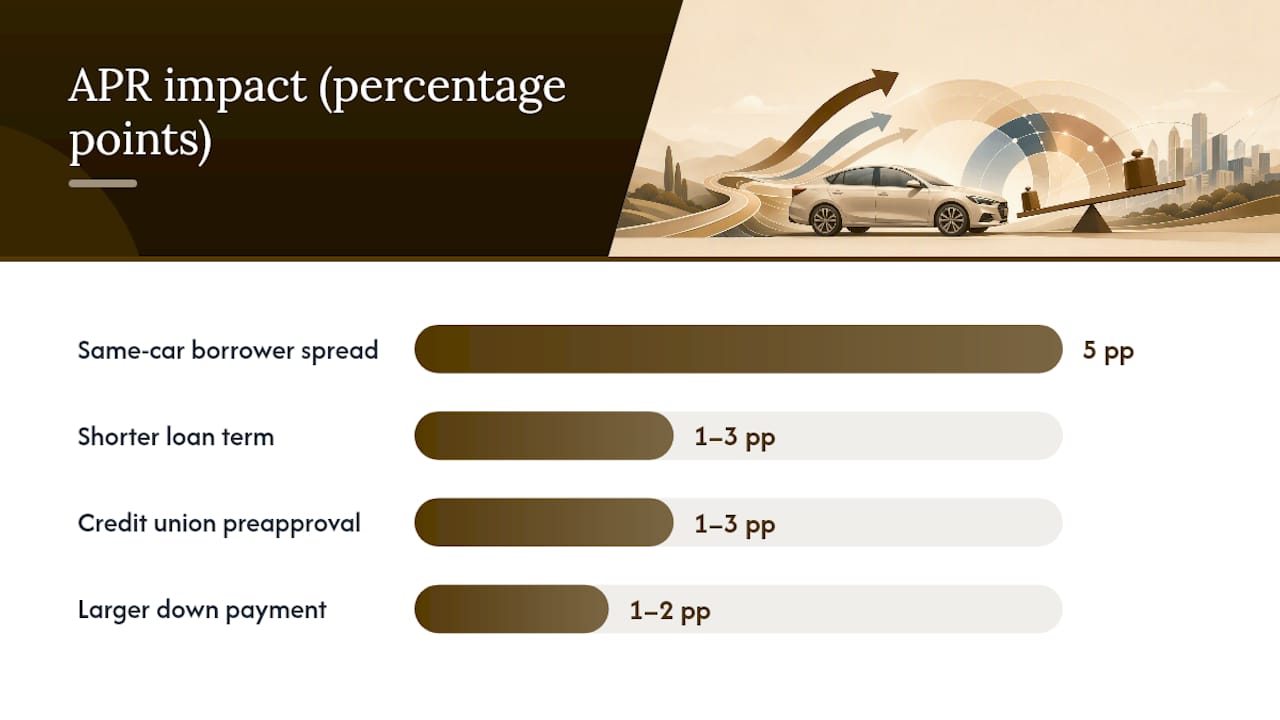
Your APR isn’t random. Lenders price it based on how risky you look on paper and what the broader market is doing. Two borrowers buying the same car can walk out with rates 5 percentage points apart.
The variables that move your APR most:
- Credit score: The single biggest lever. Lenders often use FICO Auto Scores, which can differ from your standard FICO. A score 20 points lower than you expect can push you into a higher pricing tier.
- Loan term: Longer terms (72 months) typically carry higher APRs than shorter ones (36–48 months). Lenders see more risk in a longer repayment window.
- Vehicle age: Used cars carry higher rates than new cars across every credit tier, partly because they’re harder to value and depreciate faster.
- Down payment and LTV: A larger down payment reduces the lender’s exposure. Putting 15%–20% down can shave a point or two off your rate.
- Debt-to-income ratio (DTI): High existing debt signals risk. Lenders want to see your total monthly debt obligations stay below roughly 40%–50% of gross income.
- Lender type: Credit unions consistently offer lower APRs than dealer-arranged financing for the same borrower profile. Banks and online lenders sit in between.
- Co-signer: Adding a creditworthy co-signer can move you into a better pricing tier immediately.
- Payment packing: Dealers sometimes focus the conversation on monthly payment rather than APR, then extend the term or add fees to hit a number. Experian flags this tactic as one of the most common ways buyers end up paying more than they realize.
Pro Tip: Your two highest-leverage moves are shortening the loan term and getting a preapproval from a credit union before you walk into the dealership. Either one alone can drop your APR by 1–3 points. Together, they’re hard for a dealer to ignore.
Is 12% APR actually high for your specific situation?
The honest answer is: it depends on which seat you’re sitting in. Experian notes that “high” is always relative to the national average and the loan type, which is why the same rate can be a good deal or a bad one depending on your credit tier and vehicle choice.
You could still negotiate it down, but it’s not a crisis.
Rule of thumb: For a used car, 12% is near or just below the near-prime average — not alarming, but worth negotiating. For a new car, 12% is high for anyone with a credit score above 600. If you’re prime or better and you’re seeing 12% on a new vehicle, something is off: either the dealer marked up the rate, or there’s a credit report issue worth investigating.
That collateral typically earns borrowers lower rates than personal loans, so the comparison doesn’t transfer. Judge your auto APR against auto benchmarks only.
How much does 12% APR actually cost you in dollars?
APR differences feel abstract until you see the payment math. The Investopedia car loan calculator methodology and TheCarPayment’s 12.04% APR charts both show the same pattern: a few percentage points of APR difference compounds into hundreds or thousands of dollars over a typical loan term.
Figures computed using standard amortization formula (monthly rate = APR ÷ 12). APR is the true cost figure because it includes fees; always request the APR disclosure, not just the base interest rate.
Savings callout: On a $30,000 used-car loan over 60 months, dropping from 12% to 6% saves roughly $5,220 in total interest. That’s a vacation, a year of car insurance, or a solid emergency fund start.
The monthly difference on a $30,000 loan at those two rates is $87. That’s easy to rationalize at the dealership. Over five years, it’s not.
How do you lower or negotiate a quoted 12% APR?

Walking into a negotiation without a target number is the most common mistake buyers make. Here’s a prioritized checklist that works whether you’re at the dealer or shopping online.
Before you go to the dealership:
- Pull your credit report at AnnualCreditReport.com and dispute any errors. A single incorrect late payment can cost you a full pricing tier.
- Get a preapproval from a credit union or bank. This gives you a written rate to compare against the dealer’s offer and signals you’re a serious, informed buyer.
- Run a Baywall benchmark report to see what buyers with your credit score, vehicle type, and loan term actually paid. You’ll walk in knowing your target APR, not guessing at it.
At the dealership:
- Negotiate price and APR separately. Never let the conversation collapse into “what monthly payment works for you?” That’s how dealers hide a high APR inside a longer term.
- Ask for the APR in writing before discussing any add-ons, extended warranties, or trade-in values. Each of those is a separate negotiation.
- Show your preapproval. Say directly: “I have a written offer at [X]%. Can you beat it or match it?” Most finance managers will try.
- Request a fee breakdown. Ask which fees are included in the APR and which are add-ons. Dealer fees rolled into the loan raise your effective cost even if the stated APR looks reasonable.
- Ask for the finance manager, not just the sales rep. The finance manager has more authority to adjust the rate, especially if you have a competing written offer.
When to accept vs. walk:
- Accept if the dealer’s APR is within 0.5%–1% of your preapproval and the total loan cost fits your budget.
- Walk if the APR is more than 1–2 points above your benchmark and the dealer won’t move after you’ve shown a competing offer.
Pro Tip: Trade-in negotiations and APR negotiations are easier to win separately. Settle the vehicle price and rate first, then bring up the trade-in. Mixing them gives the dealer too many levers to offset any concession you win.
- Credit unions often beat bank rates by 1–2 points for the same borrower. Check NCUA-member credit unions in your area before accepting any dealer quote.
- A co-signer with a prime credit score can move you into a lower pricing tier immediately, sometimes saving more than any negotiation tactic alone.
- Verify any lender you haven’t heard of through NMLS Consumer Access before signing.
How does Baywall give you a precise negotiation target?
You need a specific number to ask for. That’s exactly what Baywall produces.
You enter your credit score, vehicle details, loan amount, term, and the dealer’s quoted APR. Baywall benchmarks that offer against real transaction data from comparable deals: same credit tier, same loan type, similar vehicle and location. The output tells you whether the offer is great, fair, or high, and gives you a specific target APR to negotiate toward, along with an estimated dollar savings figure.
What you get from a Baywall report:
- Target APR: The rate buyers like you actually paid in comparable transactions, not a generic national average.
- Dollar savings estimate: The difference in total interest between the dealer’s quoted rate and your target rate, in plain dollars.
- Market pricing context: Comparable vehicle prices in your area, so you can negotiate the purchase price and the rate at the same time.
Pro Tip: Print or screenshot your Baywall report before you go to the dealer. Showing a specific, data-backed target APR carries more weight than a verbal claim. Finance managers respond to written numbers.
What I would do if offered 12% APR today
It would be to benchmark it.
If they came within a point, I’d probably take the deal. If they didn’t move, I’d finance through the credit union and walk.
Three things I’d do immediately, in order:
- Pull my Baywall benchmark report to get a specific target APR.
- Show the finance manager a written preapproval from a credit union and ask them to beat it.
- If neither worked, accept the credit union rate and revisit refinancing in 6–12 months once my payment history was established.
Refinancing is a real fallback.
Get a Baywall benchmark report before you sign
Knowing the national average is useful. Knowing what buyers with your credit score, your vehicle, and your loan term actually paid is what moves the needle at the dealer’s table.
Baywall gives you that specific number. Enter your credit score, vehicle, loan amount, term, and the dealer’s quoted APR, and you get a report that labels the offer as great, fair, or high, shows you the target APR to negotiate toward, and calculates your potential savings in dollars.
- Free basic version: See whether your offer is in the right range for your credit tier.
- Full report ($2.99): Get your exact target APR, dollar savings estimate, and comparable vehicle pricing for your market.
If you’re looking at a 12% offer and want to know whether to push back and by how much, run your numbers at Baywall before you sign.
Sources
The benchmarks in this article draw from Experian’s Q1 2026 auto loan data, Investopedia’s loan calculator methodology, and TheCarPayment’s amortization charts. Each source below covers a specific part of the picture.
This article is general information, not a substitute for advice from a qualified financial advisor. Consult a qualified financial professional about your own circumstances before acting on anything here.