Is 15% APR on a Car Loan Fair? What Buyers Should Know

market standards for most borrowers, but it is not automatically a reason to walk away. Whether it is fair depends almost entirely on your credit score. For deep subprime borrowers, 15% is still above average for their tier on new cars, though it may be competitive on used vehicles. The immediate move: calculate what that rate actually costs you in dollars, then compare it against what buyers with your credit profile are actually paying.
Two quick benchmarks to orient yourself:
- Edmunds reports average used-car APRs around 10.5% and new-car APRs around 7% as of mid-2026. A 15% offer is 4–5 percentage points above the used-car average.
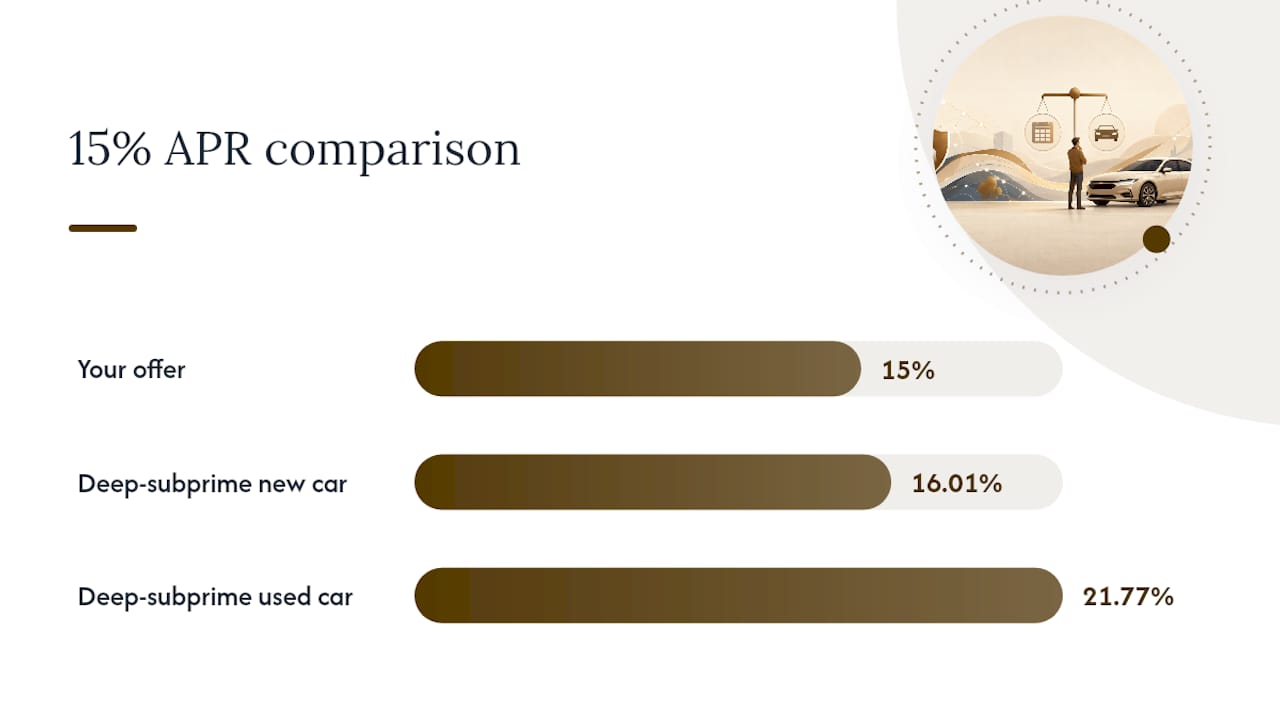
- Experian data summarized by NerdWallet shows that only deep subprime borrowers (scores below 500) see average new-car APRs near 16%, and used-car averages for that tier reach 21.77%. If your score is above 600, a 15% quote is almost certainly higher than your tier’s average.
Before you sign anything, run the numbers. Baywall lets you enter your credit score, vehicle, loan amount, and the dealer’s quoted rate, then benchmarks that offer against comparable real transactions to show you whether the rate is great, fair, or high, and what your target negotiation number should be.
Key Takeaways
| Point | Details |
|---|---|
| 15% is above market for most buyers | Edmunds puts the used-car average at ~10.5% APR; 15% is a meaningful premium worth negotiating. |
| Credit tier determines your target rate | Experian data shows near-prime buyers average — on used cars; prime buyers average —. |
| Total interest cost is what matters | A $15,000 loan at 15% over 60 months costs roughly $6,420 in interest vs. $4,140 at 10%. |
| Pre-approval is your best negotiation tool | An outside lender offer forces the dealer to compete rather than set the rate unilaterally. |
| Refinancing is a real exit strategy | If your score improves after signing, refinancing can cut your rate and reduce total interest paid. |
Table of Contents
- How does a 15% APR compare with current U.S. car loan averages?
- Which borrowers typically see a 15% APR?
- What does a 15% APR actually cost you in real dollars?
- Proven ways to get below 15% APR
- What to do when a dealer quotes you 15% APR
- When is a 15% APR acceptable, and when should you walk away?
- APR vs. interest rate: what is actually included in your car loan cost
- How loan term length affects your APR and total cost
- The real dollar impact of term length and APR together
- How improving your credit score can lower your APR over time
- State-by-state variations in car loan APRs and regulations
- What Baywall sees in the data
- Sources
How does a 15% APR compare with current U.S. car loan averages?
Edmunds’ mid-2026 data puts the average new-car APR at roughly 7% and the average used-car APR at roughly 10.5%.
Used-car loans carry higher rates than new-car loans for two structural reasons. First, lenders view older vehicles as higher-risk collateral because their value depreciates faster and they are more likely to be worth less than the outstanding loan balance.
That gap is worth fighting for.
Which borrowers typically see a 15% APR?
Credit score is the single biggest driver of your offered rate, but it is not the only one. According to Yahoo Finance’s analysis, lenders also weigh loan-to-value ratio, vehicle age, and loan term alongside your score.
That said, credit score tiers are the clearest map to expected APR ranges. The table below draws from Experian’s Q1 2026 data via NerdWallet:
If your score is above 660, you should be paying less. For used car loan benchmarks specific to your profile, Baywall’s data breaks this down by credit band, vehicle age, and geography.
Beyond credit score, your loan-to-value ratio matters more than most buyers realize. A large down payment reduces the lender’s risk and can move your offered rate down by a full percentage point or more, even without a credit score change. Understanding how LTV affects your APR is one of the most underused levers in car loan negotiation.
What does a 15% APR actually cost you in real dollars?
The total interest difference does not. Using BudgetWorksheets’ loan calculator as the basis, here is what a $15,000 loan looks like across common term lengths and APRs:
The difference in interest costs can be comparable to the price of a moderate vacation or similar discretionary expense. Stretch the term to 72 months and the gap widens further.
Pro Tip: Always compare total interest paid, not just the monthly payment. Dealers often extend the loan term to make a high-APR offer look affordable month-to-month, but the total cost tells the real story.
Loan term also interacts with APR in a compounding way. Shorter terms reduce total interest because you are paying down principal faster, leaving less balance for interest to accrue on each month.
Proven ways to get below 15% APR
The most reliable way to beat a dealer’s rate is to walk in with a competing offer already in hand. Pre-approval from an outside lender forces the dealership to compete rather than dictate. Here is where to look and what to do:
Lender types, ranked by typical rate advantage:
- Credit unions: Consistently offer the lowest rates for members, often 1–3 percentage points below bank rates. Membership requirements are usually easy to meet. See Baywall’s guide to credit union auto loans for specifics.
- Community banks: Local banks often have more flexible underwriting than national lenders and can be competitive for near-prime borrowers.
- Online lenders: Fast pre-approval, good for comparison shopping, though rates vary widely by platform.
- Captive finance arms (manufacturer lenders): Only competitive on new vehicles with promotional rates; rarely the best option for used cars.
- Buy-here-pay-here dealers: Avoid these for rate purposes. They typically charge the highest APRs in the market and report to fewer credit bureaus, limiting your ability to build credit.
Tactics that move the needle:
- Get pre-approved before you visit any dealership. This is the single most effective step.
- Separate the vehicle price negotiation from the financing discussion. Dealers often bundle the two to obscure the true cost of each.
- Increase your down payment. Even an additional $1,000–$2,000 down reduces your loan-to-value ratio and can lower your offered rate.
- Choose a shorter loan term. Lenders price 36-month loans lower than 72-month loans because shorter terms carry less default risk.
- Add a creditworthy co-signer. A co-signer with prime or superprime credit can drop your rate into a significantly lower tier.
- Improve your credit score before applying. Even a 20–30 point improvement can shift you from one tier to the next.
Pro Tip: Apply to multiple lenders within a 14-day window. Credit bureaus treat all auto loan inquiries made within that period as a single hard inquiry, so rate-shopping does not meaningfully hurt your score.
What to do when a dealer quotes you 15% APR
Do not sign immediately. Here is a practical checklist to work through before you commit:
- Get the offer in writing. Ask for a written breakdown of the APR, the interest rate, and all fees included. A verbal quote is not a commitment.
- Ask for an itemized APR breakdown. Some dealers bundle add-ons into the financing (GAP insurance, extended warranties, paint protection) that inflate the effective cost. You have the right to know what is in the rate.
- Present your pre-approval. Hand the finance manager your outside offer and ask them to beat it. The conversation shifts immediately.
- Run the offer through Baywall. Enter your credit score, vehicle details, loan amount, term, and the dealer’s quoted rate. Baywall benchmarks the offer against comparable real transactions and tells you whether the rate is fair, high, or great, along with a specific target APR and your potential dollar savings. That number becomes your negotiation anchor.
- Negotiate the rate, not just the payment. If the finance manager offers to lower your monthly payment by extending the term, ask what the APR is. A lower payment on a longer term at the same APR costs you more overall.
Dealer scripts that work:
- “I have a pre-approval at [X]%. Can you match or beat that?”
- “Can you show me the APR breakdown, including any fees rolled into the rate?”
- “My research shows buyers with my credit profile are paying around [Baywall target rate]. What would it take to get there?”
Pro Tip: If a dealer says the rate is “locked in” or “that’s just how it works for your credit,” that is a negotiation tactic, not a fact. Every rate is negotiable until you sign.
When is a 15% APR acceptable, and when should you walk away?
- Your credit score is below 580 and you have limited credit history. At deep subprime, 15% on a new car is near the tier average of 16.01%, and on a used car it is well below the 21.77% average.
- You need reliable transportation urgently and have exhausted outside lender options.
- You plan to refinance within 6–12 months after improving your credit score. Accepting a high rate now with a clear plan to refinance later is a legitimate strategy.
Red flags that mean walk away:
- A balloon payment at the end of the loan term. This is a predatory structure that leaves you owing a large lump sum.
- Prepayment penalties. A lender that charges you for paying off early is protecting their interest income at your expense.
- Mandatory add-on packages (GAP, warranty, paint protection) bundled into the loan without your explicit consent, inflating the effective APR.
- The dealer cannot or will not provide a written APR breakdown.
- The quoted rate is above 15% without a clear credit-tier justification.
A simple decision rule: get a quote from a credit union or run the offer through Baywall. If your current APR is materially above the market rate for your credit tier, either negotiate before signing or plan to refinance within the first year. Accepting a rate that is 5+ points above your tier’s average without a plan is where buyers leave the most money on the table.
For context on how a 15% offer compares to an even higher quote, Baywall’s guide on 20% APR car loans covers the walk-away threshold in detail.
APR vs. interest rate: what is actually included in your car loan cost
APR (annual percentage rate) and interest rate are not the same number, though lenders sometimes use them interchangeably in ways that confuse buyers. The interest rate is the base cost of borrowing the principal, expressed as a percentage. APR is broader: it includes the interest rate plus most fees associated with the loan, such as origination fees, documentation fees, and certain dealer finance charges. For a full breakdown of how these two figures differ and why it matters when comparing offers, Baywall’s APR vs. interest rate guide covers the mechanics in detail.
In practice, the gap between a loan’s stated interest rate and its APR is often small for auto loans compared to mortgages, but it is not zero. When comparing offers from multiple lenders, always compare APRs, not interest rates, because APR captures the true cost of each offer on a level playing field.
How loan term length affects your APR and total cost
Auto loan terms in the U.S. typically run 24, 36, 48, 60, 72, or 84 months. The most common terms are 60 and 72 months. Longer terms lower your monthly payment but increase total interest paid, and they often carry slightly higher APRs because lenders price longer-duration risk higher.
This creates negative equity, where you owe more than the car is worth, which limits your ability to trade in or sell the vehicle without bringing cash to the table.
Shorter terms (36–48 months) cost more per month but save substantially on total interest and reduce the risk of going underwater on the loan. For most buyers financing a used car at a high APR, a 36 or 48-month term is the financially smarter choice even when it stretches the monthly budget.
The real dollar impact of term length and APR together
The interaction between term length and APR is where buyers most often underestimate total cost. At a lower APR, the same extension hurts less in absolute dollars, but the proportional damage is similar.
Consider two buyers, both financing $15,000:
- Buyer A takes a 36-month loan at 10% APR. Total interest: roughly $2,400.
- Buyer B takes a 72-month loan at 15% APR. Total interest: roughly $8,000.
Buyer B pays more than three times the interest for the same car. The monthly payment difference may feel manageable, but the total cost difference is the price of a decent used car in its own right. This is why comparing total interest paid, not monthly payment, is the most important habit to build before signing any loan.
How improving your credit score can lower your APR over time
Credit score improvement is one of the few levers that can move your APR by 3–5 percentage points or more, which translates to thousands of dollars in savings over a loan’s life.
The most effective credit-building moves before applying for a car loan:
- Pay down revolving balances to below 30% of your credit limit. Credit utilization is the fastest-moving factor in your score.
- Dispute any errors on your credit report through Experian, Equifax, or TransUnion. Errors are more common than most people expect.
- Avoid opening new credit accounts in the 3–6 months before applying for a car loan.
- Keep existing accounts open, even if you are not using them, to preserve your average account age.
Pre-qualify for refinance offers without a hard inquiry first to see what rate you could access before committing.
State-by-state variations in car loan APRs and regulations
Car loan APRs vary by state for two reasons: lender competition and state usury laws. Some states cap the maximum interest rate a lender can charge on auto loans, while others have no cap at all. States with stricter consumer lending laws (such as Arkansas, which has a constitutional usury cap) tend to have lower maximum rates, while states with minimal regulation allow lenders to charge significantly higher rates to high-risk borrowers.
In states without caps, lenders have more pricing flexibility, which cuts both ways: you may find more competitive offers from credit unions and online lenders, but predatory buy-here-pay-here dealers also have more room to charge excessive rates.
State-level variation also affects credit union availability. States with strong credit union networks (such as Wisconsin and Minnesota) tend to have more competitive auto loan rates because credit unions create pricing pressure on banks and dealers. If you are in a state with limited credit union presence, online lenders become a more important comparison point.
For a broader comparison of lender options across markets, Brandcomparisons provides independent side-by-side reviews of financial products that can help you identify competitive lenders in your state.
What Baywall sees in the data
The uncertainty is understandable.
The data tells a clear story. The negotiating power is there. You just need the right number to negotiate toward.
Sources
- Average Car Loan Interest Rates by Credit Score - NerdWallet
- Average car loan interest rates (Yahoo Finance analysis)
- Car loan apr interest rate
- $15,000 Car Loan Monthly Payment Calculator
- Is 15% Apr good or bad?
This article is general information, not a substitute for advice from a qualified financial advisor. Consult a qualified financial professional about your own circumstances before acting on anything here.