6.9% Benchmark: What U.S. Buyers Should Pay for 60 Month Auto Loan Rates

The national average APR for a 60-month new-car loan sits at 6.90% as of September 2026, according to Bankrate’s weekly monitor. Used-car 60-month loans typically run 0.5 to 2.0 points higher than that.
TL;DR:
- Borrowers with higher credit scores pay significantly lower rates, with super-prime customers often near 5.2%, while subprime borrowers can pay more than double that amount.
- Extending a loan from 48 to 72 months can double total interest costs, despite lowering monthly payments, making shorter terms more cost-effective overall.
- Lenders base rates on credit score, vehicle age, down payment, and lender type, meaning shoppers should control what they can before negotiation for savings.
- Prequalifying with multiple lenders and using tools that benchmark your deal can help you negotiate a fair rate and avoid dealer markup or hidden costs.
Table of Contents
- What Are Current 60-Month Auto Loan Rates?
- 60-Month APR Bands by Credit Tier: New vs. Used
- How Loan Term Length Changes Your Payment and Total Cost
- What Actually Determines Your 60-Month APR
- How to Shop and Negotiate Your 60-Month Rate
- How Baywall Turns a Benchmark Into a Negotiation Number
- When a 60-Month Term Actually Makes Sense
- Check Your Dealer’s Rate Before You Sign
- Sources
- FAQ
What Are Current 60-Month Auto Loan Rates?
Two federal data series anchor almost every conversation about 60-month auto loan rates, and they don’t always agree with each other. Knowing the difference matters if you’re trying to figure out whether your dealer’s number is competitive.
The Bankrate Monitor 60-month new-car index reported 6.90% as of September 9, 2026. Bankrate updates this figure weekly by surveying lenders directly, which makes it the most current snapshot available to consumers. It reflects advertised offers, not necessarily what every borrower actually qualifies for.
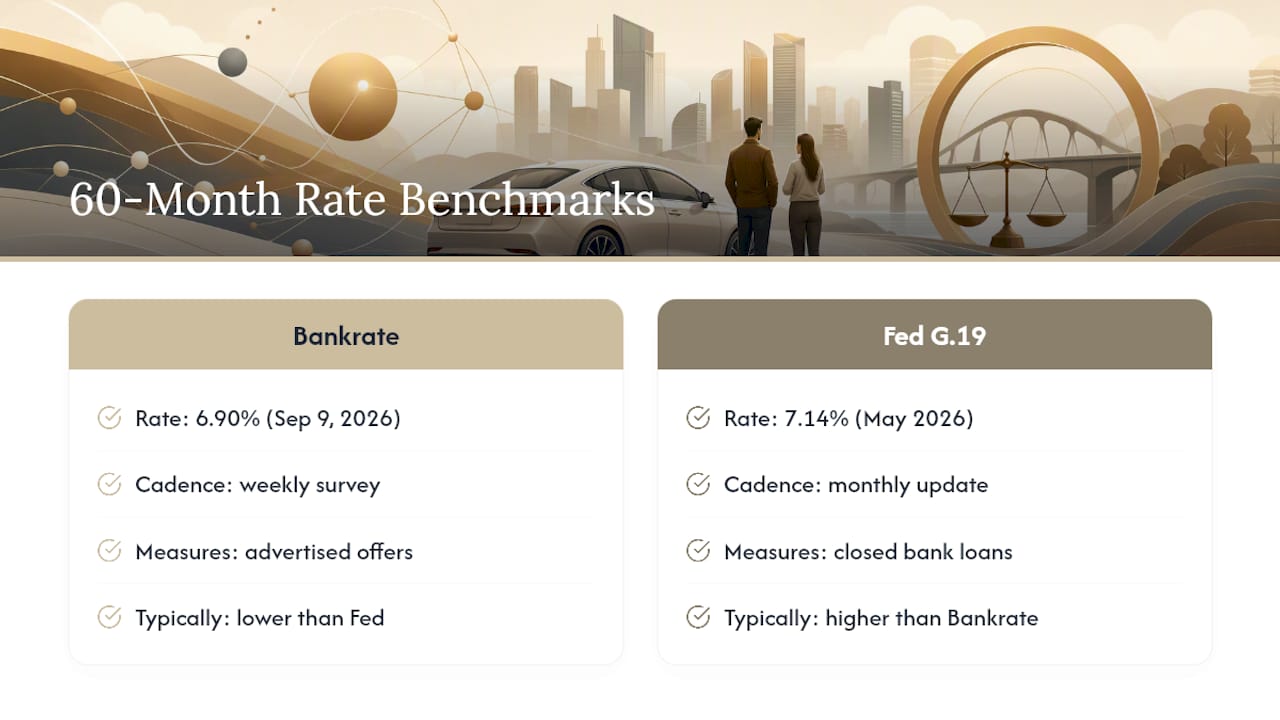
The Federal Reserve’s G.19 series tracks something different: the average finance rate commercial banks actually charged on new-auto installment loans. The Fed updates this monthly, and because it’s based on loans banks actually closed rather than advertised offers, it tends to run a bit higher than the Bankrate survey.
Why the gap? Bankrate captures competitive advertised rates meant to attract shoppers. The Fed’s number blends every credit tier a bank actually financed, including borrowers who didn’t qualify for the best pricing. Neither number is “wrong.” They’re measuring slightly different things, and reading both gives you a realistic bracket for where a fair offer should fall.
The Benchmark Snapshot: Bankrate’s weekly index puts new-car 60-month APRs at 6.90% (September 2026). The Fed’s monthly commercial-bank rate puts them at 7.14% (May 2026). A dealer quote well above both deserves a second look.
Watch the date on whichever figure you’re using. Rates move with Federal Reserve policy shifts and lender competition, so a number from six months ago won’t reflect today’s market. Bankrate’s weekly cadence makes it the better tool for a live negotiation.
60-Month APR Bands by Credit Tier: New vs. Used
Your credit score does more to set your rate than almost anything else in the transaction, and the swing between tiers is larger than most buyers expect. A subprime borrower can pay more than double the APR of a super-prime borrower for the identical car.
Used-car APRs consistently run higher than new-car APRs within the same credit tier, typically by 1 to 3 percentage points, because lenders price in the extra risk of an aging asset and less predictable resale value.
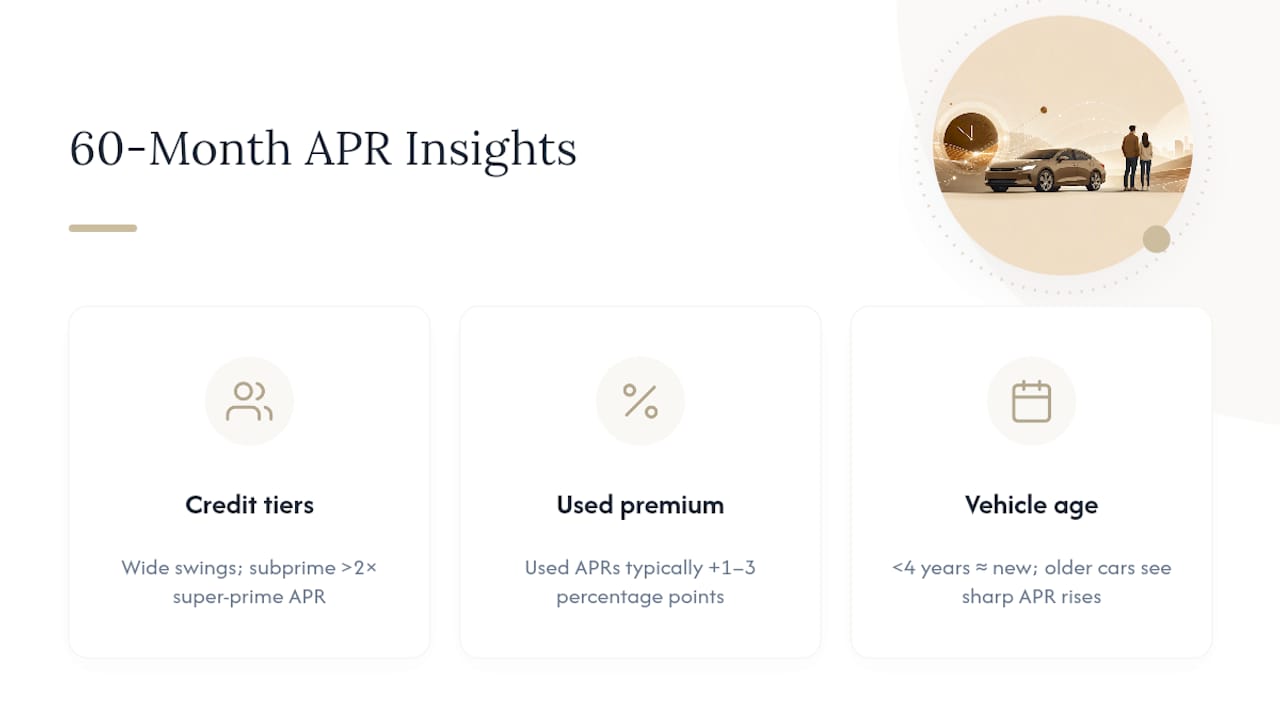
These are representative ranges compiled from lender and market-tracker reporting, not guarantees. Your actual offer will move within these bands based on the specific lender, your down payment, and the vehicle itself.
One nuance worth knowing: a used car under about four years old often prices close to new-car rates, since the lender’s collateral risk is nearly identical to a new vehicle. Push past that age window and APRs climb, sometimes sharply, which is why shopping used car loan rates by vehicle age, not just credit score, pays off. For a deeper breakdown by score band, see current APR ranges by credit score.
How Loan Term Length Changes Your Payment and Total Cost
Stretching a loan from 48 to 72 months lowers your monthly payment, but it raises your APR and dramatically increases what you pay in total interest. Here’s the math on a $25,000 loan across three common terms:
- 48 months: Monthly payments are higher but total interest lower.
- 60 months: Monthly payments moderate, total interest higher than 48-month term.
- 72 months: Monthly payments lower but total interest significantly higher than shorter terms.
The Real Cost Gap: Going from 48 to 72 months on that same $25,000 loan roughly doubles your total interest, even though your monthly payment drops by about $155. That difference could cover a family vacation, several months of car insurance, or a meaningful head start on your next down payment.
APRs rise with term length because a longer loan keeps the lender’s money at risk longer, and the vehicle depreciates faster than the loan balance shrinks in the early years. If you want a quick gut check on any offer, a simple rule works: total interest roughly tracks with (APR × average balance × years), so doubling your term without lowering your rate will nearly double your interest cost. A monthly car payment calculator makes this instant instead of back-of-envelope.
What Actually Determines Your 60-Month APR
Lenders price your rate using four buckets of information, and only some of them are within your control before you walk into the dealership.
- Borrower factors: Your credit score carries the most weight, followed by debt-to-income ratio and length of credit history. A DTI calculator can tell you where you stand before a lender does.
- Vehicle factors: New cars price lower than used. Lenders also cap financing on vehicles older than roughly 10 model years or past 125,000 miles, which can push older-car buyers into costlier alternative financing.
- Loan structure: A bigger down payment lowers your loan-to-value ratio, which reduces lender risk and often your APR. Amount financed and term length both factor into the final number.
- Lender type: Different types of lenders price differently for the same borrower.
You can’t change your credit score overnight, but you can control your down payment, your term, and which lender you shop.
How to Shop and Negotiate Your 60-Month Rate
Turning a national benchmark into money saved requires a plan you execute before you’re sitting across from a finance manager.
- Get prequalified with soft-pull lenders first. Banks, credit unions, and online lenders can give you a real rate estimate without touching your credit score, and credit unions frequently beat dealer financing by 0.5 to 1.5 points for comparable borrowers.
- Collect at least two or three competing offers. This gives you leverage and a real number to hold the dealer to, rather than hoping their first quote is fair.
- Set a specific target APR based on your credit tier, using the bands above as your starting point, then treat anything above it as a number worth challenging.
- Ask the dealer directly what markup, if any, is built into the quoted rate. Dealer reserve, the spread between what a lender approves and what the dealer quotes you, is where hidden cost usually lives.
- Watch for red flags: a rate that changes after you’ve agreed on price, pressure to sign quickly, or refusal to show you the lender’s buy rate.
- Decide if a shorter term beats a lower payment. If a 48-month loan at a lower APR keeps your payment affordable, it usually beats 60 months on total cost.
Pro Tip: Walk in already knowing your target rate and your maximum acceptable payment, separately. Dealers who can’t move your rate will sometimes try to hit your payment target by quietly extending your term instead. Know both numbers so you catch the switch.
A well-prepared buyer with prequalification in hand can shave 0.25 to 0.75 points off a dealer’s markup, which adds up to real dollars over 60 months.
How Baywall Turns a Benchmark Into a Negotiation Number
A national average tells you where the market sits. It doesn’t tell you whether your specific offer, for your credit tier, your vehicle, and your loan amount, is actually fair. That’s the gap Baywall closes.
You enter your credit score, the vehicle, loan amount, term, and the APR your dealer quoted. The tool benchmarks that offer against comparable real transactions and returns a label along with a target APR to negotiate toward and estimated dollar savings.
The report shows the gap in plain numbers, giving you a specific rate to counter with.
When a 60-Month Term Actually Makes Sense
Sixty months tends to work when you want a manageable payment on a reliable used or new vehicle you’ll keep past the loan’s final payment. It works less well if you’re financing a car likely to lose value faster than the loan balance, or if you’re already stretching your budget to qualify. Match your term to how long you’ll actually own the car, not just what fits the monthly number.
— Baywall
Check Your Dealer’s Rate Before You Sign
You now know the national benchmarks, the credit-tier bands, and how term length swings your total cost. The one thing you still don’t know from any of this is whether your dealer’s specific quote is actually fair for your exact situation.
That’s what a Baywall report answers directly. Enter your credit score, vehicle, loan amount, term, and the APR your dealer quoted, and you get back a clear label (great, fair, or high), a specific target APR to negotiate toward, and your estimated dollar savings if you push back. The benchmark data comes from real U.S. transactions in comparable credit tiers and loan types, not national averages that might not reflect your actual profile. If you’re financing an older vehicle, the same logic applies. Baywall’s old-car loan rate benchmarks show what buyers in that segment are actually paying. Run your offer through Baywall before you sign, and you’ll walk into the finance office already knowing your number.
Sources
- Bankrate Monitor (BRM): Auto Loan Rate - 60 Month New Car (BRMALR0102) | FRED | St. Louis Fed
- Current Used Car Loan Rates: 2026 Guide
- Used Car Loan Rates 2026 — By Credit Score, Vehicle Age & Lender | CarSavr
FAQ
What Is the Best Interest Rate for a 60-Month Car Loan?
For a new car, the best available rates track the Bankrate national average of 6.90% or lower, and super-prime borrowers can often land near 5.2%. For a used car, anything at or below your credit tier’s benchmark band counts as strong.
Is It Possible to Get a 3% Interest Rate on a Car?
Rates that low are rare in the current market and typically only appear as manufacturer-subsidized promotional financing on select new models, not as a standard rate any lender offers broadly. Most super-prime borrowers today see 60-month new-car APRs closer to 5% to 6%.
What Cars Have 0% Financing for 60 Months?
Zero percent offers come and go based on manufacturer incentives and usually require excellent credit, so availability varies by brand, model year, and month. Check current manufacturer promotions directly rather than assuming a specific model qualifies.
Which Car Loan Is Better, 48 Months or 60 Months?
A 48-month loan usually costs less in total interest and often carries a lower APR, but the tradeoff is a higher monthly payment. Choose 60 months if the lower payment keeps your budget comfortable and you plan to keep the car well past the loan’s end; choose 48 months if minimizing total cost matters more than payment size.