U.S. Buyers With a 600 Score: Expect 13% New Car APR, 19% Used

A 600 credit score puts you in subprime territory, and dealers know it. Expect new-car APRs roughly around 13% and used-car APRs around 19%, based on current Experian benchmarks. Before you sign anything, prequalify with at least one credit union and one online lender, then compare that number against a benchmark for your exact profile. That single step often saves you thousands over the life of the loan.
TL;DR:
- Borrowers with a 600 credit score face auto loan APRs around 13% to 19%, with used-car rates generally higher and more variable than new-car rates.
- Prequalifying with multiple lenders, including credit unions and online lenders, can save thousands by revealing better rate options before dealership negotiations.
- Loan terms, down payments, and the borrower’s full financial profile influence the final rate more than the credit score alone, making holistic application important.
- Dealer financing often includes a negotiable markup on top of the lender’s rate, and walking in with a prequalified rate strengthens negotiation power.
- Using tools like Baywall’s rate comparison reports helps confirm if a dealer’s quoted APR is fair for your credit profile and vehicle type before signing agreement paperwork.
Table of Contents
- What APR Should You Expect With a 600 Credit Score?
- What Do Lenders Actually Look at Beyond Your Score?
- Which Lenders Actually Approve 600 Credit Score Borrowers?
- How to Improve Your Loan Terms Before You Sign
- How Much Does APR Actually Cost You on a $20,000 Loan?
- How Baywall Helps You Confirm a Dealer’s APR Is Fair
- When Is a Higher APR Actually the Right Call?
- Check Your Dealer’s Offer Before You Sign Anything
- Where to Verify These Numbers Yourself
- Sources
- FAQ
What APR Should You Expect With a 600 Credit Score?
A 600 credit score lands you in Experian’s subprime tier, which the company defines as scores from 501 to 600. Borrowers just above that, in the 601 to 660 near-prime range, see noticeably better offers, which is why even a small score bump can change your loan math.
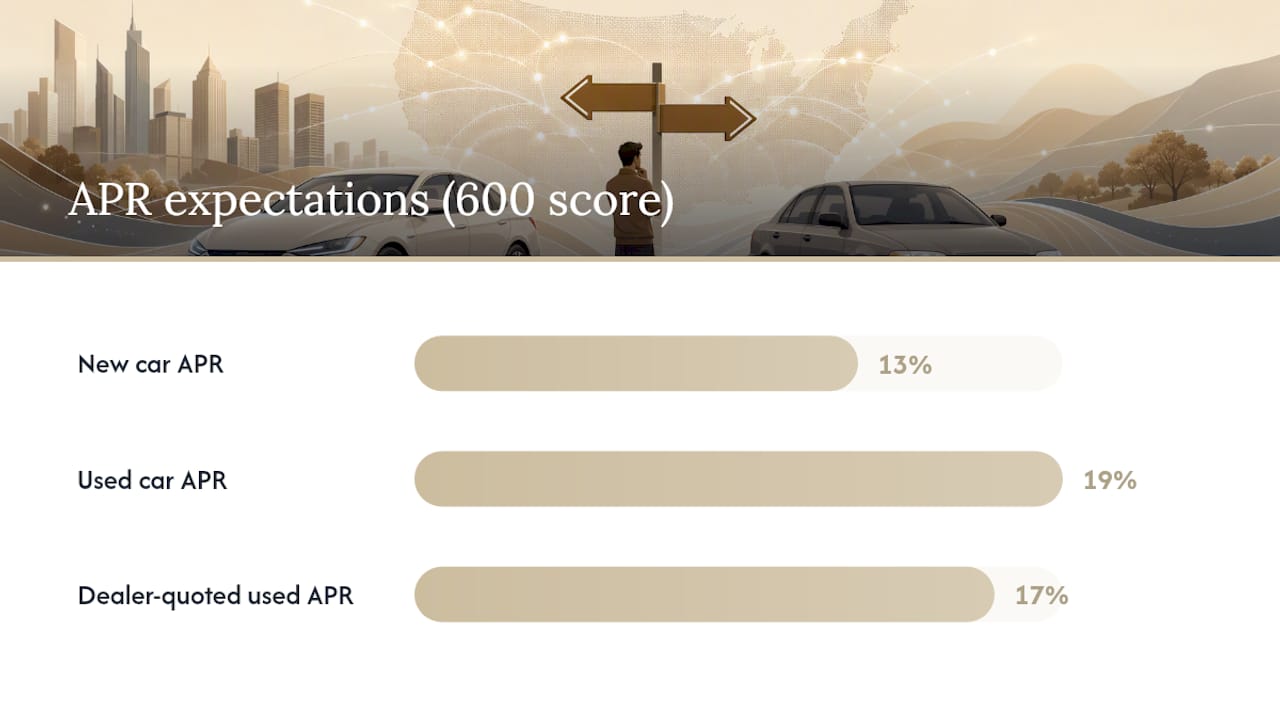
Here’s how the numbers break down using Experian’s credit-tier APR data:
Notice the gap between new and used financing. Used-car APRs run consistently higher across every tier, partly because used vehicles carry more valuation uncertainty for the lender and often get financed for longer terms. If you’re at 600 and shopping used, the average is around 19%. It’s the middle of the pack for your tier.
A few things widen or narrow that range in practice:
- Credit unions typically undercut online subprime lenders by 2 to 5 percentage points, since they lend to members rather than chasing volume from strangers.
- Loan term length matters. Longer terms sometimes carry slightly higher posted APRs, even though your monthly payment drops.
- Dealer-arranged financing adds a markup on top of whatever rate the actual lender approved, and that markup is often negotiable even when the dealer insists it isn’t.
If a dealer quotes you 17% on a used car with a 600 score, that’s within the expected band but nowhere near the best you could do. That’s exactly the gap a rate benchmark exists to close.
What Do Lenders Actually Look at Beyond Your Score?
Your score gets you in the door. What happens next depends on your entire financial picture, and Experian is direct about this: lenders weigh income, debt load, employment stability, and the loan-to-value ratio of the vehicle you want, not just the three-digit number on your report.
Here’s what underwriters typically flag first:
- Debt-to-income ratio (DTI). Most auto lenders want your total monthly debt payments, including the new car loan, under 36% to 45% of gross monthly income. Push past that and you’ll either get declined or handed a worse rate to offset the risk.
- Employment history. Two or more years at the same job (or steady income in the same field) reads as stability. Job-hopping or a recent gap raises flags even with decent income.
- Loan-to-value ratio (LTV). This compares your loan amount to the car’s actual value. A high LTV, meaning you’re financing close to or above what the car is worth, signals more risk if you default and the lender has to repossess and resell.
- Down payment size. A bigger down payment lowers LTV instantly, which is one of the fastest ways to shift into a better rate tier.
- Recent credit inquiries. A string of hard pulls in the last few months can suggest you’ve been shopping desperately or getting declined elsewhere, which makes lenders cautious.
Prequalification is your best tool here, and it works differently than a full application. When you prequalify, most lenders run a soft credit check that doesn’t affect your score, and they give you an estimated rate and loan amount based on basic financial details. A full application triggers a hard inquiry and is what you submit once you’ve picked a lender and vehicle. Prequalifying with two or three lenders costs you nothing in credit score points and gives you real numbers to compare, which is the whole point before you ever sit down at a dealership.
If you want a clearer read on where your DTI actually stands, a debt-to-income calculator can run the math in a couple of minutes using your existing bills and income.
Which Lenders Actually Approve 600 Credit Score Borrowers?
Not every lender treats a 600 score the same way, and where you apply first changes both your odds and your rate. Here’s how the three main channels stack up.
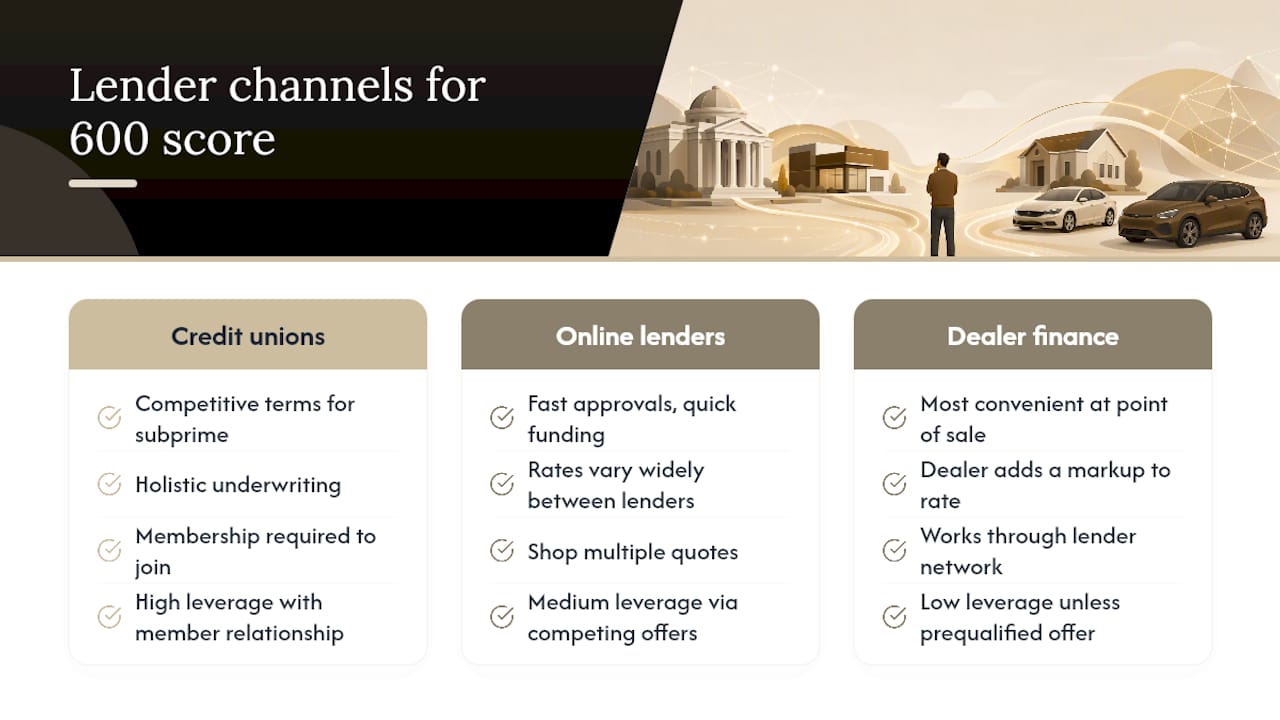
Federal credit unions tend to offer the most competitive terms for subprime borrowers. Because they’re member-owned and not chasing shareholder profit, NCUA rate data consistently shows credit unions pricing auto loans below the national average, especially for borrowers outside the top credit tiers. Many credit unions also underwrite more holistically, weighing your relationship and full financial picture rather than leaning entirely on your score. If you’re eligible to join one through an employer, community, or association, start there before anything else.
Online subprime and marketplace lenders move fast, sometimes approving and funding within a day. That speed comes at a cost. These platforms often price risk aggressively, and rates can vary widely between lenders quoting the same borrower profile. Getting multiple online quotes matters more here than anywhere else, because the spread between the best and worst offer for a 600 score can be substantial.
Dealer-arranged financing is the most convenient option and the one most likely to cost you extra. Dealers often work with a network of lenders, then add a markup to the approved rate as compensation. That markup is frequently negotiable, but only if you already know what the underlying rate should be.
Pro Tip: Walk into the dealership with a prequalified offer in hand, even if you plan to finance elsewhere. It gives you a real number to negotiate against, and it signals to the finance manager that you’ve already done your homework.
How to Improve Your Loan Terms Before You Sign
You have more leverage than you probably think, and most of it comes down to timing and preparation rather than waiting months to rebuild your score. Work through these steps roughly in order.
- Prequalify with three to five lenders before you shop for a car. Mix credit unions, banks, and at least one online lender, and get every quote in writing so you can compare APR, term, and any fees side by side.
- Increase your down payment if you can. Moving from 5% down to 15% or 20% down can shift your LTV enough to move you into a better pricing tier, since lenders treat LTV as one of the most immediately fixable risk factors for borrowers near 600.
- Add a qualified cosigner if one is available. A cosigner with strong credit and stable income can lower your APR meaningfully, but understand the legal weight of it: they’re equally responsible for the debt, and missed payments hit both of your credit reports.
- Pull your credit reports and dispute any errors now. Errors are common, and correcting even one negative item weeks before you apply can bump your score enough to matter.
- Bring a benchmarked target rate to the negotiating table. Walking in with a specific number, backed by comparable transaction data, turns a vague “this is the best we can do” into a real negotiation.
Pro Tip: Use myFICO’s loan savings calculator before you finalize anything. Plugging in even a one-point APR difference shows you exactly how many dollars that translates to over the life of your loan, which makes the case for shopping around impossible to ignore.
How Much Does APR Actually Cost You on a $20,000 Loan?
Numbers on a rate sheet don’t mean much until you see them turned into real payments. Here’s a $20,000 auto loan run at three APRs representative of what a 600-score borrower might see, from a strong credit union offer to a high subprime rate.
The pattern here matters as much as any single number. That trade-off can make sense if the lower payment is what keeps you from missing payments and damaging your score further. It’s a poor trade-off if you’re stretching the term purely to afford a car that’s outside your actual budget.
Run your own numbers through myFICO’s calculator before committing to a term. A rate difference that looks small on paper, like 15% versus 19%, adds up to real money once you multiply it across 60 monthly payments.
How Baywall Helps You Confirm a Dealer’s APR Is Fair
The hardest part of financing a car with a 600 score isn’t finding a lender willing to approve you. It’s knowing whether the rate they’re offering is actually fair for your situation, or just fair for the dealer’s bottom line.
Baywall solves this by comparing your dealer’s quoted APR against real transactions from borrowers with a similar credit tier, loan type, and vehicle category. Enter your score, the vehicle, loan amount, term, and the rate you were quoted, and the report tells you where that offer falls.
Here’s what you get back:
- A clear great, fair, or high label for the offer you’re evaluating.
- A target APR based on what comparable buyers actually paid, not a generic published average.
- A dollar savings estimate showing what negotiating down to that target would actually be worth.
- Comparable vehicle pricing so you’re negotiating from real market data, not guesswork.
If you’re closer to near-prime, the rate expectations shift meaningfully even a few points higher on your score, which is worth understanding before you assume you’re stuck at subprime pricing indefinitely.
When Is a Higher APR Actually the Right Call?
Sometimes waiting for a better rate isn’t realistic, and that’s worth saying plainly instead of pretending everyone has the luxury of patience. If your current car just died and you need reliable transportation to keep a job, a higher-APR loan today can be the sound decision, even at 19% or 20%.
The mistake isn’t taking a high-APR loan when you genuinely need one. It’s taking one without a plan to get out of it. If you accept a subprime rate now, set a firm timeline to refinance, typically after six to twelve months of on-time payments, once your score has had a chance to recover. Track your score monthly, and the moment you cross into near-prime territory, start shopping refinance offers immediately. A loan you took under pressure doesn’t have to be the loan you’re stuck with for five years.
— Baywall
Check Your Dealer’s Offer Before You Sign Anything
Baywall is the fastest way to find out if the APR a dealer just quoted you is actually reasonable for your credit tier, or if you’re leaving money on the table.
The report is available for purchase and delivers instantly, so you can run it from the finance office parking lot if you need to. Enter your credit score, the vehicle, loan amount, and term, along with the rate the dealer offered, and see where you stand before you commit to five years of payments. Run your rate check now and walk back into that dealership with a real number instead of a guess.
Where to Verify These Numbers Yourself
For a broader look at how far your rate could improve with a stronger score, Baywall’s 800 credit score benchmark shows just how wide the gap is between subprime and top-tier pricing. If you’re shopping used specifically, used car loan rate benchmarks break down negotiation targets in more detail.
For direct verification, use Experian’s APR table to confirm current tier averages, myFICO’s loan savings calculator to run your own payment math, and NCUA’s credit union rate data to find member institutions near you.
Sources
FAQ
What APR does a 600 credit score get you?
Expect roughly 13% to 16% on a new car and 19% to 21% on a used car, based on Experian’s subprime credit tier data, though credit unions often price several points lower.
Is 7% APR bad for a car loan?
No.
Can you get a $20,000 loan with a 600 credit score?
Yes, approval is possible, but lenders will also weigh your income, debt-to-income ratio, and down payment, and your APR will land in the subprime range unless a cosigner or larger down payment improves the terms.
Can you get a $30,000 car loan with a 600 credit score?
It’s possible, but a loan that size increases lender scrutiny of your DTI and LTV, so a larger down payment or cosigner becomes more important to secure reasonable terms. Running the offer through a Baywall benchmark report before signing shows you whether the dealer’s number matches what comparable buyers actually paid.