650 Credit Score APR: What Near-Prime Buyers Should Expect

With a 650 credit score, you’re in the near-prime tier, and the APR range you’ll see reflects that. Experian’s 2026 benchmark data puts near-prime (601–660) new-car APRs around 9.6% on average, while used-car APRs climb to roughly 14%. SoFi’s guidance for 650-score borrowers cites sample figures closer to 8.99% for new and 13.49% for used, depending on the lender and deal structure.
Here’s the general APR range before you read further:
- New car: APRs average around 9.6% for near-prime (601–660) scores in 2026; rates can be lower with credit unions or stronger profiles, and higher with weaker profiles or dealer financing.
- Used car: APRs average roughly 14% for near-prime borrowers, with lower rates available in some cases, and higher rates with older vehicles, high mileage, or riskier profiles.
The most useful action is to get a written pre-approval from a credit union or bank, then compare any dealer quote against it before signing.
Key Takeaways
A 650 credit score places you in the near-prime tier, where 2026 benchmarks show new-car APRs averaging around 9.6% and used-car APRs averaging around 14%, but your actual rate depends heavily on your full deal profile.
| Point | Details |
|---|---|
| Near-prime APR range | New-car APRs average around 9.6%; used-car APRs average around 14% for 601–660 scores in 2026. |
| Score tier boundaries matter | Crossing from 660 to 661 can shift you into prime pricing, potentially saving $1,500–$2,000 on a 60-month loan. |
| Deal profile drives the final rate | LTV, DTI, vehicle age, and lender type all move your APR independently of your credit score. |
| Pre-approval is your best leverage | A credit union pre-approval gives you a competing rate before the dealer quotes you anything. |
| Baywall benchmarks your exact offer | Enter your score, vehicle, and quoted APR to get a personalized target rate and dollar-savings estimate. |
Table of Contents
- Where a 650 score puts you on the APR spectrum
- What actually determines your APR beyond the credit score
- How to get a lower rate before you sign
- What a $30,000 loan actually costs at different APRs
- How to evaluate a dealer’s APR quote
- What to do right now if you have a 650 score and a quote to evaluate
- The part most buyers miss about near-prime financing
- Check if your dealer’s APR is actually fair for your profile
Where a 650 score puts you on the APR spectrum
A 650 sits squarely in the near-prime band, which most lenders define as 601–660. That’s one tier below prime (661–780) and two tiers below super-prime (781+). Experian’s fair-credit car loan data confirms that near-prime borrowers pay materially more than prime borrowers, but they’re not in subprime territory (501–600) where rates can exceed 20%.
Credit tiers generally range with approximate APRs this way, though actual offers vary by lender, vehicle, and deal profile. Near-prime borrowers (601–660) typically face higher APRs than prime borrowers but lower than subprime tiers.
The 10-point effect: Small changes near tier boundaries, such as moving just above the 660 threshold, can shift borrowers to lower pricing tiers and significantly reduce APR, saving substantial money over the term.
Small score moves around 650 carry real weight. A borrower at 658 and a borrower at 662 look nearly identical on paper, yet most lenders’ rate sheets treat them differently. If your score is within 10 points of a tier boundary, it’s worth checking whether a quick credit-report correction or a balance paydown could push you across.
What actually determines your APR beyond the credit score
Your credit score opens the door, but lenders price the full deal. Experian’s benchmark methodology makes clear that lenders evaluate the entire “deal profile,” not just the score. Here’s what moves the needle for a near-prime borrower:
- FICO Auto Score: Lenders often use a specialized auto-scoring model that weights your car-payment history more heavily than your general FICO score. Per NerdWallet’s analysis, a borrower with a 650 general score but a clean prior auto-loan history can sometimes qualify for rates closer to prime.
- Debt-to-income (DTI): A DTI above 45% signals repayment risk. Paying down a credit card before applying can shift your DTI enough to move you to a better rate tier.
- Loan-to-value (LTV): A larger down payment on your auto loan lowers LTV and reduces lender risk. Putting 15%–20% down often unlocks better pricing than the generic near-prime average.
- Vehicle age and mileage: Used cars over 5–7 years old or with high mileage carry higher collateral risk. Lenders price that in, sometimes adding 1%–3% to the rate.
- Loan term: Longer terms (72–84 months) typically carry higher APRs because lender risk extends further. A 36-month loan almost always prices better than a 72-month loan for the same borrower.
- Recent credit inquiries: Multiple hard pulls in the past 90 days signal urgency or desperation to lenders. Rate-shopping within a 14-day window counts as a single inquiry under FICO’s deduplication rules, so cluster your applications.
- Lender type: Banks, credit unions, and captive lenders (manufacturer financing arms) each use different rate sheets. Credit unions frequently offer the most competitive rates for near-prime borrowers because of their not-for-profit structure.
Pro Tip: Ask your lender which scoring model they use. If they use a FICO Auto Score, pull your auto-specific score from myFICO.com before applying — it may be higher than your general score and worth knowing.
How to get a lower rate before you sign
The steps below are ordered by impact. Do the first two before you set foot in a dealership.
Get pre-approved first
A pre-approval from a bank or credit union gives you a concrete rate to compare against the dealer’s offer. Credit unions in particular tend to beat dealer financing for near-prime borrowers, often by 1%–3%. Walk in with a pre-approval letter and the dealer knows you have an exit.
Increase your down payment
Every extra dollar down reduces LTV and signals commitment. A 15% down payment on a $30,000 vehicle ($4,500) can move you from a high-end near-prime rate to a mid-range one. Think of it as buying down your APR before the negotiation even starts.

Choose a shorter term
A 48-month loan will almost always price better than a 72-month loan for the same borrower and vehicle. Yes, the monthly payment is higher, but the total interest paid drops significantly and the APR itself is usually lower.
Add a qualified cosigner
A cosigner with a 720+ score can shift the effective pricing tier on your loan. The lender prices the deal to the stronger credit profile. This works best when the cosigner has low DTI and no recent derogatory marks.
Negotiate the dealer markup
Dealers often mark up the buy rate (the rate the lender actually offers) by 1%–3%. That markup is profit for the dealer, not a lender requirement. Asking “What’s the buy rate on this loan?” is a legitimate question, and the FTC’s consumer guidance on credit and loans confirms you have the right to understand the terms of any financing offer before signing.
Medium-term moves (if you can wait 60–90 days)
Reduce revolving balances below 30% of each card’s limit, dispute any errors on your credit report through Experian, Equifax, or TransUnion, and avoid opening new credit accounts. Each of these can add 10–20 points to your score, which at the 660 boundary could mean a full tier change.
What a $30,000 loan actually costs at different APRs
The difference between a 9% and a 14% APR isn’t abstract. On a $30,000 loan, it’s the cost of a vacation.
| APR | Term | Monthly payment | Total interest paid |
|---|---|---|---|
| 6% | 60 months | — | — |
| 9% | 60 months | — | — |
| 12% | 60 months | — | $10,019 |
| — | 60 months | — | — |
| 9% | 36 months | — | — |
| 12% | 36 months | — | $5,856 |
| — | 36 months | — | — |
Figures are calculated estimates for a $30,000 financed amount. Actual payments depend on lender fees and state taxes.
The near-prime cost gap: Moving from a typical near-prime rate of 9.6% to a prime rate of 7% on a 60-month, $30,000 loan saves roughly $1,500–$2,000 in total interest. That’s the real-dollar case for either improving your score before buying or negotiating hard on the rate.
A 60-month term at 12% costs $10,019 in interest on $30,000 borrowed. Shortening that to 36 months at the same rate cuts total interest to $5,856. The monthly payment rises by about $329, but you save over $4,000. That trade-off is worth running before you accept a dealer’s default 72-month offer.
How to evaluate a dealer’s APR quote
Dealers present financing as a package. Your job is to unpack it.
- Get the full written quote before agreeing to anything. The quote must show the APR, loan term, total financed amount, all fees, and the total cost of the loan. Verbal quotes are not binding.
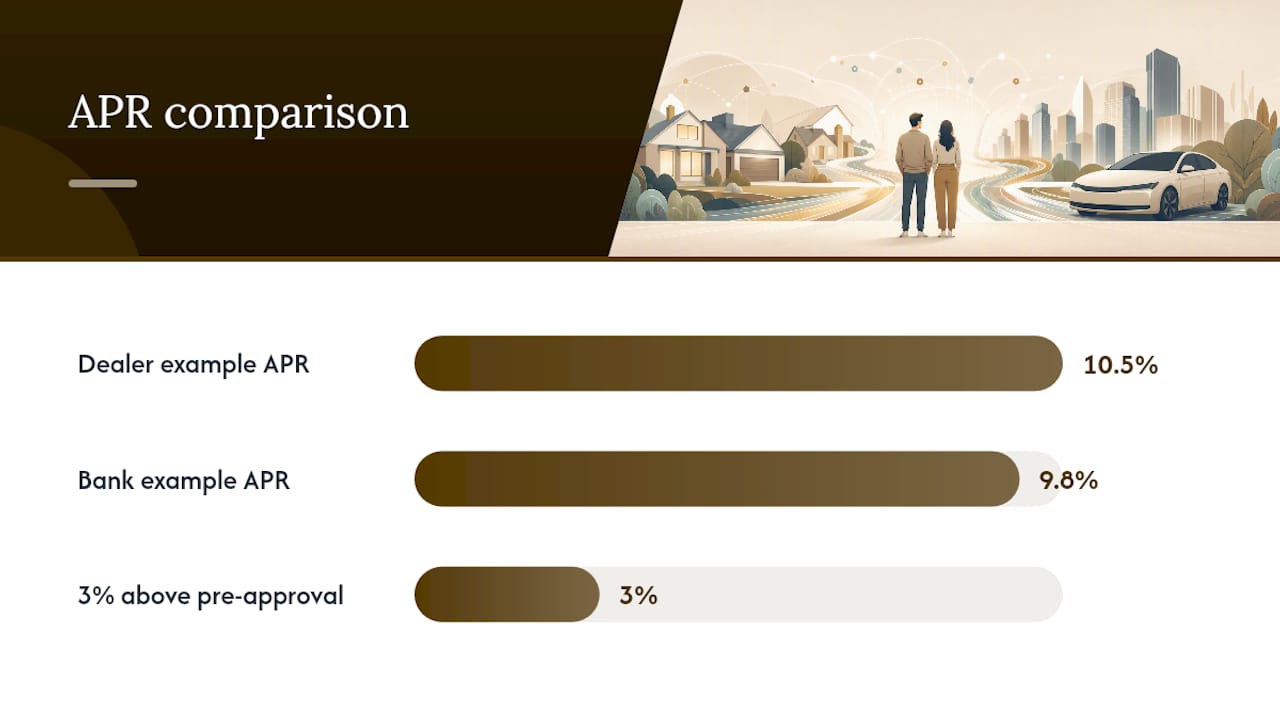
- Compare APR + fees to your pre-approval. A dealer rate of 10.5% with no fees may beat a bank’s 9.8% with $800 in origination fees on a short-term loan. Run the math on total cost, not just the rate.
- Recalculate the monthly payment yourself. Use a basic loan calculator to verify the dealer’s payment matches the quoted APR and term. Discrepancies often signal fee padding or a term extension you didn’t notice.
- Ask for the buy rate. The buy rate is what the lender charges the dealer. The dealer’s quoted rate is often marked up. Asking directly creates pressure to reduce or eliminate the markup.
- Verify the lender. Any lender or broker named in the paperwork should be licensed. Check them on NMLS Consumer Access before signing.
Red flags to watch:
- Pressure to sign before the financing terms are fully disclosed
- A monthly payment that doesn’t match the APR and term when you calculate it yourself
- Fees described as “standard” or “required” with no itemization
- A term longer than you requested with no explanation
- APR that’s 3%+ above your pre-approval for the same loan amount
When a higher dealer APR makes sense: If you need a vehicle immediately and can’t wait for a better credit position, accepting a near-prime rate now with a plan to refinance after 6–12 months of on-time payments is a legitimate strategy. Your payment history on the new loan will strengthen your auto-specific credit profile, often enough to refinance into a meaningfully lower rate.
The APR vs. interest rate distinction also matters here: APR includes fees that a simple interest rate doesn’t. Always compare APR to APR, never APR to interest rate.
What to do right now if you have a 650 score and a quote to evaluate
- If you accept a higher rate now, plan to refinance — Six to twelve months of on-time payments can lower your rate substantially. Per NerdWallet’s refinancing guidance, consistent auto-payment history is one of the fastest ways to improve your auto-specific credit profile.
The part most buyers miss about near-prime financing
Most articles about 650-score APRs focus on the rate itself. The more important question is whether the rate you’re being quoted is fair for your specific deal, not just for your score band.
A 13% APR on a 2019 used sedan with 40,000 miles and a 20% down payment is a different risk profile than a 13% APR on a 2017 truck with 95,000 miles and no money down. Lenders know this. Dealers know this. Most buyers don’t.
The practical implication: don’t accept a near-prime average as your ceiling. Your deal profile may be stronger than your score suggests, especially if you have a clean auto-payment history, low DTI, or a meaningful down payment. Those factors can push your effective rate below the tier average, but only if you negotiate with that knowledge.
The other thing worth saying plainly: the 10-point gap between 660 and 670 is worth more than most buyers realize. If you’re at 655 and your purchase can wait 60 days, a targeted paydown of revolving debt could cross you into prime pricing and save more than the cost of waiting.
Check if your dealer’s APR is actually fair for your profile
You now know the benchmarks. The next step is applying them to your specific offer.
Baywall’s rate-intelligence report takes your credit score, vehicle, loan amount, term, and dealer quote and compares them against real transaction data from comparable deals. You get a personalized target APR, a “great / fair / high” label on your current offer, and a dollar figure showing what you’d save by negotiating to the market rate.
The report costs $2.99 and takes about two minutes to generate. For most near-prime buyers, the savings from a single negotiation point cover that cost many times over. Before you sign any financing paperwork, analyze your offer at Baywall and walk into that conversation knowing exactly what you should be paying.
This article provides general financial information, not professional financial or legal advice. Confirm current rates and terms with lenders directly and consult a qualified financial advisor for guidance specific to your situation.