7% APR Costs $2,100 on a $30k Loan, U.S. Buyers’ Negotiation Steps

A 7% APR car loan is roughly fair for a new car if you’re in prime credit territory, and often a decent deal on a used car regardless of tier. Experian’s Q1 2026 data shows the typical APR for prime and superprime new-car borrowers is lower than 7%, so 7% sits a bit above prime but still inside good territory for many borrowers. Your next move is to check your credit tier and compare your dealer’s rate against real comparable offers before you sign.
TL;DR:
- A 7% APR on a new car is typical for prime borrowers but may be high for superprime tiers, requiring comparison to market averages.
- Longer loan terms at the same rate significantly increase total interest paid, with a 72-month loan costing over $4,000 more in interest than a 48-month one at 7%.
- Down payments and better credit scores can reduce your APR, with larger down payments lowering both your rate and approval risk.
- Refinancing can lower your rate if your credit improves or market rates drop but may extend your loan and increase total interest if not carefully managed.
- Using a tool like Baywall can provide an exact target rate for negotiations, saving hundreds of dollars on a typical $30,000 loan at 7%.
Table of Contents
- What Does APR Actually Mean on a Car Loan?
- Where Does 7% Fall Among Current Auto Loan Rates?
- What Does a 7% APR Actually Cost You in Dollars?
- Why Would a Lender Quote You 7% in the First Place?
- How Do You Lower or Negotiate a Quoted 7% APR?
- How Baywall Turns a 7% Quote Into a Real Negotiating Number
- Does Your Down Payment Change the APR You’re Offered?
- Can You Refinance Your Way Out of a 7% APR Car Loan?
- When Should You Accept 7% and When Should You Keep Shopping?
- Try Baywall Before You Sign on a 7% APR Offer
- Sources
What Does APR Actually Mean on a Car Loan?
APR and interest rate aren’t the same number, even though dealers often use them interchangeably. The interest rate is the raw cost of borrowing. APR wraps that rate together with certain lender fees and finance charges into one percentage, giving you the truer cost of the loan over its life. When a lender quotes you “7%,” you want to know if that’s the APR or just the nominal rate, because the gap between the two can hide real money.
Term length changes the math dramatically. A longer term lowers your monthly payment but stretches out how long you’re paying interest, which raises the total interest you hand over even at the same APR. A 72-month loan at 7% will cost you noticeably more in total interest than a 48-month loan at the same rate, even though the monthly bill feels friendlier.
Most lenders assume a fixed APR, full amortization, and no early payoff penalty when they calculate your payment. Read your truth-in-lending disclosure carefully. It should show exactly what’s baked into that APR and how simple interest accrues on your specific balance.
Where Does 7% Fall Among Current Auto Loan Rates?
Credit tier is the single biggest driver of where you land on the rate spectrum, and the gap between tiers is wider than most shoppers expect. Superprime borrowers typically see lower new-car APRs, while nonprime borrowers face notably higher rates, according to Experian’s tier breakdown. A flat 7% quote can be a strong offer or a weak one depending entirely on which bucket you fall into.
Market snapshots move around monthly, too. Edmunds reported average new-car and used-car APRs around the typical mid-2026 market values in July 2026, using dealer-originated data. NerdWallet’s ranges show good-credit borrowers commonly landing between 5% and 7% on new cars, which makes 7% a borderline case rather than a clean “good” or “bad” verdict.
The spread between sources exists because dealer-sourced averages (like Dealertrack and Cox Automotive feeds) capture what dealerships actually process, including markup, while consumer-facing aggregators often reflect what shoppers report or qualify for directly. Neither number is wrong, they’re just measuring different points in the transaction. Check the used-car benchmark breakdown if that’s your loan type, since used financing runs on a different curve entirely.
What Does a 7% APR Actually Cost You in Dollars?
Percentages feel abstract until you see them next to a real loan.
- $15,000 over 48 months: At 7%, you’ll pay about $359/month and roughly $2,232 in total interest. At 4.5%, that drops to about $343/month and $1,464 in total interest — a difference of $768.
- $30,000 over 60 months: At 7%, the payment runs about $594/month with total interest near $5,640. At 4.5%, expect around $559/month and roughly $3,540 in total interest, a gap of about $2,100.
- $45,000 over 72 months: At 7%, you’re looking at roughly $769/month and about $10,368 in total interest. At 4.5%, that falls to around $713/month and $6,336 in total interest, a swing of over $4,000.
That last example is real vacation money, or a year of car insurance, sitting on the table because of a rate gap that felt small on paper. These numbers assume a clean loan with no add-ons or fees folded in, so your actual figures will shift slightly. For a number matched to your exact loan amount and term, run it through a dedicated payment calculator rather than eyeballing it.
Why Would a Lender Quote You 7% in the First Place?
Your APR isn’t pulled from a hat. Lenders run your file through a risk model that weighs several factors at once, and understanding which ones apply to you tells you exactly which levers are worth pulling.
- Credit score and recent activity: A string of hard inquiries or a recent late payment can push your quote up even if your overall score looks solid.
- Loan term, down payment, and loan-to-value ratio: Longer terms and smaller down payments raise the lender’s risk, which raises your rate.
- Vehicle attributes: New vehicles typically carry lower rates than used ones, and high-mileage or older used cars often price higher due to resale risk.
- Dealer markup and promotional financing: Dealers can add a spread on top of the wholesale rate they get from the lender, and if there’s no manufacturer promo APR running on that model, you’re paying the standard rate.
Pro Tip: *Ask the finance manager directly whether a manufacturer-subsidized APR program exists on your specific trim right now.
How Do You Lower or Negotiate a Quoted 7% APR?
Here’s the order that gets results:
- Check your credit report and score range before you walk in. Knowing whether you’re prime or nonprime tells you what a fair number actually looks like.
- Get preapproved by a bank or credit union first to verify lender legitimacy through public registries like the NMLS as recommended by First Choice Home Loans. U.S. News notes that a credit union preapproval often undercuts dealer rates and gives you a real competing offer to wave at the finance desk.
- Ask for the lender disclosure the dealer used to generate your quote, and request a written APR breakdown showing any markup added.
- Bring a data-backed target rate, not just a gut feeling that 7% “seems high.” A number backed by comparable transactions is far harder for a finance manager to wave off.
- Compare manufacturer financing if a promotional APR is running on your model, since it can beat any rate a bank offers.
- Weigh cost against time. If you’re saving under $500 total by walking away and re-shopping for two more weeks, the math might not be worth the hassle.
On a $30,000 loan, the difference between 7% and a stronger benchmark rate can top $2,000 in total interest over 60 months. That’s the number worth fighting for before you sign anything.
How Baywall Turns a 7% Quote Into a Real Negotiating Number
You enter your credit tier, vehicle type, loan amount, term, and the dealer’s quoted rate, and Baywall benchmarks that offer against comparable transactions, same tier, same loan type, similar vehicle, to tell you whether 7% is great, fair, or high for your exact situation.
Print that number or pull it up on your phone at the dealership, and you’ve replaced a vague objection with a specific, sourced figure the finance manager has to respond to directly.
Does Your Down Payment Change the APR You’re Offered?
A bigger down payment shrinks the lender’s exposure, and that shows up in your rate. It lowers your loan-to-value ratio, meaning the loan amount is smaller relative to what the car is actually worth, and a lower LTV tells the lender there’s less to lose if you default and the car gets repossessed.
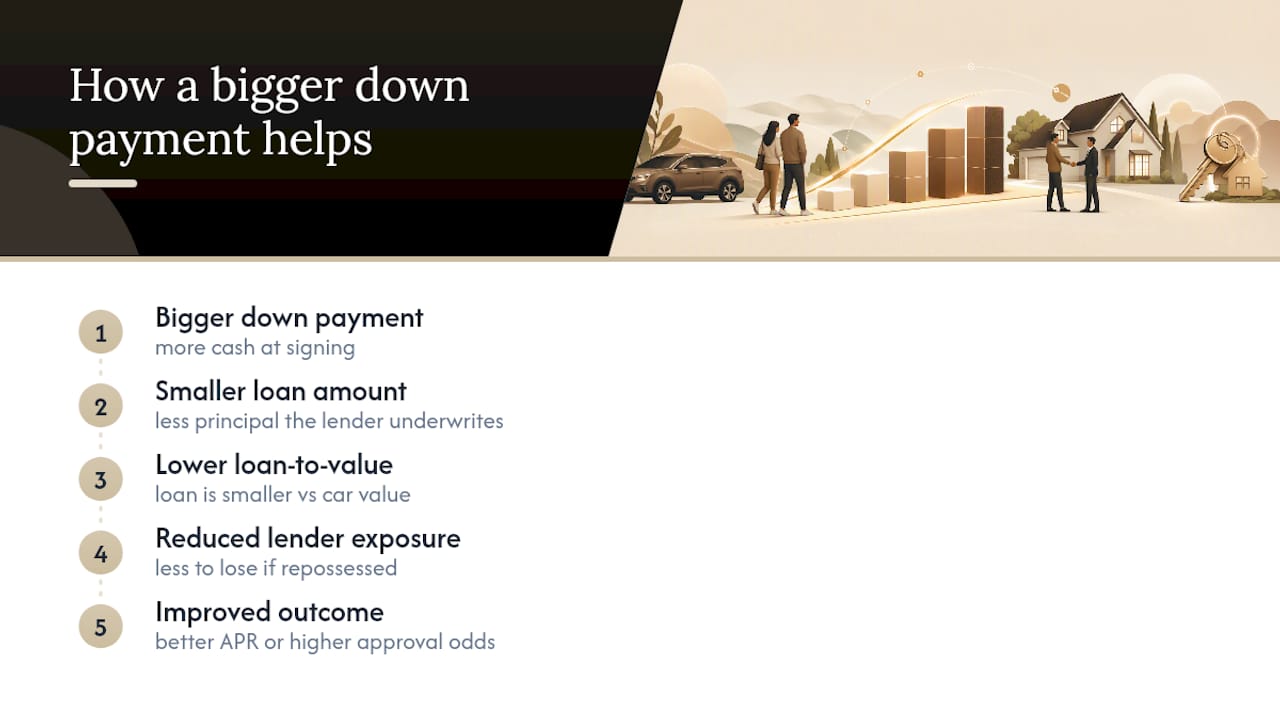
Down payment size also affects approval odds, not just the rate itself. A borrower on the edge of qualifying for a loan amount can sometimes tip the decision in their favor with a larger down payment, since it reduces the total the lender is underwriting. If you’re sitting in nonprime or subprime territory, a bigger down payment can be the difference between an approval at a workable rate and a decline, or an approval buried in fees and add-ons to offset the lender’s risk.
If you’re short on cash for a larger down payment, a trade-in with genuine equity can serve the same function. Either way, more money down at signing tends to translate into less interest paid over the life of the loan, on top of whatever rate improvement you get.
Can You Refinance Your Way Out of a 7% APR Car Loan?
Refinancing an auto loan works the same way refinancing a mortgage does: a new lender pays off your existing balance and issues you a new loan, ideally at a lower rate, once your circumstances or the market shift in your favor.
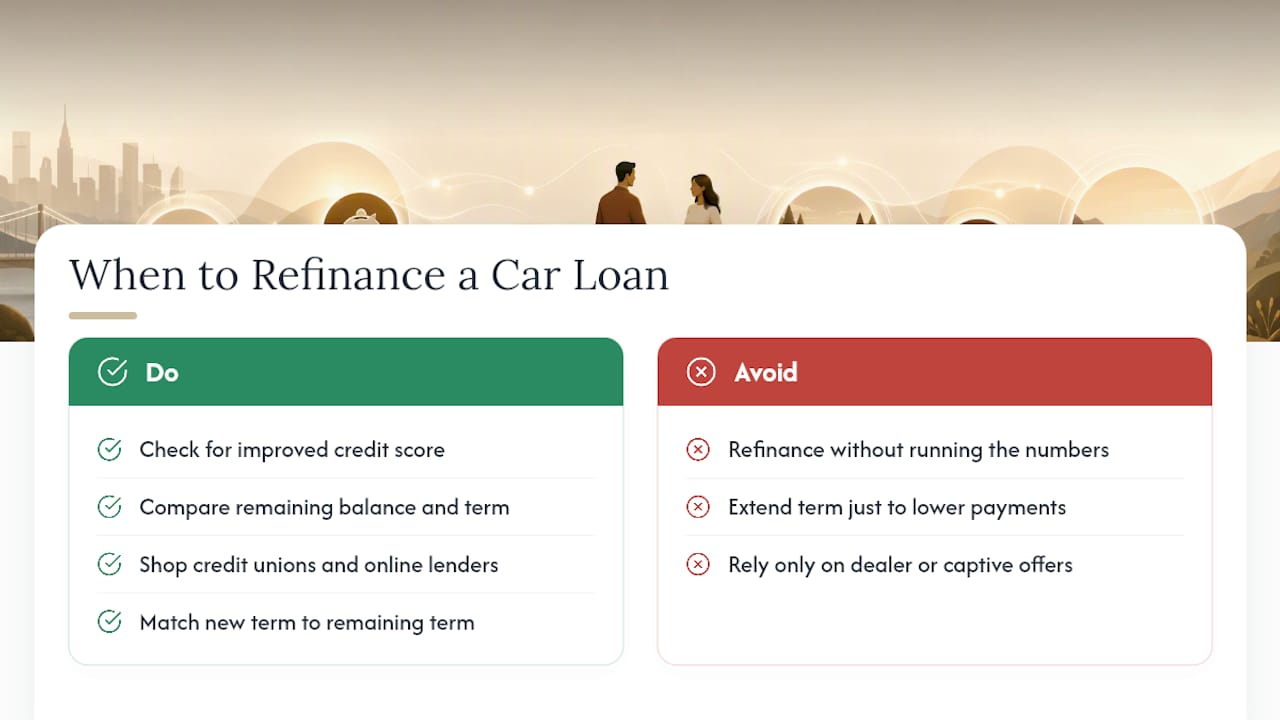
A few situations make refinancing worth pursuing. If your credit score has climbed since you signed, maybe you paid down other debt or fixed a reporting error, you may now qualify for a materially better rate than you did originally. If overall market rates have dropped since your purchase, that’s another opening. And if you rushed into a dealer loan under time pressure and skipped shopping around, refinancing is your do-over.
The math only works if the savings outweigh the friction. Refinancing usually involves a new credit pull and sometimes a small fee, so run the numbers before committing: compare your remaining balance and term at the current rate against what a new lender is offering. Credit unions and online lenders tend to be the most competitive refinance options, often beating what dealers or captive finance arms will offer on a second pass.
One caution worth flagging: refinancing into a longer term to lower your monthly payment can backfire if it extends your total interest paid, even at a lower rate. Match the new term to what’s left on your original loan whenever possible, not to whatever gets you the smallest monthly number.
When Should You Accept 7% and When Should You Keep Shopping?
Keep shopping if you’re superprime or prime and haven’t checked a credit union, or if a manufacturer promo rate exists on your model. Weigh total interest cost against how much time you’re willing to spend chasing a better number.
— Baywall
Try Baywall Before You Sign on a 7% APR Offer
That’s what Baywall’s benchmark report does: enter your credit tier, vehicle, loan amount, term, and the dealer’s quoted rate, and get back a target APR, comparable transaction data, and your estimated dollar savings.
The report costs $2.99, arrives instantly, and gives you a specific number to bring to the negotiating table instead of a hunch. If you’re weighing a used purchase, the used-car APR breakdown can help you sanity-check your tier before you even start. Run your offer through Baywall’s analysis tool before you initial anything, and know exactly what you should be paying.
Sources
- Experian automotive credit webinar
- Edmunds — car loan APR & interest rate
- Average car loan interest rates by credit score — NerdWallet