Save $2,500: Negotiate U.S. 700 Credit Score APRs

With a 700 credit score, expect a competitive APR generally lower than average on a new car and somewhat higher for a used one, depending on your lender and loan structure. Those bands sit below the national averages but above the best promotional rates reserved for near-prime and super-prime borrowers. Your actual number depends heavily on where you shop.
TL;DR:
- A 700 credit score typically yields an APR of 5% to 8% for a new car, with used car loans averaging higher due to increased risk.
- Your actual rate depends heavily on your down payment, debt-to-income ratio, employment stability, and lender type.
- Shopping within a 14 to 45-day window ensures multiple lender inquiries count as one, minimizing the score impact during rate comparison.
- Small APR differences of 1% to 2% can cost or save you thousands in interest over the loan term, emphasizing the importance of negotiation.
- Credit unions often offer the lowest rates at or below 6%, while dealer-internal financing and buy-here-pay-here options tend to have higher APRs.
Table of Contents
- 700 Credit Score APR: New Car vs. Used Car Benchmarks
- What Moves Your APR Beyond Your Credit Score
- How to Shop and Negotiate Your Rate With a 700 Score
- How Rate Shopping Affects Your 700 Score
- Concrete Numbers: What a 1% to 2% APR Swing Actually Costs
- Where 700-Score Borrowers Actually Have Leverage
- Check Your Dealer’s APR Offer Before You Sign
- Where These Numbers Come From
- Sources
700 Credit Score APR: New Car vs. Used Car Benchmarks
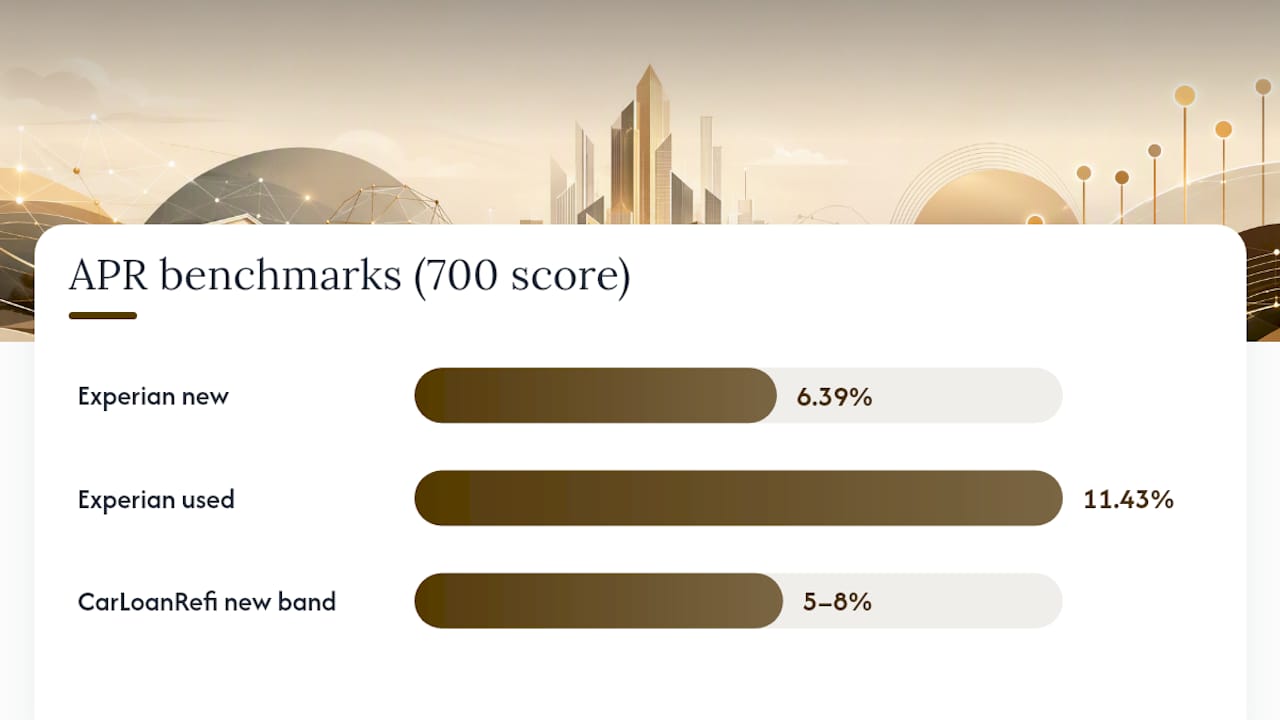
A 700 score puts you in the “prime” tier, one notch below “super prime,” and that placement matters more than most shoppers realize. Experian’s Q1 2026 data puts the national average interest rate for all new car loans at 6.39%, with used car loans averaging a much steeper 11.43%. Those are blended averages across every credit tier, from deep subprime to super prime, so a 700 score borrower should land noticeably better than the used-car average and close to, or slightly above, the new-car average.
Bankrate’s 2026 tracking of rates by credit tier confirms the same pattern: as scores rise, average APRs fall, but the drop isn’t linear. The gap between a 680 and a 700 score is often smaller than the gap between a 700 and a 740. You’re close to better pricing, but you haven’t crossed into it yet.
Separate reporting from CarLoanRefinancing narrows this down further, estimating a typical 700-score new car APR band of roughly 5% to 8%, with used car financing running higher because used loans carry more risk for lenders (older collateral, higher default rates, less predictable resale value).
Here’s what separates “average” from “what you should expect”:
- Average by credit tier blends every lender type, every loan term, and every vehicle condition into one number, so it tells you the market’s center of gravity, not your ceiling or floor.
- What an individual should expect depends on your specific down payment, debt-to-income ratio, and which lender you’re sitting across from.
- The spread between best-case and market average at the 700 tier can run several percentage points, according to Bankrate’s analysis, which is the gap you’re trying to close through shopping and negotiation.
Quick benchmark: a 700 score borrower financing a new car should aim for the low-to-mid single digits. Anything creeping toward 10% on a new loan is a signal to keep shopping, not sign.
Credit unions tend to sit at the low end of these bands. National banks and dealer captive finance arms (Ford Credit, Toyota Financial Services, and similar in-house lenders) often land in the middle. Online lenders and buy-here-pay-here dealers frequently sit at the high end, especially for used vehicles.
What Moves Your APR Beyond Your Credit Score
Your 700 score sets the tier, but it doesn’t set the number — improving it further by fixing your credit before a mortgage application can help you secure better loan terms. Lenders price the loan based on a handful of variables that either shrink or widen the range you’ll actually see quoted.
- Debt-to-income ratio (DTI): Lenders want your total monthly debt payments, including the new car loan, to stay under a manageable share of your gross income. A high DTI pushes your quoted APR up even at a 700 score, because it signals thinner repayment cushion.
- Income verification and employment history: Steady, verifiable income with a consistent job history reads as lower risk. Self-employed or recently-employed borrowers sometimes see a rate bump even with strong credit.
- Down payment and trade-in value: Putting more money down reduces the loan-to-value ratio, which directly reduces lender risk and often earns a better rate.
- Loan-to-value (LTV) ratio: The less you finance relative to the car’s value, the more favorable your pricing tends to be.
- Vehicle age and mileage: Used cars past a certain age or mileage threshold often get bumped into a higher risk category regardless of your score, which is part of why used APRs run higher across the board.
- Loan term: Stretching to 72 or 84 months can lower your monthly payment, but longer terms frequently carry higher APRs and always generate more total interest.
- Lender type: Credit unions, banks, dealer captive finance, and online lenders don’t price risk the same way. Credit unions often extend better rates to existing members, banks compete on relationship pricing, and captive finance companies sometimes offer promotional rates on new inventory that beat everyone.
Fees and add-ons don’t technically raise your APR, but they raise your effective cost of borrowing. Extended warranties, gap insurance, paint protection, and dealer “processing fees” rolled into the loan amount increase what you’re financing, which increases your total interest paid even if the rate itself stays flat. Ask for the out-the-door price before any financing conversation starts. For a deeper breakdown of how APR interacts with these add-ons, see how APR compares to interest rate on a car loan.
How to Shop and Negotiate Your Rate With a 700 Score
Getting a fair auto loan rate at a 700 credit score is a process, not a single conversation at the finance desk. Follow this sequence:
- Prequalify with soft-pull lenders first. Gather two to four preapprovals across different lender types, a credit union, a national bank, and an online lender, using soft-pull prequalification tools that don’t touch your score.
- Check a credit union before anything else. Credit unions with a 700-score member consistently show up at the low end of the benchmark bands, making them a smart first stop before you ever walk into a dealership. Compare credit union auto loan offers against what a bank quotes you.
- Lock the vehicle price before discussing financing. Negotiate the out-the-door price of the car as a completely separate conversation from the loan. Dealers sometimes offer a “great deal” on price while padding the APR to make up the margin.
- Bring your best preapproval as leverage. Tell the finance manager you have a preapproved rate and ask them to beat it. This single move often does more for your rate than any script.
- Request the full APR and fee breakdown in writing. Compare it line by line against your preapprovals before signing anything.
- Use a specific target rate, not a vague ask. If benchmarks show 700-score new car APRs running 5% to 8%, tell the dealer directly: “I’m looking for something at or below 6.5%, and I have a preapproval at 7% to compare against.”
Pro Tip: Walk into the dealership already knowing your target APR down to the decimal, not just “a good rate.” A specific number is harder for a finance manager to talk you away from than a vague expectation.
Watch for red flags along the way: add-ons quietly bundled into the loan amount, financing terms that shift between the initial quote and the final paperwork, and any pressure to sign before you’ve had time to review the numbers. If a quoted rate feels unusually high for your tier, compare it against what a 15% APR actually signals about a bad deal versus a fair one.

How Rate Shopping Affects Your 700 Score
Shopping multiple lenders feels risky if you don’t understand how scoring models treat it, but the mechanics work in your favor when you move within the right window.
TransUnion explains that multiple auto-loan inquiries submitted within a short window, typically 14 to 45 days depending on the scoring model, get bundled and treated as a single inquiry for scoring purposes. That means applying to four lenders in the same week costs you roughly the same score impact as applying to one.
The practical sequence:
- Start with soft-pull prequalification from as many lenders as you want. These don’t affect your score at all and let you compare estimated rates risk-free.
- Narrow to your top two or three offers, then submit hard applications to those lenders within the same short window.
- Choose your final lender and let the others expire. You’ve already captured the comparison benefit without stacking separate inquiry hits.
The key distinction: a soft pull gives you an estimate for comparison shopping, while a hard pull happens only once you’re formally applying for the loan you intend to take.
Concrete Numbers: What a 1% to 2% APR Swing Actually Costs
Percentage points feel abstract until you see them translate into dollars. Here’s what the spread within the 700-score band looks like on two common loan scenarios, both financed over 60 months.

On the new car example, the difference between the low and high end of the 700-score band costs an extra $2,580 in interest over the life of the loan, roughly $43 more per month for the same car. On the used car example, the swing is even sharper relative to the loan size: $2,460 in additional interest, which is real money for a smaller loan amount.
Stretching either loan to 72 or 84 months lowers the monthly payment further, but it also extends the window during which you’re paying interest, which usually increases the total interest paid even if the APR itself doesn’t change. A longer term can turn a “good rate” into a more expensive loan overall simply because you’re financing it for longer.
The math that matters for negotiation: a 3-point APR difference on a $30,000 loan is worth roughly $2,500 to $3,000 in total interest. That’s a real vacation, a semester of community college tuition, or a solid emergency fund cushion, not a rounding error you should shrug off at the finance desk.
Where 700-Score Borrowers Actually Have Leverage
The gap between “average” and “best available” at the 700 tier isn’t random. It tracks closely with which lender type you approach first, and most shoppers approach the wrong one first.
Dealer captive finance and buy-here-pay-here arrangements build their profit into the spread between what a lender actually charges the dealership and what the dealership quotes you. A 700 score often qualifies for a rate that’s meaningfully better than what gets offered at the finance desk on the first try, because dealers have financial incentive to mark the rate up and keep the difference. Credit unions, by contrast, tend to price closer to their actual cost of funds, which is why they consistently anchor the low end of the benchmark bands.
Refinancing makes sense in two situations: your score has climbed since you signed the original loan, or market rates have dropped enough that the difference covers any refinance fees within a year or two. If you financed at 8.5% eighteen months ago and now qualify for 6%, run the math. On a $25,000 remaining balance, that gap alone can save over a thousand dollars in interest before the loan matures.
Verifying whether your rate is actually fair, rather than just “acceptable,” is the entire premise behind Baywall’s benchmarking approach: comparing your specific offer against real transactions from borrowers in your credit tier, not a blended national average.
— Baywall
Check Your Dealer’s APR Offer Before You Sign
You don’t have to guess whether your dealer’s quote is fair or padded. Baywall’s APR analysis benchmarks your actual offer against real transactions from other 700-score buyers financing similar vehicles, so you’re comparing your number against reality instead of a national average that may not reflect your situation.
Enter your credit score, vehicle, loan amount, term, and the APR your dealer quoted. Baywall returns a clear fairness label, great, fair, or high, along with a target APR to negotiate toward and an estimated dollar savings if your current offer is running above market. It also shows comparable vehicle pricing, so you walk into the negotiation with more than a feeling that something’s off. For borrowers specifically shopping used inventory, the same benchmarking applies to used car loan rates too. Run your numbers before you sign anything, not after.
Where These Numbers Come From
The benchmark ranges throughout this guide draw from Experian’s quarterly auto loan data, Bankrate’s credit-tier rate tracking, and TransUnion’s rate-shopping guidance. Check these directly for the most current published averages, and confirm any specific lender’s licensing through NMLS Consumer Access before signing.
This article is general information, not a substitute for advice from a qualified financial advisor. Consult a qualified financial professional about your own circumstances before acting on anything here.
Sources
- Average Car Loan Interest Rates by Credit Score — Experian
- 700 Credit Score Car Loan: Rates You Can Expect — CarLoanRefinancing