2026 U.S. Benchmark: Make It Your Target for 72 Month Auto Loan Rates

The national average APR for a 72-month new-car loan sits at 6.97% as of May 2026, according to the Federal Reserve. That’s the benchmark, not your rate. Where you land depends heavily on credit score, with excellent-credit borrowers often paying half that and subprime buyers paying double. Yes, 72-month terms are widely available, but the tradeoff is real: more total interest over the life of the loan.
TL;DR:
- Most borrowers face APRs above 6.97% for a 72-month loan, with rates ranging from below 3% for excellent credit to well over 10% for poor credit.
- Used-car rates are typically 1 to 2 percentage points higher than new-car rates due to increased risk and depreciation.
- A higher credit score can significantly reduce your APR, saving thousands over the loan term, especially when moving from fair to good credit.
- Longer loan terms increase total interest paid and the risk of owing more than the car’s value early in ownership; a 60-month term often offers better overall costs.
- Shopping through pre-approval, requesting the buy rate, and comparing against real benchmarks help clients negotiate fairer APRs and avoid dealer markup.
Table of Contents
- What Are Current 72-Month Auto Loan Rates?
- What Determines Your 72-Month Rate?
- How Much Does a 72-Month Loan Actually Cost You?
- Is a 72-Month Auto Loan a Smart Choice?
- How to Shop for the Best 72-Month Auto Loan Rate
- How Baywall Helps You Negotiate a Dealer APR
- How Loan Term Length Affects Your Financial Health
- Alternatives to a 72-Month Loan Worth Considering
- Where Are 72-Month Rates Headed?
- Author Perspective: Common Buyer Mistakes and a Quick Checklist
- Get a Personalized Rate Check Before You Sign
- Sources
What Are Current 72-Month Auto Loan Rates?
The Board of Governors of the Federal Reserve System tracks this number every month, and the G.19 Consumer Credit release puts the average finance rate on a 72-month new-auto loan at 6.97% for May 2026. The same figure shows up in the FRED RIFLPBCIANM72NM series, which tracks this exact rate over time so you can see how it’s moved.
That’s the average across all credit tiers, all lenders, and all regions. It’s a useful compass, not a quote. Your actual APR will swing based on where your credit score falls.
Here’s roughly how the market breaks down by credit tier for 72-month new-car financing:
- Excellent credit (720+): Typically lower than the national average.
- Good credit (660 to 719): Usually moderately above the best rates.
- Fair credit (600 to 659): Generally higher rates reflecting increased risk.
- Poor credit (below 600): Often much higher rates, potentially well above typical ranges depending on the lender.
Benchmark check: If a dealer quotes you anything meaningfully above the range for your credit tier, that’s your cue to push back or shop elsewhere. A 3 or 4-point gap on a $30,000 loan isn’t a rounding error. It’s real money.
Used-vehicle rates for the same 72-month term typically run 1 to 2 percentage points higher than new-car rates, a gap reported consistently across lender data. Lenders view used cars as riskier collateral since they depreciate faster and carry more mechanical uncertainty, so that markup shows up almost universally, regardless of your credit profile.
Rates have also been drifting with the broader interest rate environment. When the Fed adjusts its benchmark rate, auto loan rates tend to follow with a lag of a few months. If you’re comparing quotes today against numbers you saw a year ago, don’t assume they’re still accurate. Check the current FRED figure before you calibrate your expectations.
What Determines Your 72-Month Rate?
Your credit score does more heavy lifting than any other factor. Move from the “fair” tier into “good,” and you could shave several percentage points off your APR, which on a 72-month term compounds into thousands of dollars in savings. Lenders price risk, and a longer repayment window means more time for something to go wrong, so they charge more to offset that exposure.
A few other variables shape your actual number:
- New vs. used vehicle: New cars get preferential rates because they hold value better and come with manufacturer incentives.
- Loan-to-value ratio: Financing 100% of the purchase price (or more, if you’re rolling in negative equity) signals higher risk than financing 80% with a solid down payment.
- Down payment size: Putting 10% to 20% down typically improves your rate and shrinks the chance you owe more than the car is worth.
- Lender type: Credit unions frequently beat both banks and dealer financing on 72-month terms, since they operate as member-owned institutions with less overhead to price into your rate.
- Term length itself: A 72-month loan almost always carries a higher APR than a 60-month loan from the same lender, on top of accruing interest over a longer stretch.
Dealer-arranged financing adds another layer. Dealers routinely mark up the “buy rate” a lender offers them before presenting it to you as your rate, and that markup is where a lot of extra cost quietly gets added.
Pro Tip: Ask your credit union for a rate quote before you set foot on a dealer lot. Even if you finance through the dealer for convenience or a manufacturer incentive, having that number in your pocket tells you instantly whether the dealer’s offer is competitive or padded.
How Much Does a 72-Month Loan Actually Cost You?
Numbers make this real faster than percentages do. Below are payment and interest totals for three common loan amounts, each run at three representative APRs, using standard amortization math (principal and interest only, no taxes or fees).
A jump from 4.5% to 8.0% APR on a $50,000 loan adds nearly $5,900 in interest over 72 months. That’s a real vacation, a year of car insurance, or a solid dent in your next down payment, gone to financing costs alone.
The formula behind these figures is standard amortization: monthly payment equals the loan balance times the monthly interest rate, divided by one minus (one plus the monthly rate) raised to the negative number of payments. You don’t need to run that by hand. Plug your numbers into any reputable monthly payment calculator and confirm the dealer’s math matches before you sign anything.
What jumps out from the table isn’t just how much total interest grows with a higher rate. It’s how little the monthly payment moves in comparison. That gap between what you feel every month and what you actually pay over six years is exactly why so many buyers underestimate the cost of a weak APR.
Is a 72-Month Auto Loan a Smart Choice?
It depends on what you’re optimizing for. A 72-month term is a legitimate financial tool when it’s used deliberately, and a costly mistake when it’s used to stretch into a car that’s otherwise out of reach.
The case for 72 months:
- Lower monthly payments free up cash flow for other financial goals or a rockier income month.
- More buying power lets you access a newer, safer, or better-equipped vehicle without straining your monthly budget.
- Predictable fixed payments make budgeting simpler than a variable-rate alternative.
The case against it:
- You’ll pay meaningfully more total interest than on a 48 or 60-month term at the same rate.
- Cars depreciate fastest in the first few years, so you can spend a long stretch owing more than the car is worth, a position Experian’s research on term trends flags as an increasingly common risk as terms lengthen.
- Six years is a long commitment if your circumstances, income, or vehicle needs might change.
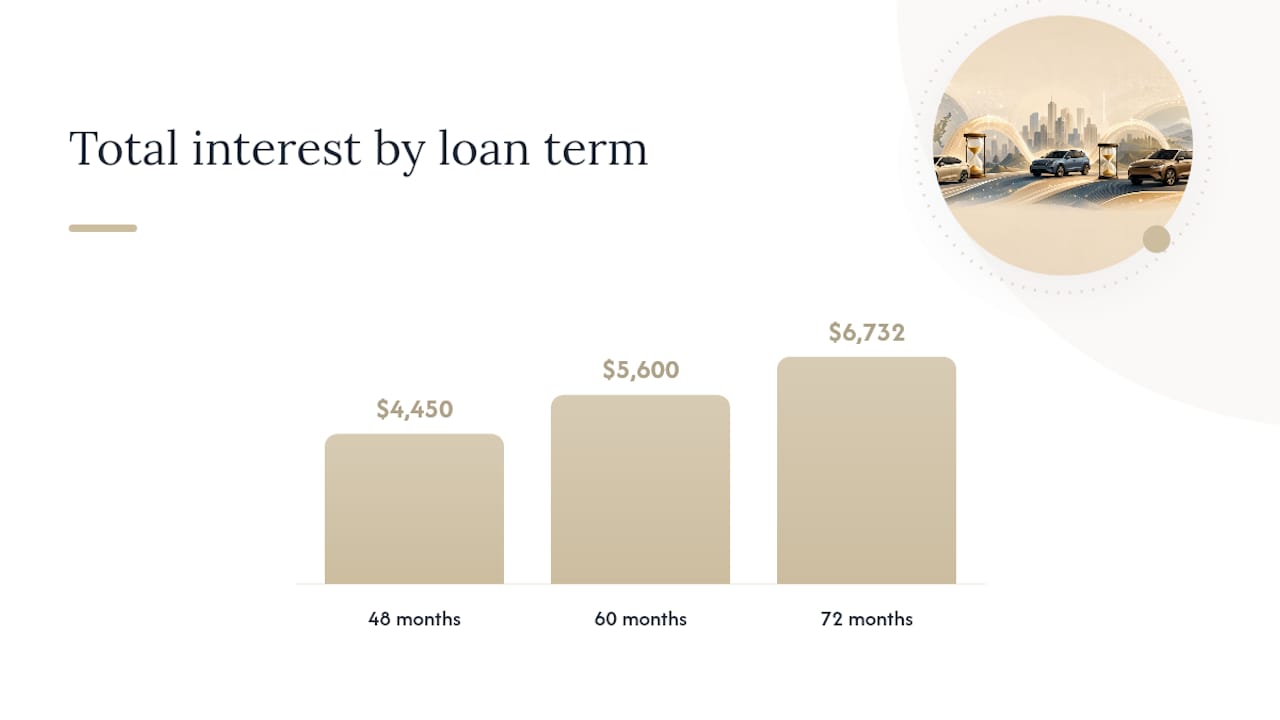
Compare that $35,000 example above at 6.0% APR across terms: a 72-month loan runs $6,732 in total interest, while the same loan at 60 months costs roughly $5,600, and at 48 months drops to around $4,450. You’re trading a lower payment now for a real cost later.
How to Shop for the Best 72-Month Auto Loan Rate
Getting a fair rate on a 72-month loan isn’t about luck. It’s about walking in with leverage instead of hoping the dealer treats you fairly.
- Get pre-approved before you shop. The FTC recommends securing pre-approval from a bank or credit union before you ever talk financing with a dealer. That approval becomes your benchmark rate and your walk-away leverage in one step.
- Check your pre-approved rate against your credit tier’s range. If your bank quotes 9% and you have a 700 score, that’s above market. Shop it elsewhere.
- Ask the dealer for the buy rate, not just the offered rate. Dealers aren’t always required to disclose the wholesale rate they got from the lender, but asking directly sometimes prompts a more honest number.
- Get the APR and full term in writing before you sign anything, and read it against what was verbally quoted. Numbers shift between the sales desk and the finance office more often than buyers expect.
- Use a concrete target number, not a vague “lower, please.” Walking in saying “I know 72-month rates for my credit tier run 6.5% to 9%, and I want 6.5%” gets further than general pushback.
- Be ready to walk, or to shorten the term or raise your down payment, if the dealer won’t move. A 60-month loan at a better rate, or a larger down payment on the same 72-month term, often beats accepting a padded APR.
Pro Tip: Dealers make money on financing markup just like they do on the vehicle price. Negotiate the two separately. Settling on a car price and then rolling over on the loan terms is where a lot of buyers lose money without realizing it.
How Baywall Helps You Negotiate a Dealer APR
You’ve got the national benchmark and the credit-tier ranges. What you don’t have is a clean answer to “is my specific offer fair.” That’s the gap Baywall fills.
You enter your credit tier, vehicle, loan amount, term, and the APR your dealer quoted. Benchmarks that offer against real transactions from comparable buyers and returns:
- A clear label for your specific offer
- A target APR to negotiate toward instead of guessing
- An estimate of potential savings if you push for that target
Pro Tip: Run your dealer’s quote through a benchmark check before you sign, not after. Once you’ve signed the financing agreement, that negotiating leverage is gone.
How Loan Term Length Affects Your Financial Health
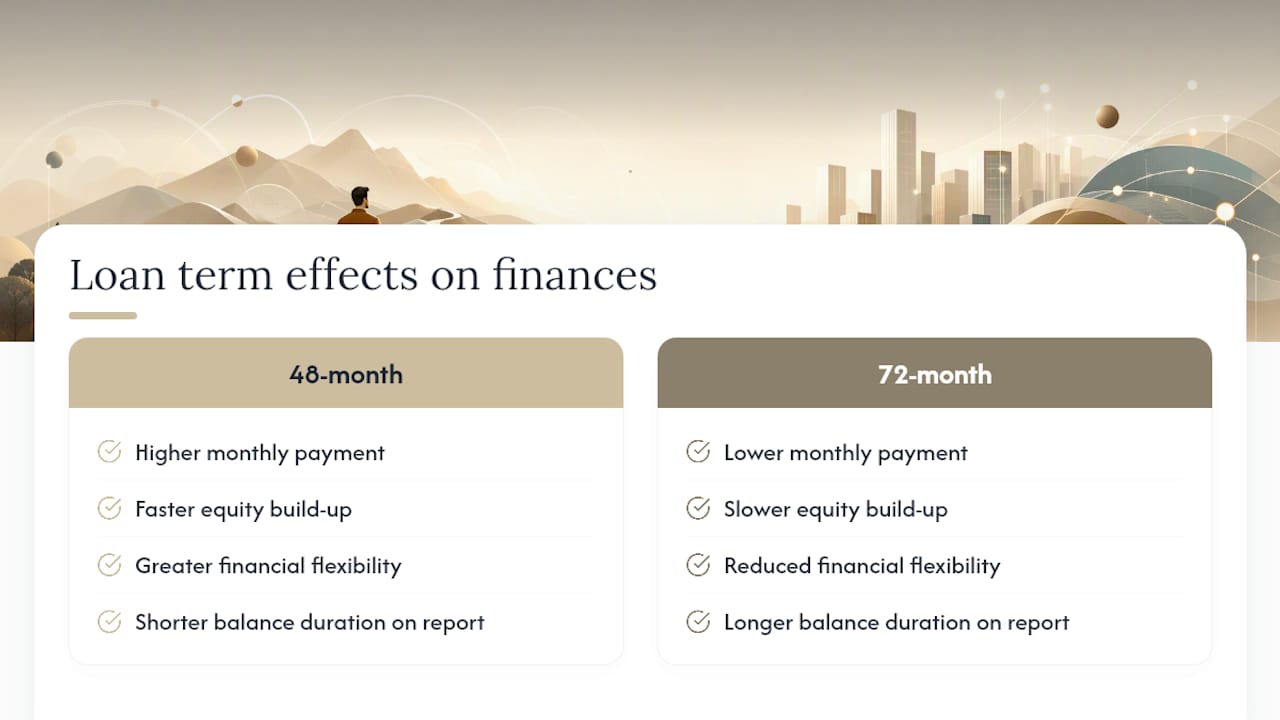
The term you choose does more than set your monthly payment. It shapes your broader financial flexibility for years. A longer loan means a longer stretch where a meaningful chunk of your income is committed before you see a dime of equity build up, which limits your ability to absorb a job change, a move, or an unexpected expense without financial strain.
Your credit score itself isn’t directly penalized for choosing a 72-month term over a 48-month one. Credit scoring models care about on-time payments and your overall credit mix, not term length specifically. But indirect effects matter: a longer loan keeps a larger balance on your credit report for longer, which can keep your credit utilization on that account higher for years, and it extends the window during which a single missed payment can do damage.
There’s also the opportunity cost. Every dollar going toward extra interest on a stretched-out loan is a dollar not going toward savings, retirement contributions, or paying down higher-interest debt like credit cards. Six years is long enough for life circumstances to shift more than once, and a car loan that felt manageable at signing can feel like a burden two years later if income drops or priorities change.
Alternatives to a 72-Month Loan Worth Considering
A 72-month term isn’t the only path to an affordable payment. A larger down payment, even an extra $2,000 to $3,000, often closes much of the payment gap between a 60-month and 72-month term while cutting total interest significantly. It’s worth running both scenarios before assuming you need the longer term.
Buying a less expensive vehicle, or a slightly older used model in strong condition, can let you stick with a 48 or 60-month term at a comparable payment. This also sidesteps the extended negative-equity risk that comes with financing a rapidly depreciating asset over six years.
Credit unions deserve a specific mention here since they often undercut both banks and dealer financing on rate alone. If your dealer’s 72-month quote feels high, a shorter term through a credit union might land at a similar payment with far less total interest.
Leasing is worth a look if you replace vehicles every three to four years and don’t want long-term ownership. It’s not right for high-mileage drivers or anyone who wants to build equity, but for the right buyer it avoids the long-term commitment question entirely. Finally, delaying the purchase by six to twelve months while you improve your credit score or save a larger down payment can shift you into a better rate tier, saving more than most negotiation tactics ever will.
Where Are 72-Month Rates Headed?
Auto loan rates move with the broader interest rate environment, and that environment has been anything but static. The Federal Reserve’s monthly G.19 data gives the clearest read on where 72-month rates actually stand, updated regularly rather than relying on stale annual estimates.
What’s clear from the trend data is that longer terms aren’t going anywhere. Experian’s analysis of loan-term patterns points to extended terms becoming more common as vehicle prices climb, since a longer term is often the only lever that keeps monthly payments within reach for the average buyer. That trend shows no sign of reversing as long as vehicle prices stay elevated relative to incomes.
Whether rates themselves drift up or down from the current 6.97% benchmark depends largely on Fed policy moves, which respond to inflation and broader economic conditions rather than anything specific to the auto market. What that means for you practically: don’t assume the rate you saw quoted three months ago still applies. Check the current FRED figure, then compare your specific offer against it, every time you shop, rather than relying on a number you remember from earlier in the year.
Author Perspective: Common Buyer Mistakes and a Quick Checklist
The most expensive mistake buyers make isn’t picking a 72-month term. It’s walking into the dealership with no benchmark, focusing only on the monthly payment, and letting the finance office set every term of the deal. Fix that by getting pre-approved first, knowing your credit tier’s rate range, and asking for the APR in writing before you sign. That’s the whole checklist, and it works.
— Baywall
Get a Personalized Rate Check Before You Sign
A national average tells you where the market sits. It doesn’t tell you whether the specific number your dealer just wrote down is fair for your credit tier, your vehicle, and your loan amount. That’s a different question, and it’s the one that actually determines how much you’ll pay.
Baywall’s analyze tool takes your credit tier, vehicle, loan amount, term, and dealer-quoted APR, then benchmarks it against real transactions from comparable buyers. You get a straightforward great, fair, or high label, a target APR to negotiate toward, and an estimate of what you’d save by hitting that target. If your dealer’s number sits in a gray zone and you want a clear answer before signing, running it through Baywall’s analyze report takes a few minutes and gives you a specific number to push for instead of a vague hunch that you’re overpaying.
Sources
The benchmark figures in this article come from the Board of Governors’ G.19 release and the matching FRED RIFLPBCIANM72NM series, both updated monthly. The FTC’s guide to financing or leasing a car covers pre-approval strategy in more depth, and Experian’s automotive report breaks down how longer terms are reshaping negative-equity risk industry-wide. For a deeper look at how credit and borrower risk shape pricing more broadly, The Root Agency’s explainer on insurance rate calculation is a useful companion read.
- Board of Governors of the Federal Reserve System — G.19 Consumer Credit
- Finance Rate on Consumer Installment Loans at Commercial Banks, New Autos 72 Month Loan (FRED)
- Financing or Leasing a Car | Consumer Advice (FTC)
- Experian automotive report on loan-term trends (2026)