5%–7% APR for 750 Credit Auto Loans in the U.S., 2026: Benchmarks and Baywall Targets

A 750 credit score puts you solidly in upper-prime territory, and that should translate to a new-car APR roughly between 5% and 7%, with used-car loans landing closer to 7% to 9%. Your exact number depends on loan term, the vehicle’s age, your down payment, and whether you finance through a credit union, bank, or the dealer’s finance office. The rest of this guide breaks down where those numbers come from and shows you how to benchmark whatever rate a dealer quotes you.
TL;DR:
- A 750 credit score typically secures auto loan rates between 5% and 7% for new cars and 6.5% to 9% for used cars, depending on loan term and vehicle age.
- Longer loan terms and used vehicles often result in higher APRs, with 72-month loans pushing rates toward the upper end of the expected range.
- Lenders such as credit unions tend to offer the lowest rates, while dealer markups can increase APRs by over a point, making preapproval essential for negotiation.
- Small differences of 0.5 to 1.5 points in APR can increase total interest payments by thousands over the life of the loan, emphasizing the importance of rate shopping.
- Benchmarking tools like Baywall help verify if dealer offers are fair by comparing specific loan details against real market data, strengthening negotiation leverage.
Table of Contents
- Current 750 Credit Auto Loan Rate Benchmarks by Term
- What Affects Auto Loan Rates Beyond Your Score
- How to Benchmark and Negotiate Your Dealer’s APR
- What a 0.5 to 1.5 Point Rate Difference Actually Costs You
- How Baywall Benchmarks Your Dealer’s Offer
- What Separates a Fair Offer From a Bad One
- Stop Guessing and Run Your Dealer’s APR Through Baywall
- Where to Verify Rates and Check a Lender
- Sources
- FAQ
Current 750 Credit Auto Loan Rate Benchmarks by Term
Your 750 credit auto loan rate should track close to the top of the prime tier, but not quite superprime pricing. Experian’s data shows the average new car loan APR for buyers with excellent credit sat at 4.41% in Q2 2026, while broader market trackers paint a wider picture across all credit tiers.
The gap between those two numbers matters. NerdWallet’s rate snapshots show average new-car rates near 7.0% and used-car rates topping 10% when you blend every credit tier together, including subprime borrowers who drag the average up. A 750 score sits well above that blended average, which is why your realistic auto loan rate 750 credit score buyers should expect skews toward the lower end of the market, not the middle.
Loan term changes your APR more than most buyers realize. Stretching a loan from 48 to 72 months often adds a modest increment in rate, on top of the extra interest you pay just from carrying the balance longer.
| Loan Term | New Car APR (750 Score) | Used Car APR (750 Score) |
|---|---|---|
| — | approximately 5% to 6% | approximately 6.5% to 9% |
| 48 months | roughly 5% to low 6% | about 6.5% to low 9% |
| 60 months | mid-5% to about 7% | low 7% to around 9% |
| 72 months | mid-5% to low 7% | mid 7% to low 9% |
A few things worth flagging before you take any single number as gospel:
- Rate trackers disagree slightly month to month because they pull from different lender panels, so treat any published average as a directional guide, not a guarantee.
- Promotional 0% APR offers do exist, but they’re manufacturer-specific, usually reserved for the shortest terms and highest credit tiers, and often require giving up cash rebates you’d otherwise get.
- Used car financing costs more across every credit tier because lenders price in faster depreciation and higher default risk on older vehicles.
- Your actual quote can beat these ranges if you have a strong relationship with a credit union or a low debt-to-income ratio.
If a dealer hands you a number well outside these bands, that’s your first signal to ask questions before you sign anything.
What Affects Auto Loan Rates Beyond Your Score
Two buyers with identical 750 scores can walk away with completely different rates. Your credit score gets you into the right neighborhood, but several other factors decide exactly where you land inside it.
Loan term and vehicle age. Shorter terms carry lower APRs because the lender’s risk window is smaller. New vehicles also price better than used ones at every term length, since a used car has already absorbed its steepest depreciation and carries more uncertainty about future value.
Down payment and loan-to-value ratio. Putting more money down reduces what you’re borrowing relative to the car’s worth, and lenders reward a lower loan-to-value ratio with a better rate. Vehicle condition and mileage matter too. A used car with 80,000 miles is a different risk profile than one with 20,000, even if the sale price is similar.
Debt-to-income ratio and credit history depth. Lenders look past your score to your monthly obligations. A high DTI can push your quoted APR up even with excellent credit, and a flurry of recent credit inquiries from other loan applications can nudge it further.
Lender type. This is the one most buyers underestimate.
- Credit unions typically post the lowest buy rates because they operate on thinner margins and often prioritize member relationships over profit spreads.
- Banks generally sit in the middle, competitive but rarely the cheapest option.
- Captive finance arms (Toyota Financial, Ford Credit, and similar) can beat everyone on promotional terms but often mark up their standard rates.
- Dealer finance offices frequently add a markup on top of whatever buy rate the lender actually offered them, which is legal but negotiable.
The bigger economic picture. Federal Reserve policy shapes the baseline cost of money for every lender, which is part of why advertised rates shift over the course of a year even for borrowers whose credit profile hasn’t changed at all.
How to Benchmark and Negotiate Your Dealer’s APR
Most buyers accept the first number a finance manager writes down. You don’t have to, and with a 750 score, you have real leverage to push back.
- Get the dealer’s offer in writing. Ask for the exact APR, loan term, and every fee attached to the deal before you agree to anything. A verbal quote can shift once you’re at the signing table.
- Get preapproved outside the dealership. Apply with a credit union or bank before you shop for the car. This gives you a real outside offer to compare against, not just a hypothetical.
- Compare like-for-like terms. Match term length, fees, and any add-ons across offers before you calculate a monthly payment. A lower payment on a longer term can hide a worse APR.
- Shop multiple lenders within a short window. Credit scoring models group auto loan inquiries made within a 14 to 45-day window (depending on the model) as a single inquiry, so applying to several lenders in that window has minimal impact on your score.
Before you sit down to negotiate, build yourself a short checklist:
- Ask for the buy rate, the actual rate the lender offered the dealer, not the marked-up “sell rate” they hope you’ll accept.
- Decline add-ons like extended warranties or gap insurance in the initial financing conversation. You can always add them later, and bundling them upfront muddies your rate comparison.
- Request a full written financing breakdown, showing principal, APR, term, and total finance charges, before you sign.
Pro Tip: Bring a printed preapproval offer or a rate benchmark report with you and negotiate the buy rate itself, not the monthly payment. Dealers can make almost any rate look reasonable by stretching the term, so anchor the conversation on the percentage, not the dollar figure on the payment line.
Once you’ve done this, you’re not hoping the dealer treats you fairly. You’re negotiating from a position where you already know what fair looks like.
What a 0.5 to 1.5 Point Rate Difference Actually Costs You
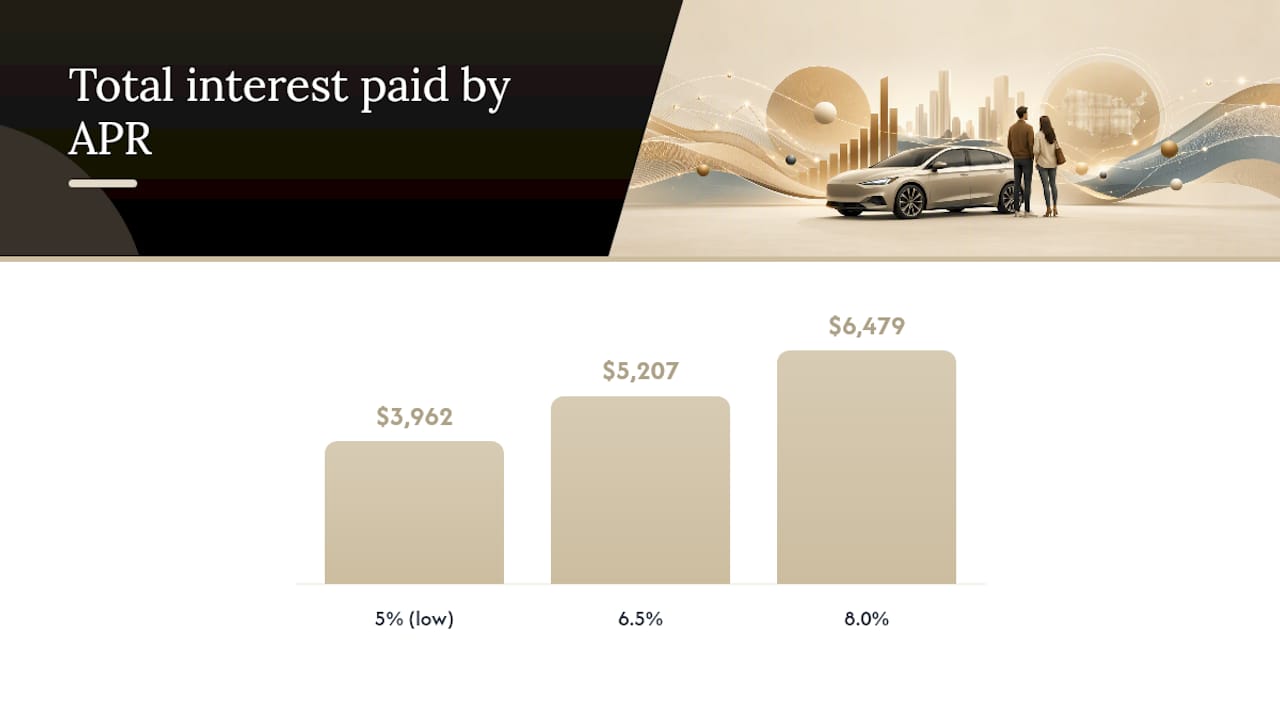
Small APR differences sound trivial until you see them in dollars. Here’s what a $30,000 loan looks like at three different rates within the realistic 750-score range, on a 60-month term.
| APR | Monthly Payment | Total Interest Paid |
|---|---|---|
| low 5% | $566 | $3,962 |
| 6.5% | $587 | $5,207 |
| 8.0% | $608 | $6,479 |
That 3-point spread between the low and high end costs you $42 a month and roughly $2,500 over the life of the loan. Run the same math on a $40,000 loan over 48 months and the total interest gap between 5.5% and 7.5% climbs past $1,700, money that buys nothing but the lender’s margin.
Smaller gaps matter too. Moving from 6.5% to 7.0% on a $20,000 loan over 48 months adds roughly $200 in total interest, not a fortune, but not nothing either, especially when the only thing separating those two numbers is whether you negotiated or accepted the first offer. A calculator like the PsyFi loan calculator lets you plug in your own numbers and see the exact dollar impact before you commit to any deal.
How Baywall Benchmarks Your Dealer’s Offer
Published rate tables tell you what buyers with your credit score are getting on average. They don’t tell you whether the specific number on your paperwork is fair for your specific car, term, and location. That’s the gap Baywall fills.
You enter your credit score, the vehicle, loan amount, term, and the APR your dealer quoted. Baywall compares that offer against aggregated transaction data from buyers in a similar credit tier financing similar vehicles, then provides a straightforward verdict with a label, a target APR to use as a negotiating anchor, estimated potential dollar savings, and current market pricing on comparable vehicles.
Baywall operates as a benchmarking service and does not originate loans. Reports generate instantly, and user information is not sold or shared with dealers or lenders.
What Separates a Fair Offer From a Bad One
A fair auto loan rate for a 750 credit score usually sits within half a point of the benchmark for your term and vehicle type, coming from a lender you can verify through NMLS Consumer Access. If a dealer’s quote runs more than a point above that, especially paired with vague fees or pressure to skip reading the contract, that’s a red flag worth walking away from.
Preapproval changes the entire negotiation before it starts. Walk in with an outside number, and the dealer’s finance office is competing against a real offer instead of guessing what you’ll accept.
— Baywall
Stop Guessing and Run Your Dealer’s APR Through Baywall
Baywall exists because published rate tables can’t tell you if your specific dealer offer is fair, and dealer finance managers count on that gap. Enter your credit score, loan amount, term, and the vehicle, and Baywall’s analyze tool compares your offer against real transactions from buyers in your credit tier, then hands you a clear verdict: great, fair, or high, along with a target APR and your estimated dollar savings.
The report generates in minutes, which matters when you’re sitting in a finance office or weighing an offer before you sign. Baywall offers a free basic version to get you started, plus a one-time $2.99 detailed report if you want the full negotiation breakdown for one specific deal. Run your numbers before you sign, and you’ll know exactly what to say if the finance manager pushes back.
Where to Verify Rates and Check a Lender
Cross-check any number you’re given against a second source before you sign.
- Experian’s credit-score rate tables for the most recent published averages by tier.
- The FTC’s consumer guidance on reviewing loan terms and spotting unfair lending practices.
- NMLS Consumer Access to confirm a lender is properly licensed before signing.
- The PsyFi loan calculator to test payment and interest scenarios on your own.
Sources
- Average Car Loan Interest Rates by Credit Score
- Average Car Loan Interest Rates by Credit Score
- Consumer
- NMLS Consumer Access
FAQ
What is a good interest rate for a car with a 750 credit score?
A good new-car rate for a 750 score generally falls between 5% and 6.5% on a standard 60-month term, with used-car loans running roughly 1.5 to 2 points higher. Rates above that range, without a clear reason like a long term or low down payment, suggest the dealer built in extra markup worth negotiating down.
Can I get an auto loan with a 750 credit score?
Yes, a 750 score qualifies you for prime to near-superprime pricing at nearly every bank, credit union, and dealer finance program. Some lenders set their top tier cutoff at 760, so shopping more than one lender can surface a better rate than sticking with just one application.
Is it possible to get a 3% interest rate on a car?
Rates that low are rare outside of manufacturer promotional financing, which typically requires a shorter loan term, the highest credit tier, and often means giving up a cash rebate. For most 750-score buyers, current market averages sit well above 3%, so treat any offer that low as a promotional exception rather than the standard rate to expect.
Can I get a 1.9% interest rate on a car loan?
Rates near 1.9% almost always come from limited-time manufacturer incentives on specific models, not standard bank or credit union financing. If a dealer offers this rate, confirm whether it requires waiving a cash rebate, since the math sometimes favors taking the rebate and financing at a slightly higher standard rate instead.