Pay $5,300 More: 84‑Month Loans and How U.S. Buyers Benchmark Dealer APRs

Expect advertised 84-month APRs to vary by credit tier, with credit unions typically posting the lowest “as low as” rates. The trade-off is real: a lower monthly payment now, but more total interest and a longer stretch of owing more than the car is worth. Before you sign anything, benchmark the dealer’s quoted APR against what buyers with your credit profile actually pay.
TL;DR:
- Borrowers with excellent credit may qualify for APRs as low as 3.39%, but lower credit scores often lead to higher rates that significantly increase total interest costs.
- Extending a loan from 60 to 84 months can add around $5,300 in interest for the same principal and often results in borrowers owing more than their car’s value for most of the loan term.
- Credit unions offer the most competitive ‘as low as’ rates for 84-month loans, but eligibility requirements and loan caps can limit access for some borrowers.
- Your APR depends mainly on your credit score, vehicle age, down payment, and whether you have a co-signer, with refinancing possible after 12-18 months to lower total interest.
- Using tools like Baywall can help you determine whether a dealer’s rate is fair for your credit profile and vehicle, potentially saving hundreds in interest.
Table of Contents
- Current 84-Month Auto Loan Rates and What They Cost You
- Which Lenders Offer 84-Month Auto Loans?
- What Determines Your 84-Month APR?
- How Much More Does an 84-Month Loan Really Cost?
- How to Evaluate a Dealer’s 84-Month Offer
- How Baywall Benchmarks Your 84-Month Offer
- Why We’re Cautious About 84-Month Loans in 2026
- Check Your Dealer’s Offer Before You Sign
- Sources
Current 84-Month Auto Loan Rates and What They Cost You
Advertised rates vary sharply by credit tier, and the gap between “as low as” and what most buyers actually qualify for is wider than most dealers let on. Borrowers with excellent credit often see the lowest rates, while those with lower scores encounter higher rates when 84-month terms are offered.
State Farm Federal Credit Union publishes 84-month APRs starting around 4.49% along with payment-per-$1,000 figures, which is the clearest way to translate an abstract rate into a real number. Monthly payments per $1,000 borrowed increase with the APR over 84 months, illustrating how interest rates affect payment size.
Here’s how that plays out on a $30,000 loan:
A $30,000 loan at 5.99% costs about $2,000 more in total interest over 84 months than the same rate would cost over 60 months. That’s the real price of the lower payment, and it’s before you factor in that longer terms often carry higher APRs to begin with, not the same rate as shorter ones. Rates above are illustrative examples as of early 2026 and will shift with market conditions and individual lender pricing.
Which Lenders Offer 84-Month Auto Loans?
Not every lender offers seven-year terms, and the ones that do attach real strings. Three types of lenders dominate this space:
- Credit unions generally post the most competitive “as low as” rates but require membership, and that membership can come with its own eligibility hoops.
- National and regional banks offer 84-month terms less consistently and often reserve them for prime and super-prime borrowers.
- Dealer indirect/captive lenders will arrange 84-month financing but frequently mark up the rate above what the underlying lender would offer you directly.
PenFed Credit Union advertises 84-month rates starting at 3.39% APR, but caps come with it: a minimum loan amount of $20,000 applies to 73 to 84 month terms. Navy Federal Credit Union publishes similar “as low as” tables for 73 to 84 month terms and discloses mileage and loan-size restrictions that limit which vehicles qualify. That “as low as” language matters: it describes the rate available only to the strongest applicants, not a typical outcome. If you’re weighing credit unions against dealer financing, comparing credit union auto loan options directly against your dealer’s number is worth the ten minutes it takes.
What Determines Your 84-Month APR?
Your APR isn’t handed down arbitrarily. It’s built from a handful of factors, some you control and some you don’t.
- Credit score does the heaviest lifting. Moving from the fair tier into the good tier can shave a percentage point or more off your quote, which on an 84-month term compounds into real savings.
- New versus used matters because used vehicles carry more risk for the lender and usually see higher rates; some lenders also cap mileage or model year for extended terms specifically because older, higher-mileage cars depreciate faster than the loan pays down.
- Down payment and loan-to-value ratio shift your rate directly. A larger down payment lowers the amount financed relative to the car’s value, and lenders reward that lower LTV with a better APR, sometimes with a minimum LTV required to even access a 73 to 84 month term.
- Co-signers can help borrowers in the fair or poor tiers access lower rates, though the co-signer takes on equal liability for the debt.
Pro Tip: Refinancing an 84-month loan after 12 to 18 months, once your credit improves or rates drop, can meaningfully cut your total interest without giving up the payment size that made the loan affordable in the first place.
Reviewing how credit tiers map to APR bands before you shop gives you a realistic target instead of a guess.
How Much More Does an 84-Month Loan Really Cost?
The monthly payment looks friendlier. The total cost usually isn’t. Lenders charge higher rates on longer terms because the extended timeline raises their risk, so you’re often paying a higher APR and stretching it over more months, a double hit to total interest.
That’s roughly $5,300 more in interest between the 48-month and 84-month options, on the identical loan amount. Switching from 48 to 84 months can raise total interest by several thousand dollars even at a flat APR, and the real-world gap is usually larger because 84-month rates run higher.
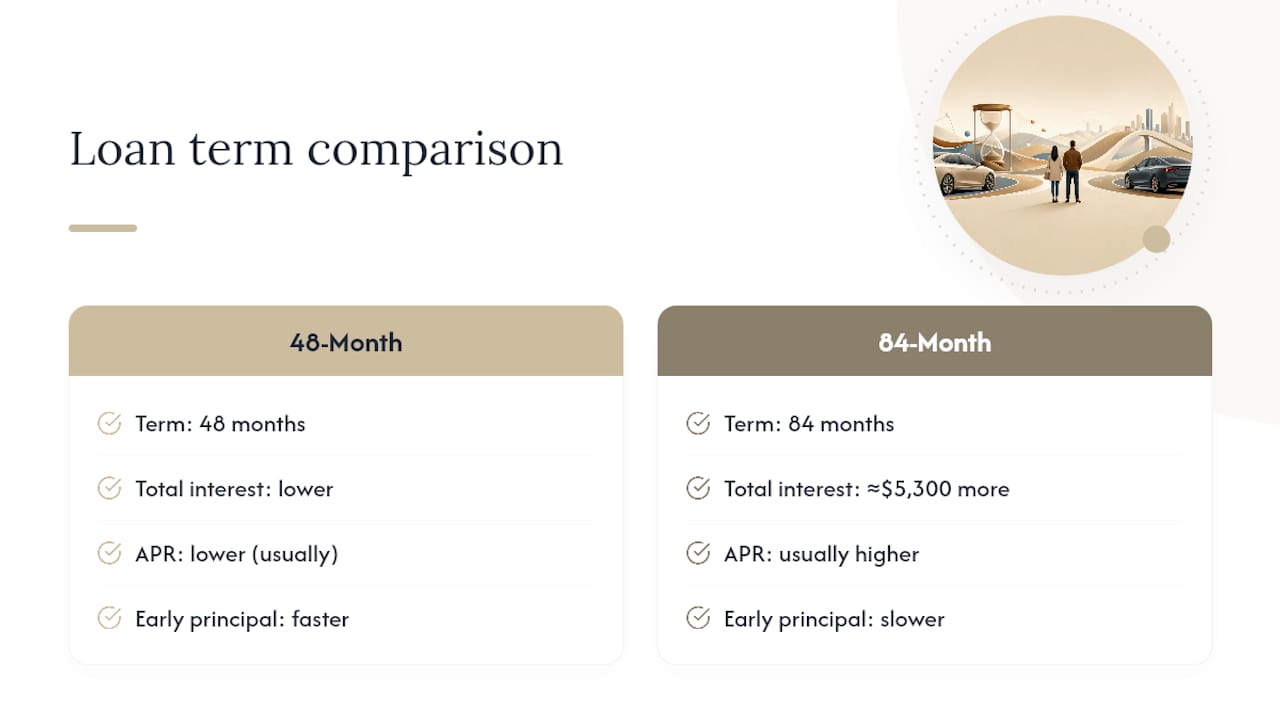
The depreciation problem compounds this. A new car can lose 20% of its value in year one alone, while your loan balance drops slowly in the early years because so much of each payment goes to interest. Consumer Reports warns that this combination leaves many 84-month borrowers underwater, owing more than the car’s worth, for most of the loan term. An 84-month loan can still make sense if you land a genuinely low promotional APR, put down 20% or more, and plan to keep the vehicle well past the loan’s end date.
How to Evaluate a Dealer’s 84-Month Offer
Walking into the finance office with a checklist changes the entire negotiation. Get these numbers in writing before you sign:
- The exact APR, not just the monthly payment the finance manager leads with.
- The total finance charge over the full loan term, in dollars.
- Every fee attached to the loan, itemized separately from the vehicle price.
- The full amortization or payoff schedule, showing how the balance declines.
- Your loan-to-value ratio based on the agreed vehicle price.
Compare that APR against real benchmarks for your credit tier and vehicle type, then aim to negotiate the rate down, not just the payment. If the offer sits a point or more above what comparable borrowers are getting, say so directly and ask them to match it or explain the gap.
Watch for red flags: a finance manager who only discusses monthly payment, fees that appear without explanation, or “mandatory” add on packages bundled into the loan amount. Those are signs to slow down or walk.
Pro Tip: Say this exact line: “I have a benchmark APR for my credit tier and this offer is above it. Can you match it, or do I need to look elsewhere?” It puts the burden on them to justify the number.
How Baywall Benchmarks Your 84-Month Offer
You already know the APR range for your credit tier from lender rate tables. What you don’t know standing at the dealership is where your specific offer falls within that range, and that’s the gap Baywall closes.
Enter your credit score, the vehicle, loan amount, term, and location, along with the APR the dealer quoted. Baywall compares it against real transactions from buyers in the same credit tier, financing similar vehicles, and returns a target APR, a plain “great,” “fair,” or “high” label, and an estimated dollar savings if the rate gets negotiated down.
- No guessing whether 6.5% is a fair number for your situation or a markup.
- A concrete target rate to name out loud in the finance office.
- A savings figure that shows exactly what’s at stake over the loan term.
The realistic outcome isn’t always a rock-bottom rate. It’s walking in knowing precisely what “fair” looks like for someone with your profile.
Why We’re Cautious About 84-Month Loans in 2026
The math on 84-month loans hasn’t changed just because they’re more common. You’re trading a smaller monthly number for a longer window of owing more interest and, often, more than the car is worth. That trade only makes sense at a genuinely low APR paired with a real down payment. Before you sign, run the numbers, not just the payment.
— Baywall
Check Your Dealer’s Offer Before You Sign
Baywall exists for the moment right before you sign the paperwork, when the finance manager quotes an APR and you have no way to know if it’s fair. Run your dealer’s quoted rate through a Baywall analysis and you’ll get a target APR based on real transactions from buyers with your credit tier and vehicle, plus an estimated dollar figure showing what a better rate would actually save you over 84 months.
The report takes minutes: enter your credit score, the vehicle, loan amount, term, and the rate you were quoted. You’ll see whether that offer is great, fair, or high, and exactly what number to push for instead. If you’re staring down a seven-year loan and want to know if 7% is reasonable or a markup, analyze your offer with Baywall before you sign anything.
This article is general information, not a substitute for advice from a qualified financial advisor. Consult a qualified financial professional about your own circumstances before acting on anything here.
Sources
- Don’t rush into an 84-month car loan — Consumer Reports
- Auto Loan Rates for New & Used Cars — Navy Federal Credit Union