$2,000–$4,000 at Stake: Is a 9% Car Loan Worth It for U.S. Buyers

A 9% APR is high for a superprime or prime buyer but roughly average for someone in the nonprime tier, especially on a used car. The right move isn’t to panic or sign blindly. Run the payment numbers for your exact loan size and term, then compare your quote against real benchmarks for your credit tier before you commit.
TL;DR:
- A 9% APR is typical for nonprime borrowers but generally high for prime and superprime credit tiers, especially on new cars.
- Longer loan terms, such as 72 months on a $30,000 vehicle, can lower monthly payments but increase total interest by over $3,000.
- The dealer’s markup, or buy rate, significantly influences your final APR and can often be reduced by asking for the lender’s base rate before add-ons.
- Benchmarking your specific loan details against real-world data can reveal $2,000 to $4,000 in unnecessary interest charges on a typical loan.
- Preapproval from banks or credit unions and running your numbers through dedicated tools can help negotiate a fairer rate before signing.
Table of Contents
- Is 9 APR Car Loan Rate High? Benchmarks By Credit Score And Vehicle Type
- What A 9% APR Auto Loan Actually Costs You
- What Drives A Quoted 9% APR
- Why APR Beats The Advertised Interest Rate For Comparing Offers
- How To Shop And Negotiate If You’re Quoted 9%
- What Benchmarking A Dealer’s APR Actually Reveals
- When 9% Makes Sense And When To Walk
- Benchmark Your Rate Before You Sign Anything
- Sources
- FAQ
Is 9 APR Car Loan Rate High? Benchmarks By Credit Score And Vehicle Type
Whether 9% is a good deal depends almost entirely on where you sit on the credit spectrum, not on some universal cutoff. Experian’s Q1 2026 automotive finance data breaks average APRs down by credit-score band, and the spread is wide:
- Superprime (781-850): around 4.55% for new cars, 6.30% for used
- Prime (661-780): meaningfully higher than superprime, but still well under 9% on most new-car loans
- Nonprime (601-660): new-car APRs average around 9.67%, putting a 9% offer right in the expected range
- Subprime (below 600): rates climb well past 9% on both new and used vehicles
If you have superprime or prime credit and you’re being quoted 9%, that’s a red flag, not a market rate. If your credit sits in the nonprime band, 9% is close to typical, and used-car loans tend to run higher than new-car loans across every tier because lenders view older, lower-value collateral as riskier. Market averages also shift monthly. Edmunds has tracked new-car APRs near 7% and used-car APRs above 10% in recent readings, so checking a current benchmark matters more than memorizing a fixed number.
What A 9% APR Auto Loan Actually Costs You
Percentages are abstract. Dollars are not. Here’s what 9% APR looks like across common loan amounts and terms, using standard amortization math:
These figures align with the worked examples NerdWallet uses to illustrate how APR translates into real payments, and you can plug in your own numbers with Bankrate’s auto loan calculator to double-check any quote a dealer hands you.
Notice the pattern on the $30,000 loan: stretching from 48 to 72 months drops the monthly payment by $207, but it adds over $3,000 in total interest. Longer terms feel more affordable month to month, but you’re financing the same amount for longer, so more of every payment goes to interest before it touches principal. Now compare a 1 to 2 percentage-point swing on that same $30,000, 60-month loan. That gap is real money you could put toward a down payment on your next car, or, as our 7% APR breakdown shows in more detail, toward almost anything else you’d rather spend it on.
What Drives A Quoted 9% APR
Your APR isn’t pulled from a single chart. It’s built from several factors that stack on top of each other, and understanding which ones you can influence is where the negotiation leverage actually lives.
- Credit score: the single biggest lever. Moving from nonprime to prime can shave several points off your rate before you even start negotiating.
- New vs. used: used vehicles carry higher APRs because the loan-to-value ratio is riskier for the lender, and depreciation has already eaten into the collateral’s worth.
- Loan term: longer terms sometimes carry a slightly higher rate on top of the added interest cost from time alone.
- Dealer markup: dealers often add a margin on top of the lender’s actual approved rate, known as the buy rate, before presenting you with a “contract rate.”
- Fees: origination charges and mandatory add-ons get folded into your final cost, even when they don’t show up as a separate line item on the sticker.
That dealer markup point deserves its own spotlight, because it’s the one factor most buyers never think to question.
Pro Tip: Ask the finance manager directly, “What’s the buy rate from the lender before your markup?” Dealers are legally allowed to add a margin, but naming the buy rate specifically tends to shrink that markup fast because it signals you already know how the pricing works.
Why APR Beats The Advertised Interest Rate For Comparing Offers
The interest rate and the APR are not the same number, and mixing them up is how buyers accidentally accept a worse deal than they think they’re getting. The interest rate only reflects the cost of borrowing the principal. APR wraps in mandatory fees, like origination charges, on top of that rate, giving you the true annual cost of the loan, as Discover’s APR explainer lays out clearly.
Here’s a quick example. The rate sounds better on paper; the APR tells you what you’re actually paying.
Before signing anything, ask the lender or dealer for:
- The exact APR in writing, not just the interest rate
- A full breakdown of every fee rolled into that APR
- Confirmation of whether the APR quote assumes any add-ons, like GAP coverage, that you can decline
Our APR vs. interest rate guide walks through more scenarios where the gap between the two numbers gets wider than most buyers expect.
How To Shop And Negotiate If You’re Quoted 9%
Getting a fair rate starts before you ever walk into a dealership finance office, and it ends with knowing exactly when to push back and when to sign.
- Check your actual credit score through your bank or a free monitoring service, not the dealer’s version, which sometimes uses a different scoring model.
- Run the payment calculator on your specific loan amount and term so you know your real monthly number before you negotiate anything.
- Get preapproved from a bank or credit union first. A preapproval gives you a comparison rate and, more importantly, leverage in the finance office.
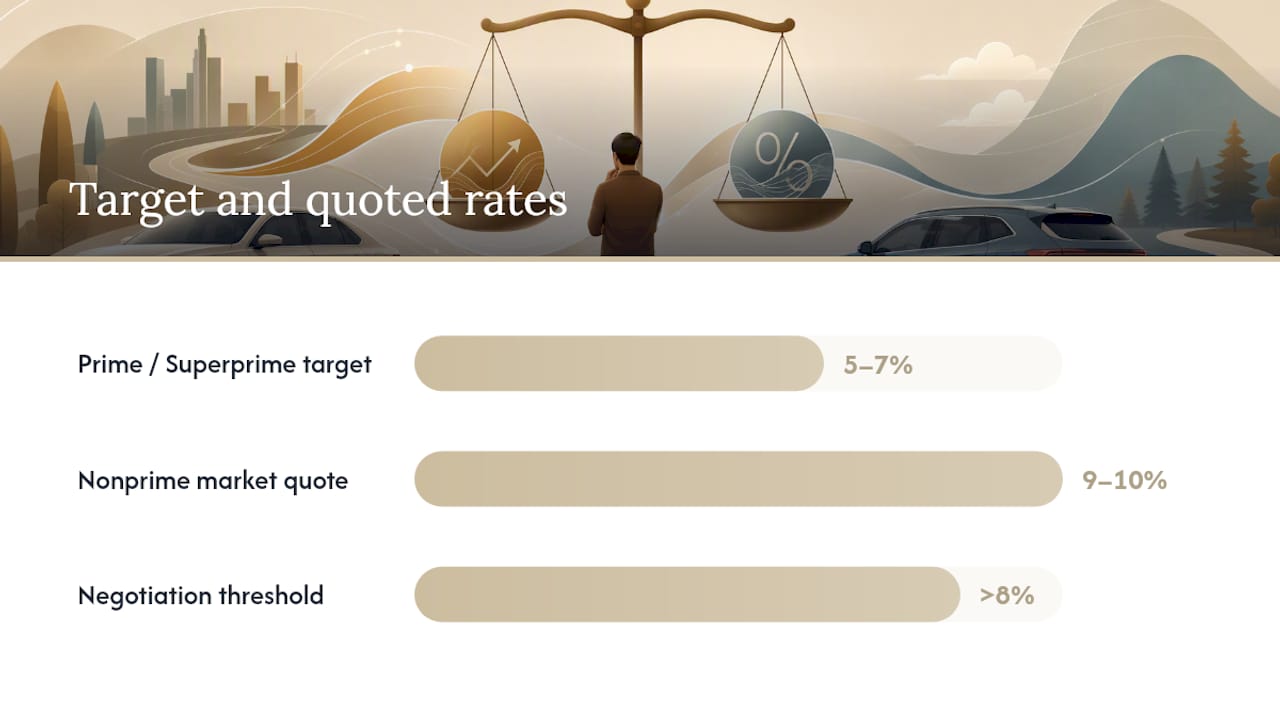
- Compare your quote to your credit tier’s benchmark. Nonprime borrowers seeing 9% to 10% are near market. Prime or superprime borrowers should be targeting rates closer to 5% to 7%.
- Ask for the buy rate explicitly. If the dealer won’t share it, that’s a signal the markup is worth pushing on.
Pro Tip: If you’re financing a used car and your credit sits in the prime tier or above, treat anything over 8% as a starting offer to negotiate down, not a final number.
Refinancing after purchase can help if your credit improves or if the original loan carried an inflated dealer markup you didn’t catch at signing. It’s a weaker fix if you’re already underwater on the loan or if rates have risen since you bought, so understanding when a lower rate actually helps before assuming refinancing will bail you out is worth the ten minutes it takes.
What Benchmarking A Dealer’s APR Actually Reveals
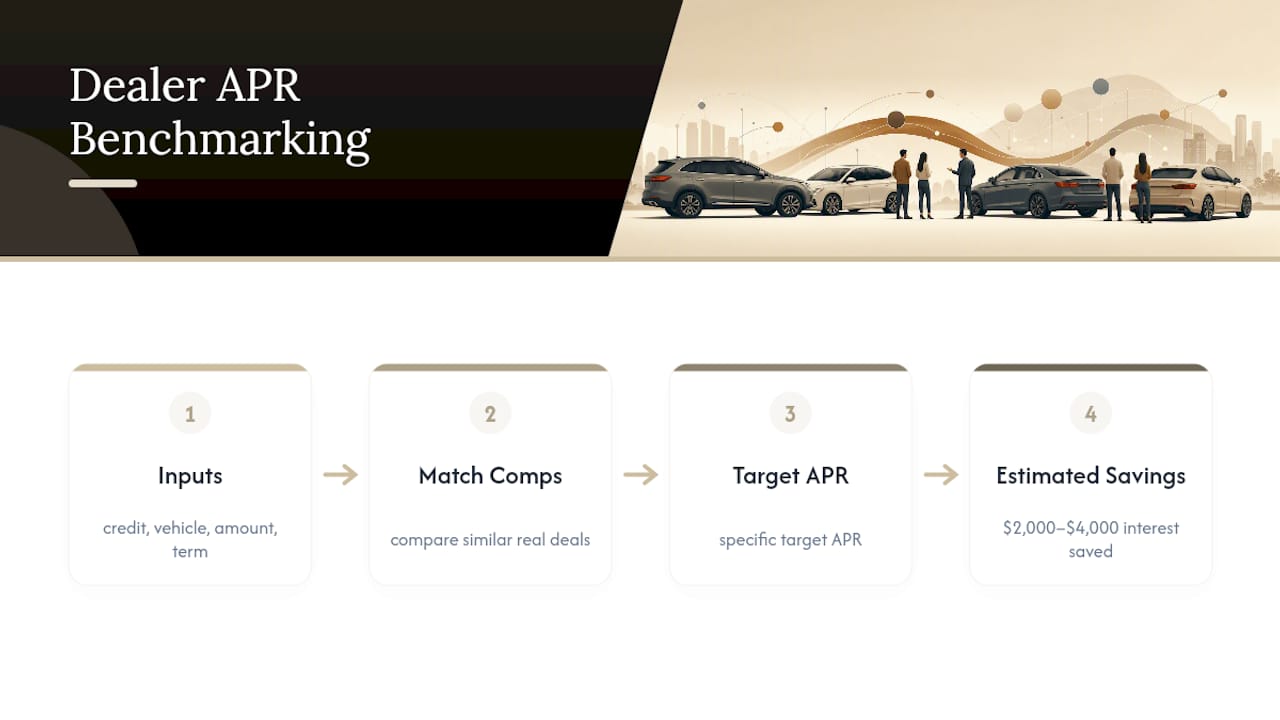
Baywall’s own analysis of comparable loan transactions found that benchmarking a dealer’s quoted APR against real deals from buyers with similar credit, loan size, and vehicle type can uncover $2,000 to $4,000 in unnecessary interest on a typical loan. The process works by comparing your exact inputs, credit score, vehicle, loan amount, and term, against what people in your same tier actually paid, then producing a specific target APR instead of a vague “ask for less.” Walking into a finance office with a number and a dollar figure tends to get a very different response than walking in with a feeling that the rate seems high.
When 9% Makes Sense And When To Walk
Either way, run your numbers and check your benchmark before you sign anything.
— Baywall
Benchmark Your Rate Before You Sign Anything
The tool gives users information beyond a dealer quote by showing what buyers with similar credit tier, vehicle, and loan size actually paid. By entering credit score, loan amount, term, and the quoted APR, users receive a label indicating the offer’s competitiveness along with a target rate for negotiation and an estimated potential savings.
Running a report costs $2.99 as a one-time analysis, or you can subscribe weekly for $8.99 if you’re shopping across multiple vehicles or helping family members compare offers. Either way, the report gives you a number to hand the finance manager instead of a hunch. Before you sign a contract at 9% or anything close to it, run your offer through Baywall’s analyzer and see whether that rate is actually competitive for your situation.
This article is general information, not a substitute for advice from a qualified financial advisor. Consult a qualified financial professional about your own circumstances before acting on anything here.
Sources
- Experian Automotive finance market data (Q1 2026)
- NerdWallet — auto loans for good, fair and bad credit
FAQ
Is 9% APR High For A Car Loan?
It depends on your credit tier. For nonprime borrowers, Experian’s data shows average new-car APRs near 9.67%, making a 9% offer close to typical.
Is 9.9% APR Good For A Loan?
Consumer finance guides like WalletHub suggest aiming below 10% when possible, with lower rates considered strong long-term outcomes for well-qualified borrowers.
Which Bank Gives 7% Interest On A Car Loan?
Prime credit borrowers are the ones most likely to see offers near 7%, based on recent Edmunds market averages, and getting preapproved from multiple banks or credit unions is the most reliable way to find your actual rate.
How Do I Know If My 9% Quote Is Fair?
Compare it against your specific credit tier, vehicle type, and loan term rather than a single national average. Baywall’s benchmarking tool checks your exact inputs against comparable transactions and returns a target APR along with an estimated dollar savings if the quote runs high.