APR vs Interest Rate on Car Loans: 2026 Buyer’s Guide

What’s the real difference between APR and interest rate on a car loan?
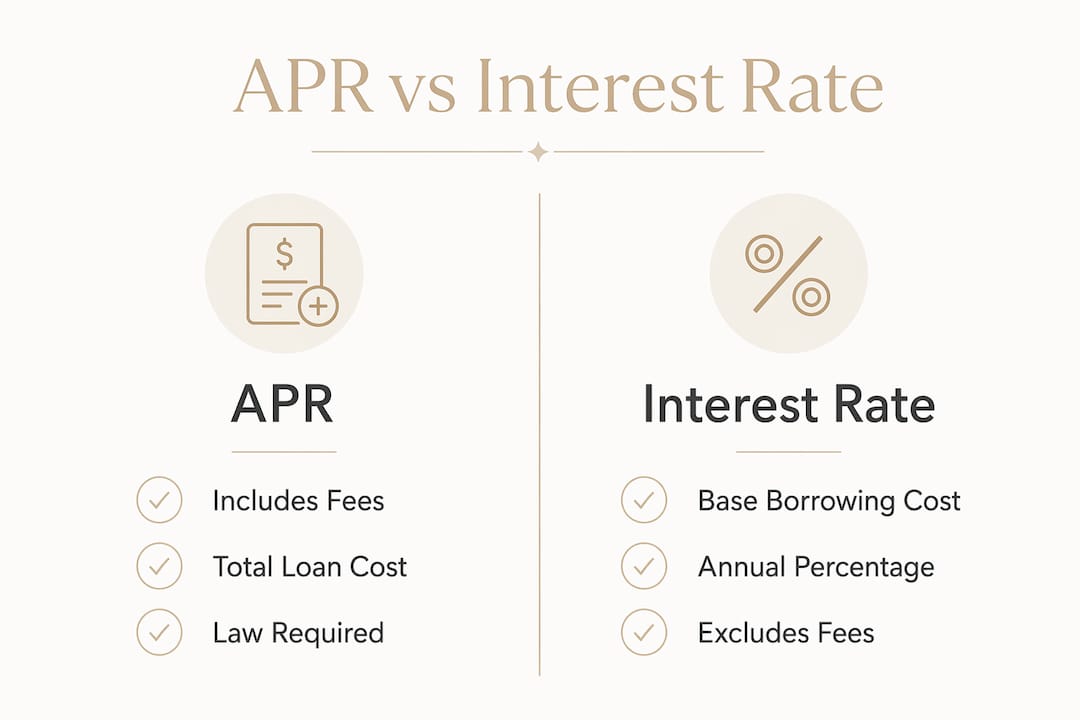
The interest rate is the base cost of borrowing the loan principal, expressed as an annual percentage. APR, or annual percentage rate, goes further: it wraps the interest rate together with lender fees like origination and processing charges into a single number. As the Consumer Financial Protection Bureau explains, APR is the interest rate plus any additional fees charged by the lender.
That distinction matters most when you’re sitting across from a dealer. Two loans can carry the same interest rate but very different fee structures, making the APR the only reliable number for a true side-by-side comparison. If a loan has no fees at all, APR and interest rate are identical. Every fee added pushes APR above the interest rate.
Key differences at a glance:
- Interest rate reflects only the cost of borrowing the principal
- APR includes interest plus origination, underwriting, and processing fees
- APR is almost always higher than the interest rate on car loans
- Monthly payment calculations are driven by the interest rate, not the APR
- APR is the standard tool for comparing total loan cost across lenders
Table of Contents
- What the law requires lenders to tell you before you sign
- How to use APR and interest rate to compare and negotiate your car loan
- How Baywall benchmarks your APR so you negotiate from strength
- Common misconceptions about APR that cost car buyers money
- Key Takeaways
What the law requires lenders to tell you before you sign
Federal law gives you real protection here. The Truth in Lending Act requires lenders to disclose APR in writing before you finalize any car loan. That standardized disclosure is what makes it possible to compare offers from a dealership, a credit union, and an online lender on equal footing, even when their fee structures differ.
The disclosure must appear in writing and cover all fees the lender charges. Lenders who are vague about which fees are bundled into the APR may be obscuring the true cost of the loan.
Legal disclosure highlights for car buyers:
- APR must be disclosed in writing before loan finalization
- The disclosure must include all lender-charged fees
- Standardized format allows apples-to-apples comparison across lenders
- Both the interest rate and APR must appear in the loan documents
How to use APR and interest rate to compare and negotiate your car loan
Your monthly payment is calculated from the interest rate on the principal. APR tells you what the loan actually costs over its full life. The CFPB notes that negotiating a lower interest rate directly reduces your monthly cash flow burden, while comparing APRs prevents you from overpaying on hidden fees.

Loan term length changes the equation. Fees spread across a longer term shrink the APR’s apparent impact, but you pay more total interest. A 72-month loan may look cheaper by APR than a 48-month offer, yet cost you significantly more by the time you’re done. Always compare loan terms alongside APR, not instead of it.
Pro Tip: Ask every lender for an itemized list of fees included in the APR before you negotiate. If a dealer hesitates, that hesitation tells you something. Knowing exactly which fees are bundled gives you specific line items to push back on, rather than arguing against a single opaque number.
Steps to compare and negotiate using both rates:
- Get every offer expressed as an APR, not just an interest rate
- Request an itemized fee breakdown from each lender
- Compare total dollar cost over the full loan term, not just monthly payments
- Use the interest rate to model monthly affordability
- Challenge high APR components by naming specific fees
- Factor loan term length into every comparison
How Baywall benchmarks your APR so you negotiate from strength
Knowing the APR definition is one thing. Knowing whether your APR is fair for your credit score, vehicle, loan amount, and term is another. That’s exactly what Baywall is built to answer.
You enter your credit score, vehicle details, loan amount, loan term, and the dealer’s quoted rate. Baywall benchmarks that offer against verified data from comparable transactions — same credit tier, same loan type, similar vehicle — and tells you whether the offer is great, fair, or high. The output isn’t a generic market average. It’s a personalized target APR to negotiate toward, plus a dollar estimate of what a better rate would save you.
Pro Tip: Generic rate quotes from a quick internet search won’t hold up in a dealer negotiation. A personalized benchmark tied to your exact credit profile and vehicle gives you a specific number to cite, which changes the conversation entirely.
What Baywall delivers for car loan shoppers:
- Benchmarks your dealer’s APR against real comparable transactions
- Labels your offer as great, fair, or high for your specific profile
- Provides a target APR to negotiate toward
- Calculates your potential dollar savings from a better rate
- Includes comparable vehicle pricing to strengthen your position
- Delivers results instantly via a paid report for $2.99
Run your APR analysis before you sign anything.
Common misconceptions about APR that cost car buyers money
The most expensive mistake is assuming a lower APR automatically means a better deal. Experian warns that different lenders bundle different fees into APR, so a lower percentage can mask higher hidden costs. Always confirm what’s included before drawing conclusions.
APR and APY are also frequently confused. APY, or annual percentage yield, measures earnings on savings accounts and factors in compounding interest. APR, as Fidelity clarifies, relates to the cost of credit and is standardized by federal law for loan comparisons. For a car loan, APY is irrelevant. Focus on APR.
Used car loans carry additional complexity. Fees on used vehicles can be higher, and some lenders apply different rate structures than they do for new cars. Comparing APRs across new and used loan offers without accounting for those structural differences leads to flawed conclusions.
Pitfalls to avoid:
- Confusing APR with APY — they measure entirely different things
- Assuming a lower APR always means lower total cost without checking fees
- Accepting a vague APR figure without an itemized fee breakdown
- Ignoring loan term differences when comparing APRs across offers
- Treating new and used car loan APRs as directly comparable without adjustment
Key Takeaways
APR is the only reliable number for comparing total car loan costs because it includes both the interest rate and lender fees, while the interest rate alone determines your monthly payment.
| Point | Details |
|---|---|
| APR vs. interest rate | APR includes fees; interest rate covers only the cost of borrowing the principal. |
| Federal disclosure law | The Truth in Lending Act requires written APR disclosure before any car loan is finalized. |
| Monthly payment driver | Your monthly payment is calculated from the interest rate, not the APR. |
| Loan term matters | Longer terms reduce APR’s apparent impact but increase total interest paid over time. |
| Benchmark before signing | Baywall compares your dealer’s APR to real comparable transactions so you negotiate with a specific target. |