How Simple Interest Works on Your Auto Loan

A simple-interest auto loan charges interest only on the outstanding principal balance, typically calculated daily, so every payment you make reduces what future interest is calculated against. Most U.S. auto loans use this method, and understanding it gives you real leverage at the negotiating table.
Three things to know before you read further:
- Payment timing matters. Pay a day early and slightly less interest has accrued; pay a day late and you owe more, with less of that payment going toward principal.
- Extra payments work in your favor. On a simple-interest car loan, any amount above the scheduled payment that goes to principal shrinks the balance interest is calculated on.
- Check the contract first. Before anything else, find the section labeled “interest calculation method” or “finance charge.” Confirm it says simple interest, not precomputed interest. That single clause determines whether early payoff actually saves you money.
Key Takeaways
Simple-interest auto loans charge interest on the outstanding balance daily, so payment timing, extra payments, and loan term directly control how much you pay in total.
| Point | Details |
|---|---|
| Confirm the interest method | Check your contract for “simple interest” or “actuarial method” before signing — precomputed interest limits early-payoff savings. |
| Payment timing affects cost | Paying a few days early reduces accrued interest; paying late increases it, leaving less of your payment for principal. |
| Extra payments reduce total interest | Principal-only payments lower the balance interest is calculated on — confirm your lender applies them immediately. |
| Shorter terms cost less overall | A longer term keeps the balance high longer; total interest is the real cost, not the monthly payment. |
| Baywall benchmarks your APR | Enter your offer details at Baywall to see if your rate is great, fair, or high, and get a target APR for negotiation. |
Table of Contents
- How auto loan simple interest is calculated and applied
- A worked example: seeing the numbers in action
- Simple interest vs. precomputed interest: what actually changes
- Pros and cons of simple-interest auto loans
- Tactical steps to lower the total cost of your car loan
- How to check whether the APR you’re offered is fair
- What most borrowers get wrong about simple interest
- Know your rate before you sign: Baywall’s APR analysis
- Sources
How auto loan simple interest is calculated and applied
The daily interest formula is straightforward: multiply your outstanding principal balance by the daily interest rate (your annual rate divided by 365 or 360, depending on the lender). SoFi notes that many auto lenders use daily simple interest based on exactly this calculation, with the day-count convention specified in the contract.
When your payment arrives, the lender applies it in a strict order: accrued interest first, then any fees, then principal. Chase confirms this sequencing and flags that late payments are particularly costly because more interest has accrued by the time the payment posts, leaving less of that payment to reduce the balance.
Variables that determine your interest cost each period:
- Annual interest rate (and whether the lender divides by 360 or 365)
- Outstanding principal balance at the time of calculation
- Number of days since your last payment
- Any fees rolled into the balance
- Payment timing relative to the due date
What to verify in your loan agreement:
- The phrase “simple interest” or “actuarial method” in the finance-charge section
- Whether extra payments are applied to principal immediately or held until the next due date
- The day-count convention (360 vs. 365)
- Prepayment penalty language (rare on simple-interest loans, but confirm)
- Grace period length and when late fees trigger
GM Financial explains that while principal-only payments speed payoff, lenders have specific rules about how they process extra amounts. Always call or write to confirm your lender applies the overage directly to principal on the same day it posts.
A worked example: seeing the numbers in action
Suppose you borrow a typical loan amount at a typical moderate annual rate for a medium-term period, using a 365-day year.
Step 1: Daily interest rate The annual interest rate divided by 365 gives the daily interest rate.
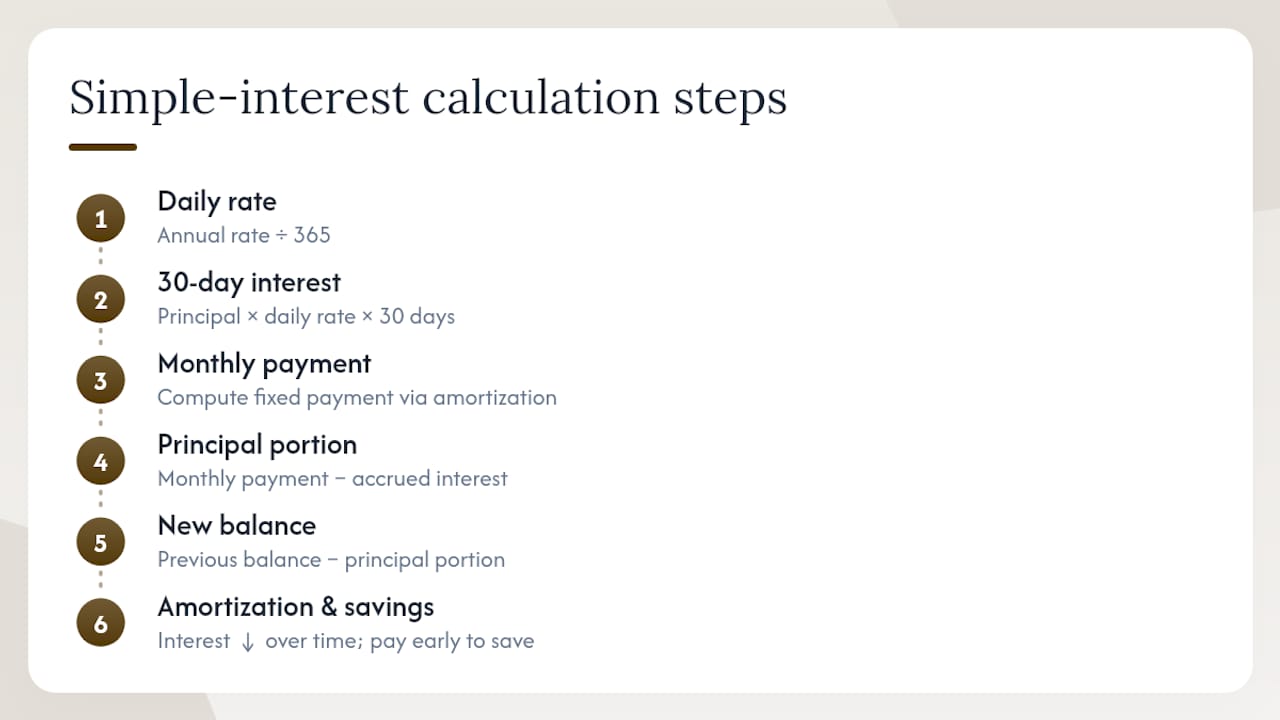
Step 2: Interest for the first billing period (30 days) Multiply the principal balance by the daily interest rate and the number of days to find the interest accrued.
Step 3: Monthly payment (standard amortization at the given annual rate and loan term) Use a standard amortization formula to determine the fixed monthly payment amount.
Step 4: Principal reduction in month 1 Subtract accrued interest from the monthly payment to find the principal portion applied.
Step 5: New balance Subtract the principal portion from the previous balance to get the new outstanding balance.
The amortization shifts gradually over the life of the loan, with the interest portion decreasing and the principal portion increasing each month as the balance declines.
Each month, the interest portion shrinks slightly because the balance is lower. That is the compounding-free advantage Investopedia highlights for simple-interest auto loans.
Savings callout: Making an extra principal payment early reduces your outstanding balance, which lowers interest accrued on future payments, resulting in total interest savings and a shorter payoff period.
Pro Tip: Set up autopay two or three days before your due date. On a daily-accrual loan, even two fewer days of accrued interest per payment add up across 60 payments.
Simple interest vs. precomputed interest: what actually changes
The CFPB draws a clear line between these two methods: simple interest is calculated on the outstanding balance as you go, while precomputed interest is calculated on the full loan amount at the start and then spread across scheduled payments. That distinction has real financial consequences.
| Dimension | Simple Interest | Precomputed Interest |
|---|---|---|
| How interest accrues | Daily on outstanding principal | Calculated up front, allocated to each payment |
| Effect of early payoff | Saves money; less interest has accrued | Minimal savings; interest already allocated |
| Extra payments | Reduce principal and future interest | May not reduce total interest owed |
| Late payments | More interest accrues; less goes to principal | Payment schedule unchanged; late fees apply |
| Transparency | Amortization schedule reflects actual balance | Total interest fixed regardless of payoff timing |
Under precomputed terms, paying off the loan six months early does not automatically cut your interest bill by six months’ worth of charges. The lender may use a “Rule of 78s” or similar formula to calculate how much “unearned interest” to refund, and that refund is often smaller than borrowers expect. The CFPB’s guidance makes this the single most important reason to confirm your contract method before signing.
Red flags in precomputed loan language:
- “Precomputed finance charge” or “add-on interest” in the contract
- A fixed total finance charge stated in dollars regardless of payoff date
- No mention of daily accrual or outstanding-balance calculation
- Refund of unearned interest calculated by the Rule of 78s
Simple interest is the standard for most modern U.S. auto loans, but some buy-here-pay-here dealers and older loan products still use precomputed terms. Knowing the difference before you sign is the difference between a payoff that saves money and one that doesn’t.
Pros and cons of simple-interest auto loans
Simple interest is generally the borrower-friendly choice, but it is not without conditions.
Advantages:
- Interest does not compound, so you never pay interest on interest
- Every extra dollar toward principal immediately reduces future interest
- Paying early in the billing cycle costs you less than paying on the due date
- Amortization schedules are transparent and verifiable
- Early payoff produces real, calculable savings
Drawbacks:
- Daily accrual means a late payment costs you more than just the late fee; extra interest has built up
- A longer loan term keeps the balance high longer, producing more total interest even at a low rate
- If you consistently pay a few days late, the interest drag compounds across the full term
- Lender rules on how extra payments are applied vary; some hold overpayments until the next cycle
Red flags to watch for in any offer:
- Precomputed or add-on interest language (covered above)
- Prepayment penalties on a loan marketed as simple interest
- Vague contract language about how overpayments are credited
- Unusually high origination or documentation fees rolled into the principal
- No written confirmation of the day-count convention (360 vs. 365)
A 72-month or 84-month loan at a low rate can still cost thousands more in total interest than a 48-month loan at a slightly higher rate. Monthly payment is a budget tool; total interest is the real cost.
Tactical steps to lower the total cost of your car loan
Reducing lifetime interest on a simple-interest loan comes down to a few high-impact moves, roughly ranked by effect.
- Choose the shortest term your budget allows. Fewer months means less time for interest to accrue. A 48-month term at the same rate as a 72-month term saves a meaningful amount in total interest, even though the monthly payment is higher.
- Make principal-only payments when possible. Confirm with your lender that the extra amount posts directly to principal on the same day. GM Financial’s guidance notes that lenders have specific rules here, so get written confirmation.
- Pay a few days early each month. On a daily-accrual loan, fewer days of accrued interest means more of your regular payment hits principal.
- Round up your payment. Paying $520 instead of $483 each month on the example above applies an extra $37 to principal every cycle, accelerating payoff with minimal budget impact.
- Avoid late payments entirely. A single late payment increases the accrued interest balance, meaning the next on-time payment does less principal reduction than it would have otherwise.
- Refinance if rates drop or your credit improves. Compare total interest cost across the remaining term, not just the new monthly payment. Use APR vs. interest rate comparisons to make sure you’re seeing the full picture.
- Compare multiple lenders before accepting a dealer’s offer. Credit unions often offer lower APRs than dealer-arranged financing, especially for borrowers with good credit.
Questions to ask any lender before signing:
- “How are extra payments applied — immediately to principal, or held to the next due date?”
- “Is there a prepayment penalty?”
- “Does the loan use a 360- or 365-day year for daily interest calculation?”
- “Can I make principal-only payments online or by phone?”
When evaluating refinancing, run the numbers on total interest paid over the remaining term at the new rate versus the current rate. A lower monthly payment on a longer new term can actually cost more overall.
How to check whether the APR you’re offered is fair
Knowing the mechanics of simple interest is useful. Knowing whether the specific rate you’ve been quoted is competitive for your credit profile is where you save real money. Here is a practical workflow.
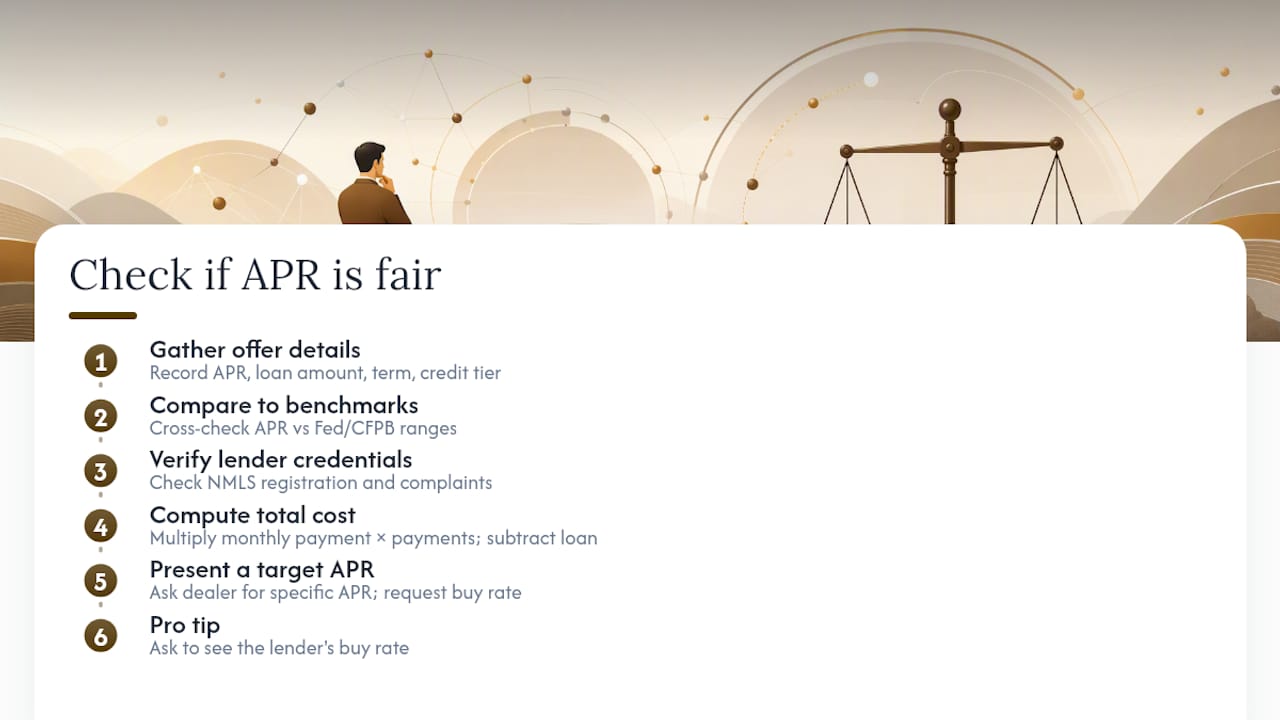
Step 1: Gather your offer details. Write down the APR (not just the interest rate), loan amount, term in months, and your credit tier. The APR includes fees and is the number to compare across lenders. For context on what APRs look like across credit tiers, used car loan rate benchmarks give a useful starting point.
Step 2: Compare against published benchmarks. Federal Reserve and CFPB data publish average auto loan rates by credit tier. Cross-reference your quoted APR against those ranges. A rate well above the average for your tier is a signal to push back.
Step 3: Verify the lender’s credentials. Check the lender’s registration on NMLS Consumer Access before signing anything. You can view registration status and, in some cases, complaint history. Usa also links to federal consumer finance agencies if you need to escalate a concern.
Step 4: Compute total cost for each offer. Multiply the monthly payment by the number of payments, then subtract the loan amount. That figure is your total interest cost. Do this for every offer you receive, including any refinancing scenario.
Step 5: Present a target APR. Once you know the benchmark for your profile, go back to the dealer or lender with a specific number. A short script: “Based on current market rates for my credit tier and this loan amount, I’m expecting an APR closer to X%. Can you match that?” Dealers often have room to move on rate, especially if you’ve done the homework. You can also use a financing comparison tool to cross-check offers from multiple sources before committing.
Pro Tip: Ask the dealer to show you the “buy rate” — the rate the lender actually approved before the dealer’s markup. Dealers are not always required to disclose this, but some will if asked directly. The gap between the buy rate and your quoted APR is the dealer’s profit on the financing.
What most borrowers get wrong about simple interest
The monthly payment is not the cost of the loan. It is the installment. The cost is the total interest you pay from the first payment to the last, and that number is shaped by rate, term, and payment behavior in ways a monthly payment figure completely obscures.
A borrower who stretches a $25,000 loan to 72 months to keep the payment under $400 will pay substantially more in total interest than someone who takes a 48-month term at the same rate, even though both loans use identical simple-interest mechanics. The longer the balance stays high, the more days of daily accrual accumulate. That is not a flaw in simple interest; it is arithmetic. But it is arithmetic that dealers rarely volunteer.
The second thing borrowers miss is the contract language around extra payments. Sending an extra $200 to your lender does not automatically reduce principal on the day it posts. Some servicers hold overpayments and apply them on the next scheduled due date, which means the interest reduction you expected is delayed. Confirming this in writing before you make the first extra payment takes five minutes and can save a meaningful amount over the life of the loan. Payment flexibility is not just a nice feature; it is a financial variable worth verifying the same way you verify the rate.
Know your rate before you sign: Baywall’s APR analysis
You now know how simple interest works and what to look for in a contract. The harder question is whether the specific APR on your offer is fair for your credit score, vehicle, and loan amount.

Baywall answers that question directly. Enter your credit score, vehicle details, loan amount, term, and the dealer’s quoted APR, and Baywall benchmarks that offer against real transaction data from comparable deals — same credit tier, same loan type, similar vehicle. The report labels your offer as great, fair, or high, gives you the exact target APR to negotiate toward, and shows your potential dollar savings. It also includes current market pricing for similar vehicles, so you walk into the negotiation with the full picture. Reports are delivered instantly online. Run your analysis at Baywall before you sign anything.
Sources
The sources below are the primary references for the claims in this article. Each is worth bookmarking if you want to verify a specific calculation or check lender credentials.
- What’s the difference between a simple interest rate and precomputed interest on an auto loan? | Consumer Financial Protection Bureau
- How Does Interest Work on a Car Loan? | SoFi
- Simple-Interest Car Loans: What You Need to Know | Capital One Auto Navigator
- What is Simple Interest on an Auto Loan? | Chase
This article is general information, not a substitute for advice from a qualified financial advisor. Consult a qualified financial professional about your own circumstances before acting on anything here.