Balloon Auto Loans: $14,000 Example, Baywall Check for U.S. Buyers

That trade-off eases short-term cash flow, but it usually raises your total borrowing cost and creates real risk if your car’s resale value or your finances shift. It tends to suit buyers with low mileage, dependable income, and a concrete exit plan, not casual shoppers chasing a smaller payment.
TL;DR:
- Balloon auto loans typically have shorter terms of 24 to 72 months and balloon payments that range from 30% to 60% of the vehicle’s original financed amount.
- Lower monthly payments come with higher total interest costs because interest accrues on the deferred principal throughout the loan term.
- The resale value of the vehicle is crucial; if it depreciates faster than expected, you may owe more than the car is worth at the end of the loan.
- Planning for the balloon payment involves either paying it off, refinancing, selling the car, or returning it, with each option tested well before the due date.
- Use market data and a credit union or independent tools to benchmark financing offers and verify the fairness of quoted rates before signing a balloon auto loan agreement.
Table of Contents
- What Is a Balloon Auto Loan and How Does It Work
- Weighing the Pros and Cons of a Balloon Payment Car Loan
- Balloon Loan Calculator Example: Monthly Payment vs. Total Cost
- What Happens When the Balloon Payment Is Due
- Is a Balloon Auto Loan Right for You?
- Where to Find a Balloon Auto Loan and What to Expect
- Checking a Dealer’s Balloon Offer Before You Sign
- Our Take: Use Balloon Loans as a Tool, Not a Shortcut
- Check Your Dealer’s Rate Before You Commit to a Balloon Structure
- Where to Verify Balloon Loan Terms and Run the Numbers Yourself
- Sources
What Is a Balloon Auto Loan and How Does It Work
A balloon auto loan spreads out smaller monthly payments for most of the term, then requires one large final payment, called the balloon or residual, to close out the loan. You’re not avoiding the cost of the car. You’re deferring a chunk of the principal to the end instead of paying it down gradually like you would with a traditional installment loan.
The balloon itself typically runs 30% to 60% of the vehicle’s original financed amount, depending on the lender and the term length. A $35,000 loan with a 40% balloon means $14,000 sits untouched until the final due date. Because less principal amortizes each month, your regular payments can come in notably lower than a comparable fully amortizing loan, often by roughly one-fifth to nearly half, according to figures from 1st Community Federal Credit Union. That’s the appeal. It’s also the catch, since interest keeps accruing on that deferred balance the entire time you’re making the smaller payments, a mechanic explained in detail by LendingTree.
Balloon contracts carry structural features that borrowers often miss on the first read:
- Term length: most balloon auto loans run 24 to 72 months, shorter than many standard 72 to 84 month installment loans.
- Mileage caps: many contracts limit annual mileage, often between 12,000 and 15,000 miles a year.
- Return riders: some agreements let you hand back the car instead of paying the balloon, mimicking a lease.
- Disposition fees: turning in the vehicle can trigger a fee, plus charges for excess wear or mileage overages.
Reading how simple interest actually accrues on an auto loan helps explain why the deferred principal costs you more over time even though your monthly bill looks smaller.
Weighing the Pros and Cons of a Balloon Payment Car Loan
The appeal of a balloon payment auto loan is straightforward: it can put a car within reach that a traditional loan’s payment would rule out. The risk is just as straightforward, and it shows up later, not upfront.
What works in your favor:
- Lower monthly payments free up cash flow for savings, debt payoff, or other expenses.
- You can finance a higher-priced vehicle without stretching your monthly budget.
- Some state registration and tax handling for balloon structures can differ slightly from lease taxation, which is worth confirming with your state’s DMV before signing.
What works against you:
- Total interest paid over the life of the loan tends to run higher. One worked comparison from HoldingCost found additional interest costs compared to an equivalent standard loan.
- If the car depreciates faster than expected, you can end up owing more than it’s worth, a classic setup for negative equity.
- Refinancing the balloon at the end isn’t guaranteed. Your credit, income, and prevailing rates at that time all factor in.
- Mileage and wear charges can add unexpected cost if you go over the cap or return the car in rough shape.
Pro Tip: *Ask your lender for the exact balloon dollar amount in writing before you sign, not just the percentage.
Balloon Loan Calculator Example: Monthly Payment vs. Total Cost
Numbers make this trade-off concrete.
The balloon version cuts the monthly payment by a significant amount, providing real relief if your budget is tight. But because $14,000 sits accruing interest for the full five years before you pay it off, total cost climbs. HoldingCost’s modeling shows that total interest paid tends to be higher in comparable scenarios, and that’s before factoring in what happens to the balloon amount itself.
The real variable is depreciation. If your $35,000 vehicle is worth $16,000 at the five-year mark, your $14,000 balloon is manageable. If it’s only worth $11,000 because of heavy mileage, an unpopular trim, or a rough market for used vehicles that year, you’re underwater on the balloon before you’ve even paid it.
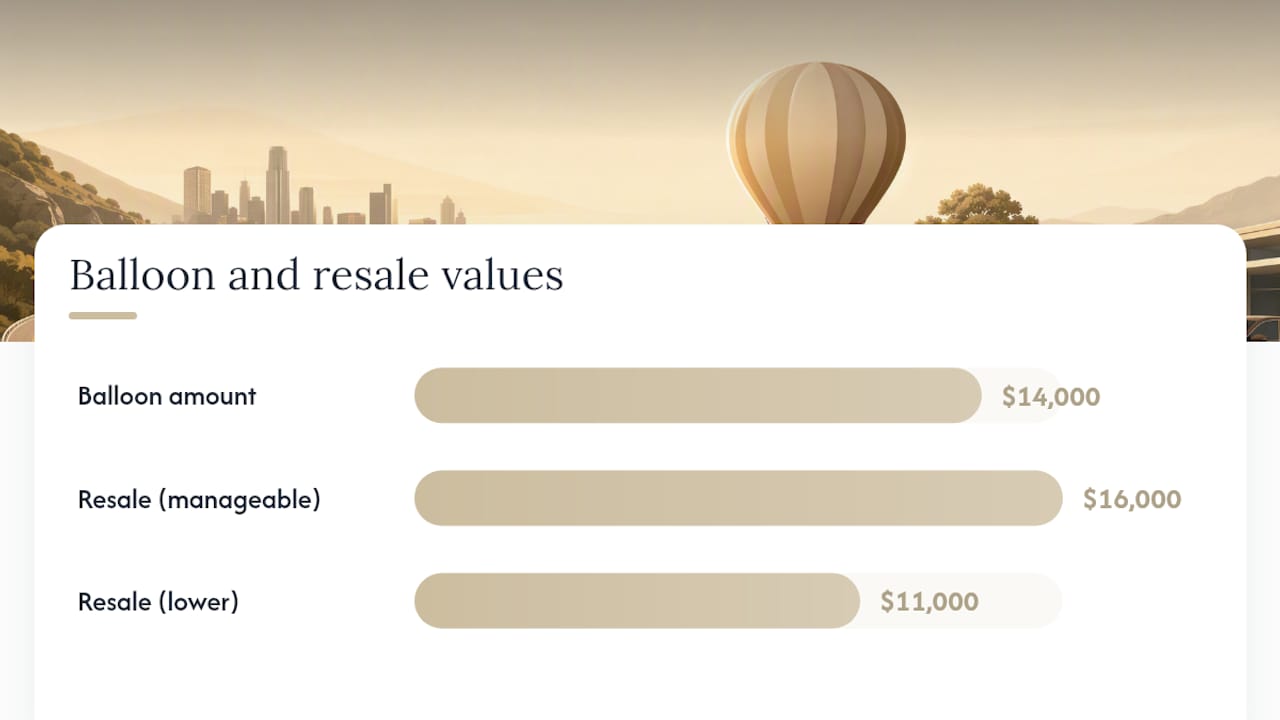
Shift any of the three levers and the math moves fast. Stretch the term from 60 to 72 months, and monthly payments ease, but you’re paying interest on the untouched principal for a full extra year. Push the APR up two points, and the gap between balloon and traditional financing widens further, since more of every payment goes toward interest rather than principal. Running these variables through a loan-to-value comparison before you sign shows you exactly how exposed you’d be if resale value comes in lower than expected.
What Happens When the Balloon Payment Is Due
You have four realistic paths when the balloon comes due, and the choice you make should be made well before the due date arrives, not after.
- Pay it off in cash. This is the cleanest exit if you’ve been saving specifically for the balloon amount. No new debt, no negotiation, no risk.
- Refinance the balloon into a new loan. This is common, but it’s conditional. Approval depends on your credit standing and market rates at that future date, not the terms you signed originally, a point Accel’s financing guide makes clearly. A drop in your credit score or a spike in rates can shrink or eliminate the benefit of refinancing.
- Sell or trade the vehicle. If the car’s market value exceeds the balloon, you walk away with equity. If not, you’ll need to cover the shortfall out of pocket to close the loan.
- Surrender or return the vehicle, if your contract includes a return rider. Expect a disposition fee and charges for excess mileage or wear, similar to lease-end fees.
In the year before your balloon is due, start gathering the paperwork you’ll need regardless of which path you take: your current loan payoff statement, a recent vehicle valuation from a source like Kelley Blue Book or Edmunds, and a current credit report so you know where you stand for refinancing. If refinancing looks likely, comparing private-party and dealer auto loan rates six months out gives you a realistic sense of what a new loan would actually cost, rather than guessing.
Is a Balloon Auto Loan Right for You?
Run through this before you sign anything. If most of the positive signals apply to you, a balloon structure might genuinely fit your situation. If the negative signals dominate, walk away from the offer.
Signals this could work for you:
- You drive well under the mileage cap, typically below common lease limits such as around twelve thousand miles a year.
- You’re buying a make and model with a strong track record for holding resale value.
- You expect stable or growing income over the loan term.
- You already have a savings plan or refinance strategy targeting the exact balloon amount.
Signals to avoid it:
- Your annual mileage regularly exceeds 15,000 miles.
- Your income or job situation feels uncertain over the next few years.
- Your credit is borderline, which makes refinancing approval shaky.
- You have no specific plan for covering the balloon when it’s due.
Reject the offer outright if: the dealer won’t state the balloon dollar amount in writing, the mileage cap seems unrealistically low for your driving habits, or the APR quoted is meaningfully above what buyers with your credit tier typically pay.
Where to Find a Balloon Auto Loan and What to Expect
Balloon auto loans aren’t as widely advertised as standard financing, but they’re not hard to find if you know where to look. Credit unions are a primary source, and many of them resell third-party administered products, including programs run by firms like Auto Financial Group, rather than building the balloon structure in-house. Access can hinge on credit union membership, so check eligibility requirements before assuming a program is out of reach. Comparing credit union auto loan rates against dealer-quoted APRs is worth doing regardless of loan structure.
Dealer-administered and manufacturer captive finance programs also offer balloon products, often branded under a specific name tied to the automaker.
What to expect when you’re shopping:
- Term lengths typically run 24 to 72 months.
- Balloon amounts commonly land between 30% and 60% of the financed amount.
- Mileage caps and disposition fees vary by lender, so read the fine print closely.
- Always request the official Loan Estimate and the exact balloon dollar amount in writing before comparing offers.
Checking a Dealer’s Balloon Offer Before You Sign
A dealer quoting you a balloon structure is still quoting you an APR, and that rate needs the same scrutiny you’d apply to any traditional loan. Before you agree to anything, gather four numbers: your credit score, the vehicle price and loan amount, the loan term, and the exact APR the dealer quoted.
Feed those into Baywall, and the report benchmarks the dealer’s rate against real transactions from buyers in your same credit tier financing similar vehicles. You’ll see whether the offer is labeled great, fair, or high, plus a specific target APR to negotiate toward and the dollar amount you’d save by hitting it.
- Gather your credit score, vehicle details, loan amount, term, and quoted APR before you start.
- Review the target rate and savings estimate the report generates.
- Print or save the report and bring it to the dealer, or use it to shop competing lenders directly.
Pro Tip: Run the benchmark before you’re sitting in the finance office. Knowing your target rate in advance changes the entire negotiation, because you’re no longer guessing whether the number on the page is fair.
Our Take: Use Balloon Loans as a Tool, Not a Shortcut
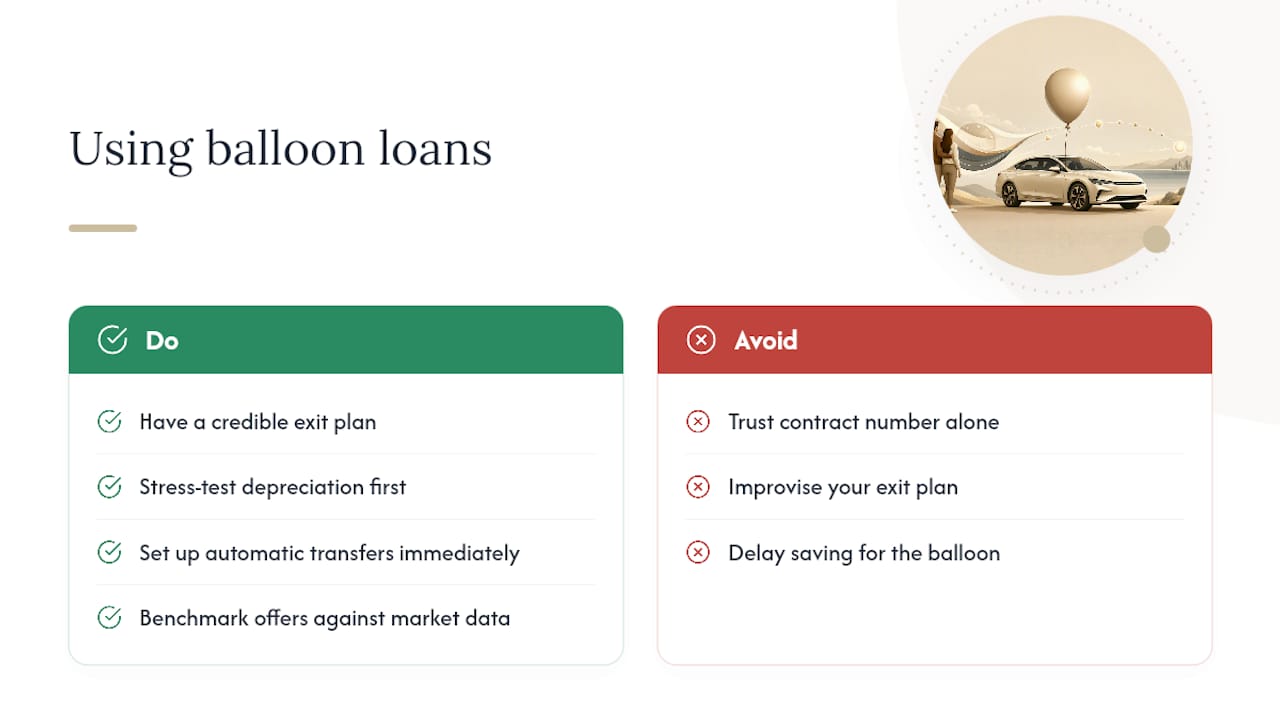
A balloon auto loan only makes sense if you have a credible exit plan and the savings discipline to back it up. Without both, the lower monthly payment is a mirage that gets expensive later.
Stress-test the depreciation scenario before you sign, not after. Set up automatic transfers toward your balloon target the same month you drive the car off the lot. And benchmark every dealer offer against real market data instead of trusting the number printed on the contract. The math behind balloon financing rewards preparation and punishes improvisation in roughly equal measure.
— Baywall
Check Your Dealer’s Rate Before You Commit to a Balloon Structure
A car loan rate benchmarking tool gives you leverage the finance office doesn’t want you to have: proof of what buyers with your credit tier actually paid for similar vehicles. Whether you’re comparing a balloon offer against a traditional loan or just want to know if the quoted APR is fair, the report benchmarks your numbers against real transaction data and hands you a specific target rate to negotiate toward.
Enter your credit score, the vehicle, loan amount, term, and the dealer’s quoted APR, and the tool labels the offer great, fair, or high, then shows your potential dollar savings if you push back. It’s a fast way to walk into a balloon loan decision with facts instead of guesses, whether the dealer is offering a standard loan or a balloon structure with a large final payment attached. If refinancing is part of your plan, reviewing how APR differs from a contract’s stated interest rate and picking up a few negotiation tactics for lowering rates on existing debt rounds out your prep. Run your numbers through Baywall before you sign anything.
Where to Verify Balloon Loan Terms and Run the Numbers Yourself
- The FTC’s credit and loans resources cover your rights to clear disclosures and how to compare total loan costs.
- Credit union program pages, like 1st Community Federal Credit Union’s balloon offering, show real examples of current terms and rates.
- Independent breakdowns such as HoldingCost’s balloon payment guide walk through total-cost math you can replicate with your own numbers.
This article is general information, not a substitute for advice from a qualified financial advisor. Consult a qualified financial professional about your own circumstances before acting on anything here.
Sources
- Understanding car loan balloon payments — HoldingCost
- Auto Balloon — 1st Community Federal Credit Union
- Credit and loans — Consumer Financial Protection (FTC)