For U.S. Buyers, Save $936 Per Point by Bringing Your Own Financing

Yes, bringing your own financing works, and for most buyers it beats walking onto a lot with no plan. A written preapproval from a bank, credit union, or online lender gives you a benchmark APR, term, and maximum loan amount before you ever talk price. Walk in with that number, negotiate the vehicle price first, and use your preapproval to push back on any dealer markup that shows up in the finance office.
TL;DR:
- Securing a true preapproval before shopping ensures you know your maximum loan terms, helping you negotiate the vehicle price effectively without dealer markups.
- Comparing APR, loan term, and total interest paid provides a more accurate picture of financing costs than focusing solely on monthly payments.
- Getting preapproved from a credit union or online lender can often yield better rates than dealer financing, but it requires early timing and proper documentation.
- Using your preapproval to negotiate first on the vehicle price and then on financing prevents dealer tactics like price creep and unapproved add-ons.
- Factoring in small APR differences and longer loan terms can significantly impact total interest paid, so precise math is essential before signing any deal.
Table of Contents
- What Does “Bring Your Own Financing” Actually Mean?
- Where Should You Get Preapproved: Banks, Credit Unions, or Online Lenders?
- How Do You Compare Your Preapproval to a Dealer’s Offer?
- How Do You Use Your Preapproval at the Dealership?
- What Dealer Countermoves Should You Watch For?
- What Does a Better Rate Actually Save You?
- Baywall’s Take: Why Separating Price From Financing Wins
- Know Your Number Before You Negotiate
- Sources
What Does “Bring Your Own Financing” Actually Mean?
Bringing your own financing, known in lending circles as direct lending, means you secure a loan offer before you shop instead of financing through the dealer’s finance office. It’s different from prequalification, which is a soft-pull estimate with no binding terms. A true preapproval is a conditional commitment tied to your credit profile, and it typically spells out:
- The APR you qualify for
- The loan term (36, 60, or 72 months, for example)
- The maximum loan amount the lender will fund
- Any conditions, like proof of income or insurance, needed to finalize
Having those terms locked in before you negotiate separates two decisions dealers like to blur together: what you pay for the car and what you pay to borrow the money. Keep them apart, and you control both.
Where Should You Get Preapproved: Banks, Credit Unions, or Online Lenders?
Each lender type has a different personality. Credit unions tend to offer the lowest rates for members with solid credit, but you often have to join before you can borrow, which can take a day or two. National banks move faster and are convenient if you already bank there, though rates can run higher than a credit union’s. Online and fintech lenders approve quickly and are useful if you’re shopping under time pressure, but that convenience can come with a higher rate than a traditional lender would offer the same borrower.
Before applying anywhere, gather what nearly every lender wants:
- Proof of income (pay stubs or tax returns)
- A government-issued ID and proof of residence
- An estimate of the vehicle price and down payment, which affects loan-to-value
Pro Tip: Apply to two or three lenders within a 14-day window. Credit bureaus typically treat multiple auto-loan inquiries in a short window as a single rate-shopping event, so you won’t tank your score by comparing offers.
Time your preapproval one to two weeks before you plan to buy. Preapprovals usually stay valid for a limited period, giving you room to shop without reapplying.
How Do You Compare Your Preapproval to a Dealer’s Offer?
Monthly payment is the number dealers love to talk about, and it’s the number you should mostly ignore. A lower payment stretched over 72 months can cost you far more in total interest than a higher payment over 48. The CFPB recommends comparing three things instead: APR, loan term, and total amount financed.
To do that math yourself:
- Multiply the monthly payment by the number of months, then subtract the loan amount. That’s your total interest.
- Add any financed extras, like an extended warranty or gap insurance, to the loan amount before comparing offers.
- Check whether the dealer’s APR includes a markup. Dealers routinely add a percentage point or more on top of what the lender actually approved them for, and that markup is where a lot of the dealer’s profit hides.
Dealer APR markups can add a significant amount of extra interest over the life of a loan, even on the exact same vehicle price.
There’s one exception worth checking before you dismiss dealer financing outright: manufacturer-sponsored special rate programs on new vehicles sometimes beat anything a bank or credit union can offer, especially on slower-selling models. Ask the dealer for a written Loan Estimate and an itemized out-the-door price, then hold both offers side by side before you decide.
How Do You Use Your Preapproval at the Dealership?
Sequence matters more than most buyers realize. Here’s the order that keeps you in control:
- Negotiate price first. Ask for the out-the-door price, the total including tax, title, and fees, before mentioning financing at all. If the salesperson asks how you’re paying, say “I have my own financing” and steer back to price.
- Reveal your preapproval once price is set. Show the letter or app screen with your APR and term, and say something like, “My lender approved me at this rate. Can you beat it?” That gives the dealer a real number to compete against instead of a guess.
- Let the finance office try, but verify. If they offer a lower rate, get it in writing before you agree to anything. A “conditional approval” that changes after you sign is a red flag, not a formality.
- Bring your paperwork. Recent pay stubs and proof of insurance speed up final underwriting and reduce the odds of last-minute term changes.
Pro Tip: If anyone says they need to “re-run your credit” after you’ve already negotiated price, ask why. A legitimate reason exists sometimes, but it’s also a common stall tactic to soften you up for a worse rate.
Walk away if the final contract doesn’t match what you agreed to verbally. A signed deal beats a promise every time.
What Dealer Countermoves Should You Watch For?
The most common way dealers claw back the savings from your lower APR is by inflating the price of the car or the paperwork around it. Watch for these:
- Backend add-ons rolled into the loan: extended warranties, gap insurance, paint protection, or VIN etching, often added without a clear verbal explanation.
- Price creep, where the vehicle price quietly rises to offset the fact that they can’t mark up your outside APR.
- Blank or incomplete forms presented for a signature “to save time.” Never sign a form with empty fields.
- Verbal promises about rate or price that don’t appear in the written contract.
Before you sign anything, read every line of the contract against what was agreed. Confirm the vehicle price, APR, term, and any add-ons match your understanding exactly, and ask that anything you didn’t agree to be removed on the spot.
What Does a Better Rate Actually Save You?
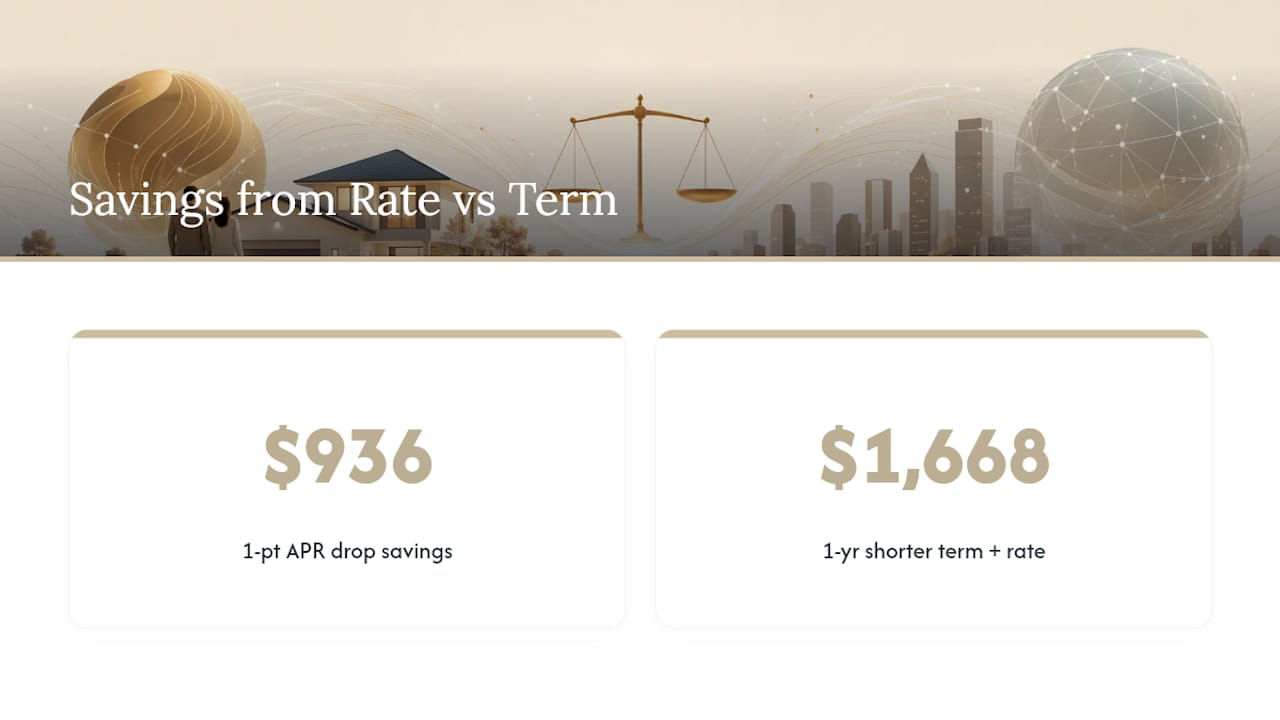
Small APR differences look trivial until you run the numbers over a full loan term. Take a $30,000 loan and compare two realistic scenarios:
A single-point APR drop on that loan saves roughly $936 in interest, and shortening the term by a year on top of it saves closer to $1,668, even though the monthly payment rises.
That gap gets erased fast if you finance a $1,500 warranty on top of the loan. Rolling it in adds interest for the life of the loan, sometimes enough to cancel out the entire APR advantage you fought for. This is the kind of math a rate-benchmarking tool can run for you, comparing your credit tier, loan amount, and term against comparable transactions, so you know your target number before you negotiate.
Baywall’s Take: Why Separating Price From Financing Wins
Buyers who treat price and financing as one negotiation almost always lose leverage on both. Split them, and each conversation stays honest. This is the core reason we built Baywall around benchmarking rather than lending: a target APR backed by comparable transaction data removes the guesswork that lets dealer markups survive in the first place. Before you commit either way, though, check manufacturer promotional rates. Sometimes a factory-sponsored program can beat any outside offer, and skipping that check is the one mistake that undoes otherwise solid preparation.
— Baywall
Know Your Number Before You Negotiate
Some tools let you check a dealer’s APR like any other price before committing; learn the practical steps for securing independent financing in advance at How It Works | Texas Bank Statement Loans. You enter your credit score, vehicle, loan amount, and term along with the dealer’s quoted rate, and receive a benchmark against real transactions in your credit tier and loan type.
You get a straightforward label (great, fair, or high), a target APR to negotiate toward, and an estimated dollar-savings figure, the same numbers described in the worked example above. Bring that target rate and dollar figure into the finance office and use them exactly the way you’d use a preapproval letter: as a number the dealer has to beat, not a guess they can talk you out of. Baywall doesn’t lend money and isn’t a substitute for getting preapproved elsewhere. It tells you whether the rate you’re being offered, from any lender, is actually fair. Run your numbers at Baywall’s analyzer before your next dealer visit and walk in already knowing what you should pay.
Sources
- Financing or Leasing a Car | Consumer Advice (FTC)
- How do I compare auto loan offers? | CFPB
- How does financing a car work? | U.S. Bank
- How to Buy a Car With Non-Dealership Financing | CarGurus