Sub-36% DTI Unlocks Lowest Auto Rates — U.S. Buyers, Negotiate APRs

Most lenders will still work with you up into the mid-40s, and credit unions or a larger down payment can stretch that further. DTI is only one piece of the puzzle. Your credit score and down payment carry real weight too. Run your own numbers in the calculator below before you assume where you stand.
TL;DR:
- Lenders generally approve auto loans up to a DTI of around 50%, but approval becomes more difficult and APRs increase sharply above 50%.
- A higher down payment, paying off small debts, and adding verified extra income can reduce your DTI quickly and improve approval chances.
- A higher DTI often results in a significantly increased monthly payment and overall interest, especially when moving from a low to a high APR band.
- Payment-to-income ratio, specifically the car payment being under 15-20%, is also crucial and can trigger rejection despite acceptable overall DTI.
- Using a DTI calculator with real figures can help identify whether your projected auto loan fits within acceptable thresholds before applying.
Table of Contents
- How to Calculate Your DTI for an Auto Loan
- What DTI Range Gets You Approved for a Car Loan?
- How Does DTI Affect Your Rate and Loan Options?
- How to Lower Your DTI Before You Apply
- How to Use a DTI Calculator With Real Examples
- Is DTI the Only Number Lenders Care About?
- Baywall’s Take: Use Data, Not Guesswork, When Your DTI Is Borderline
- Check Your Dealer’s APR Before You Sign
- Where to Verify These DTI Guidelines Yourself
- Sources
- FAQ
How to Calculate Your DTI for an Auto Loan
Lenders calculate debt-to-income by adding up your monthly debt payments and dividing that total by your gross monthly income, then multiplying by 100 to get a percentage. That’s the exact formula the Consumer Financial Protection Bureau uses to define DTI, and it’s the same math every auto lender runs behind the scenes.
Gross monthly income means your pay before taxes, not your take-home amount. If you earn $70,000 a year, that’s roughly $5,833 a month in gross income.
Lenders typically count these monthly obligations toward your DTI:
- Rent or mortgage payment
- Minimum credit card payments
- Student loan payments
- Existing auto loan payments
- Personal loan payments
- Alimony or child support obligations
Here’s the calculation in three steps:
- Add up all monthly debt payments listed above.
- Divide that total by your gross monthly income.
- Multiply by 100 to get your DTI percentage.
Say your monthly debts total $1,200 and you earn $5,833 a month before taxes.
To see how a new auto loan changes things, estimate your projected monthly payment using the loan amount, term, and an assumed APR, then add that figure to your existing debts before dividing again. That’s the number your lender actually cares about.
What DTI Range Gets You Approved for a Car Loan?
Lenders sort DTI into rough tiers, though every institution draws its own lines. At 50% or higher, approval gets harder and the rates you do qualify for climb fast, according to TDECU’s underwriting guidance.
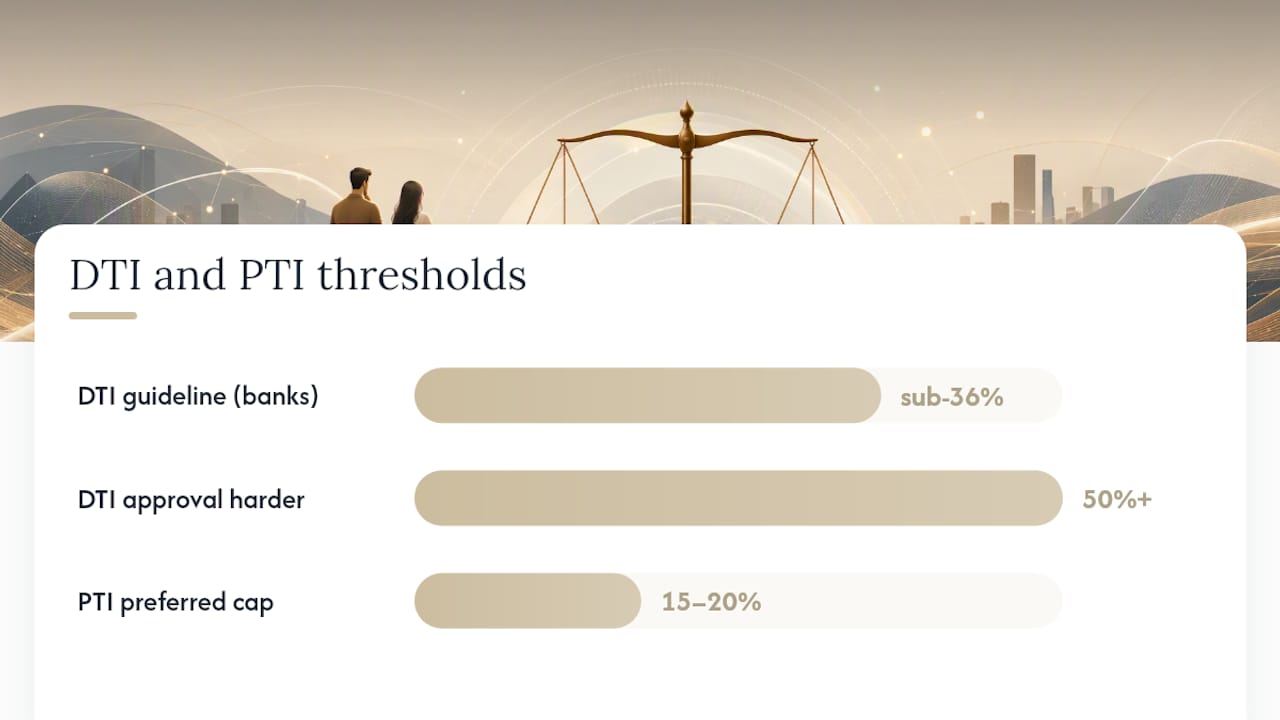
A handful will go above 50%, typically at meaningfully higher APRs, according to TDECU.
These ranges shift depending on who’s lending:
- Traditional banks tend to hold tighter to the sub-36% guideline, especially for their lowest advertised rates.
- Credit unions often show more flexibility, particularly for members with an existing relationship or direct deposit history.
- Subprime and dealership financing will approve much higher DTI, but the APR markup can be steep enough to erase any convenience.
Alongside DTI, some lenders isolate what’s called payment-to-income, or PTI, which measures just the car payment against your gross monthly income. Many conventional lenders prefer that figure to stay under roughly 15% to 20%, according to Lendward. A buyer can have a fine overall DTI and still get flagged if the car payment alone eats too much of their paycheck.
How Does DTI Affect Your Rate and Loan Options?
DTI never works alone. Underwriters weigh it against your credit score, how stable your income looks, the loan-to-value ratio on the vehicle, and how much you’re putting down. Two applicants with identical DTI can land in different rate bands depending on those other factors, which is why your credit tier matters just as much as the DTI math.
Push your DTI higher and you’ll typically see:
- A jump into a higher APR band, even if your credit score stays the same
- Pressure to bring a bigger down payment to offset the perceived risk
- A shorter list of lenders willing to approve you at all
- A possible requirement for a co-signer to get competitive terms
Here’s why the rate gap matters in dollars, not just percentage points. On a $30,000 loan over 60 months, moving from 6% APR to 11% APR raises your monthly payment by roughly $65 and adds close to $3,900 in interest over the life of the loan. That’s not a rounding error. That’s a family vacation, or a meaningful dent in your next down payment, handed to the lender instead of staying in your pocket.
How to Lower Your DTI Before You Apply
You don’t need months to move your DTI in the right direction. Some fixes work almost immediately, others take a bit more runway.
- Pay off or pay down small balances first. Knocking out a credit card with a $75 minimum payment does more for your DTI than you’d expect, since lenders count the minimum, not the balance.
- Document any extra income. Verified overtime, a bonus structure, or a side gig with a consistent deposit history can all get added to your gross income if you can show the paper trail.
- Increase your down payment. A bigger down payment shrinks your loan amount, which shrinks your monthly payment, which directly lowers your projected DTI.
- Stretch or shorten the loan term carefully. A longer term lowers the monthly payment and your DTI, but it also means more interest paid over time, so weigh that trade-off before you lock it in.
- Consider a co-signer. A co-signer with strong income and low debt can pull your combined DTI down significantly, though it also means they’re on the hook if you miss a payment.
Pro Tip: Run your DTI calculation twice, once with your current debts and once with the exact projected car payment for the vehicle you’re actually considering. A $5,000 difference in loan amount can be the difference between a workable DTI and one that gets flagged.
How to Use a DTI Calculator With Real Examples
A DTI calculator needs three inputs: your gross monthly income, the total of your existing monthly debts, and your estimated car payment. Plug those in and you get both your current DTI and your projected DTI with the new loan added. A free tool like the debt-to-income calculator from Texas Bank Statement Loans lets you run this math online in a couple of minutes.
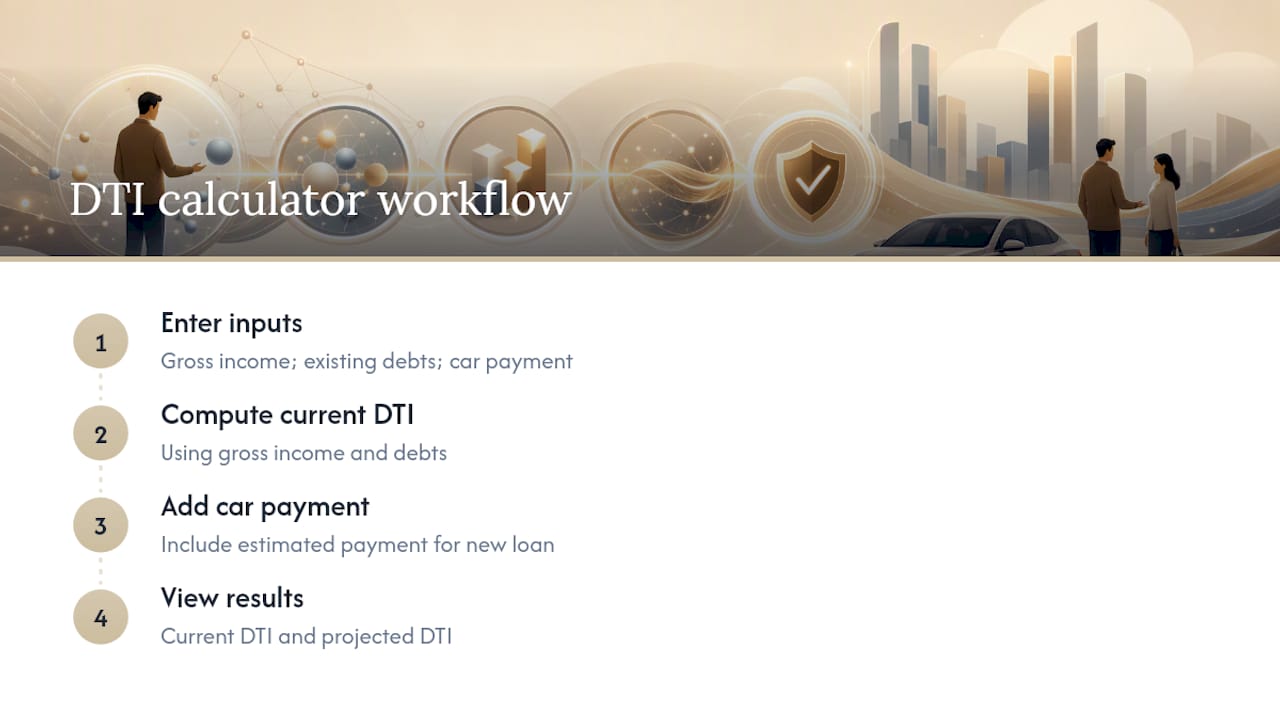
Example A: The $70,000 earner buying a used car. Gross monthly income comes to about $5,833. That’s comfortably inside the strong range, and this buyer should qualify for competitive rates at most lenders.
Example B: The borrower with heavier existing debt. Same $5,833 gross income, but $2,400 in existing monthly debt from a mortgage, two car-adjacent loans, and credit cards.
For a borrower like Example B, the fix isn’t complicated: a larger down payment, a cheaper vehicle, or a co-signer with clean credit can all pull that projected DTI back into workable territory.
Is DTI the Only Number Lenders Care About?
DTI tells only part of the story. A bank might hold firm at 36%, while a credit union extends real flexibility to members with a strong relationship or steady deposit history, since NCUA-insured institutions often underwrite more manually than large national banks.
Loan-to-value matters just as much. A bigger down payment lowers your LTV, and a lower LTV can offset a DTI that’s higher than a lender would normally accept on its own.
Credit tiers interact with all of this too.
Baywall’s Take: Use Data, Not Guesswork, When Your DTI Is Borderline
When your DTI sits in that mid-30s to mid-40s gray zone, the dealer’s quoted APR carries more weight than usual. Benchmarking that number against what buyers in your credit tier and loan type actually paid tells you whether the offer reflects your risk profile or just pads the dealer’s margin. Walk in with a specific target APR and a dollar figure for what you’d save. That’s a stronger position than hoping the number they hand you is fair.
— Baywall
Check Your Dealer’s APR Before You Sign
You can find out what buyers with your credit score, loan amount, and vehicle type actually paid. Instead of guessing whether a quoted APR reflects your borderline DTI or just protects the dealer’s margin, you get a benchmark pulled from comparable real deals.
Enter your credit score, loan amount, term, and the rate you were quoted to see whether the offer is great, fair, or high. You’ll also get a specific target APR to negotiate toward and an estimated dollar savings if you push back. This matters most when your DTI sits in that mid-30s to mid-40s range, where lenders price risk unevenly and dealers know it. Before you sign anything, run your numbers through Baywall’s analysis tool and walk into the finance office already knowing what you should pay.
Where to Verify These DTI Guidelines Yourself
Check the CFPB’s DTI explanation, TDECU’s lender guidance, and HUD’s fair lending resources for further reading.
Sources
- Consumer Financial Protection Bureau — What is a debt-to-income ratio?
- TDECU — What’s a Good Debt to Income Ratio (DTI) for a Car Loan?
- Experian — What to do if you’re denied a car loan
FAQ
How Much Car Can I Afford Making $70,000 a Year?
At $70,000 a year, your gross monthly income is about $5,833.
Is a 43% DTI Too High for an Auto Loan?
Credit unions and lenders willing to weigh a strong down payment or credit score often have more room at this level than traditional banks.
What Credit Score Do I Need for a $40,000 Auto Loan?
There’s no single universal cutoff, since approval depends on your DTI, down payment, and the specific lender’s guidelines alongside your credit score. Stronger credit tiers unlock better APR bands, so checking where your score falls before you shop gives you a realistic sense of your options.
What Is the 8% Rule for Cars?
It’s a conservative guideline for buyers who want extra breathing room rather than a formal lender requirement.
What Happens if a Lender Denies Me for a High DTI?
If a lender denies you based on DTI, shopping other lenders often gets a different result, since credit unions may be more flexible than major banks and compensating factors like a larger down payment or a co-signer can offset the risk, according to Experian.