Electric Car Loan Rates in 2026: What You’ll Actually Pay

Electric car loan rates for new EVs currently vary for well-qualified buyers, with used EVs tending to have higher APRs depending on vehicle age and credit tier. The single most important step before you sign anything: get prequalified quotes from at least three lender types, then run the dealer’s quoted APR through Baywall to see whether it’s fair, high, or worth walking away from.
Here’s what to bring to the table the moment a dealer quotes you a rate:
- Rate target: For strong credit (720+), a relatively low APR (as low as 4.75%) is achievable at credit unions as of July 2026; rates above a typical threshold often deserve a counteroffer.
- Ask about green discounts: Some credit unions and specialized lenders offer small discounts off standard rates for EVs.
- Confirm fees and prepayment terms: Dealer-arranged loans sometimes carry origination fees or prepayment penalties that inflate the true cost even when the headline APR looks competitive.
- Check manufacturer promos: 44 EV and hybrid finance offers were tracked in July 2026, including multiple 0% APR deals over 60–72 months from manufacturers like Hyundai. These can beat any bank rate, but they come with strings.
Pro Tip: Run the dealer’s APR through Baywall before you respond to any finance office offer. A $2.99 report can show you the exact target rate for your credit tier, vehicle, and loan amount, and translate any gap into dollar savings you can put in front of the dealer.
Table of Contents
- What determines the APR you’ll be offered on an EV loan?
- Where can you check live EV loan rates right now?
- How to compare EV loan offers and negotiate a better rate
- EV-specific financing issues that change the math
- How Baywall benchmarks a dealer APR and what the numbers mean
- Key Takeaways
- The EV financing shift most buyers are missing
- Know your rate before you sign with Baywall
- Sources and further reading
What determines the APR you’ll be offered on an EV loan?
Six variables move your APR more than anything else, and most of them are within your control before you walk into a dealership.

Credit score is the biggest lever. Lenders typically segment borrowers into tiers: 720 and above (prime/super-prime), 660–719 (near-prime), and below 660 (subprime). The spread between a prime and subprime offer on the same loan can easily exceed 5 percentage points. Loan term is the second lever. Longer terms (72–84 months) often carry higher APRs because the lender’s risk exposure extends further. A 48-month loan on the same vehicle will usually price lower than an 84-month version, even from the same lender.
Down payment and loan-to-value ratio (LTV) matter more for EVs than for gas cars because battery depreciation creates residual-value uncertainty. A larger down payment reduces LTV and signals lower risk to the lender. Vehicle age is the fourth factor, and it hits used-EV buyers hardest. Mainstream banks often treat used EVs older than roughly 7–8 years as higher-risk assets, which can mean a rate add-on or outright decline. Specialized green lenders and credit unions tend to be more flexible on older EVs.
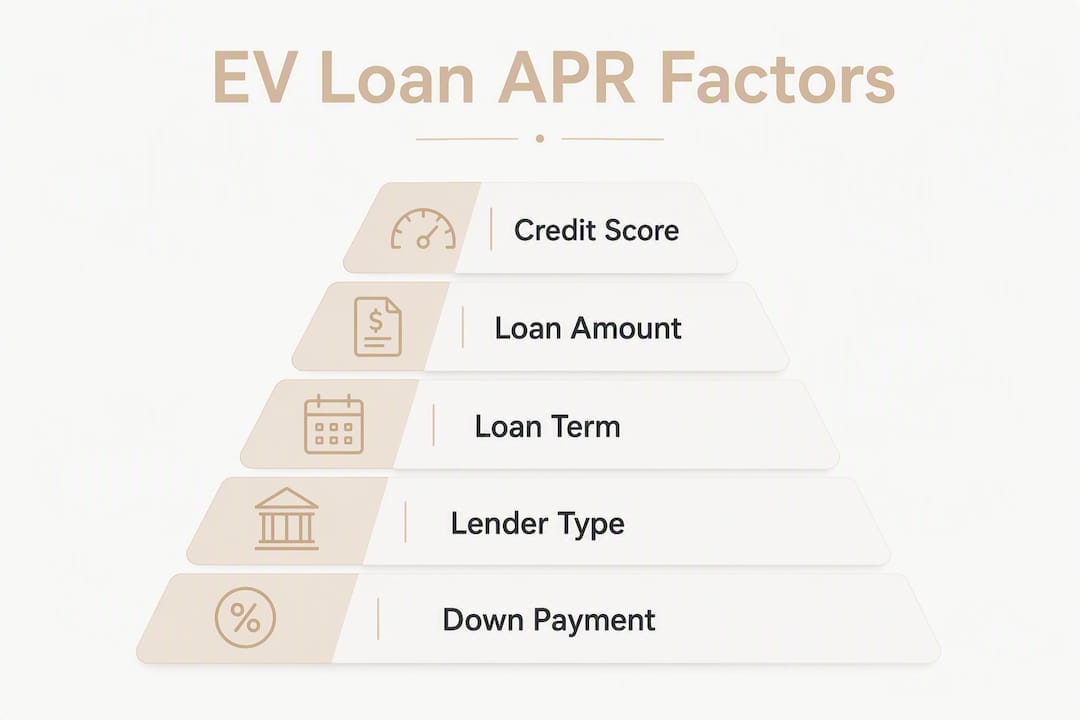
Lender type creates a consistent 1–3 point APR swing for the same borrower profile. Credit unions like Mountain America advertise competitively low EV rates and explicitly discount rates for members with checking-account relationships. Dealer-arranged financing, by contrast, often carries a markup over the lender’s buy rate. Finally, relationship discounts (autopay, ACH enrollment, membership) can trim 0.25–0.50 points off a posted rate at many credit unions.
Manufacturer 0% APR promotions are a separate category entirely. They’re not lender rates; they’re subsidized by the automaker’s captive finance arm. The trade-off is usually a shorter term (often 60 months), restricted trims, and sometimes a required trade-in or specific model-year inventory. When a 0% offer is available on the vehicle you want, it almost always beats any bank or credit union rate, but you need to verify the total cost including any forfeited cash rebate.
Pro Tip: Rolling charger installation into your auto loan makes sense when the lender explicitly permits it and your LTV stays below 110%. Push past 120–125% LTV and you may trigger a rate add-on that costs more than a separate home-equity or personal loan for the charger.
Where can you check live EV loan rates right now?
Five distinct sources offer EV financing, and they don’t price the same loan the same way.
| Lender type | Typical APR range | Best for | Terms available | Key eligibility notes |
|---|---|---|---|---|
| Credit unions / green lenders | 4.75%–6.50% | Prime borrowers, new and used EVs | 48–84 months | Membership required; autopay discounts common |
| National banks | 6.00%–8.00% | Existing customers, fast approval | 60–72 months | Relationship discounts for account holders |
| Online lenders / fintechs | — | All credit tiers, fast prequalification | 60–84 months | Soft-pull prequalification widely available |
| Captive / manufacturer finance | 0%–— (promo dependent) | New vehicles, prime borrowers | 60–72 months | Specific trims, model years; may require forfeiting rebate |
| Dealer-arranged third-party | — | Convenience; one-stop | 60–84 months | Rates often include dealer markup |
Star One Credit Union lists EV loan APRs starting at 4.75% for prime borrowers across terms up to 84 months, with posted range up to 8.75% as of July 4, 2026. Clean Energy Credit Union advertises new EV rates as low as 4.99% and layers in discounts for autopay and residency in eligible counties.
A few practical notes on using these sources well. “As low as” rates on any lender’s homepage require very strong credit, often a short term, and sometimes a specific vehicle trim. Mountain America Credit Union states this explicitly in its disclosures: the lowest advertised rate applies only to highly qualified borrowers. Treat posted floor rates as a benchmark for negotiation, not a guarantee.
Most online lenders and credit unions now offer soft-pull prequalification, which shows you a real rate estimate without touching your FICO score. Use this before you visit a dealership. A monthly-payment calculator is useful for comparing scenarios, but always run the total interest calculation across the full term. A 72-month loan at 6.5% on a $45,000 vehicle costs roughly $9,600 in interest. A 48-month loan at 5.5% on the same amount costs about $5,400. The monthly payment difference is smaller than most buyers expect; the lifetime difference is not.
How to compare EV loan offers and negotiate a better rate
Shopping EV financing is a process, not a single phone call. Here’s the sequence that consistently surfaces the best offers.
- Prequalify with at least three lender types before visiting a dealer. Include your primary bank or credit union, one green or EV-specialized credit union, and one online lender. Soft-pull prequalification at each gives you a real rate range without a FICO impact.
- Request identical quotes. Same loan amount, same term, same vehicle. A 72-month quote from a credit union and a 60-month quote from a dealer are not comparable.
- Check fees and rate-lock policy. Some lenders lock a rate for 30–45 days; others don’t. Origination fees, documentation fees, and dealer finance reserve (the markup over the buy rate) all add to the true cost.
- Confirm prepayment penalties. Federal credit unions are prohibited from charging prepayment penalties on auto loans, but some bank and dealer-arranged loans include them. Ask directly.
- Calculate total cost of borrowing. APR is the right comparison metric because it folds in fees, but total interest paid over the term is what actually comes out of your pocket. Use a full APR vs. interest rate breakdown to make sure you’re comparing the right number.
Negotiation targets vary by credit tier for new EV loans of typical terms.
- 720+ (prime/super-prime): Target 4.75%–5.75% at a credit union as of July 2026; anything above 6.5% from a dealer warrants a counteroffer.
- 660–719 (near-prime): Expect 6.00%–8.00%; a green-lender discount can bring this down 0.25–0.50 points.
- Below 660 (subprime): Rates above 10% are common; focus on improving LTV with a larger down payment and consider a shorter term to reduce lender risk.
When you’re in the finance office, these are the questions worth asking out loud: “What is the buy rate on this loan before the dealer markup?” “Is there a prepayment penalty?” “Does this lender offer a green-vehicle discount?” “What happens to this rate if I enroll in autopay?”
Pro Tip: Submit all your loan applications within a 14-day window. FICO’s rate-shopping window treats multiple auto-loan hard inquiries within that period as a single inquiry, so shopping aggressively won’t hurt your score.

Bringing a Baywall benchmark report into the finance office changes the conversation. Instead of negotiating from a gut feeling, you’re presenting the dealer with the actual market rate for your credit tier, vehicle, and term. That’s a different kind of leverage.
EV-specific financing issues that change the math
A few factors apply specifically to EV purchases and don’t show up in standard auto-loan guides.
Federal and state incentives can effectively lower your APR equivalent when applied correctly. The federal clean vehicle credit (up to $7,500 for eligible new EVs under the Inflation Reduction Act) can be applied at the point of sale as a price reduction, which shrinks the loan principal and reduces total interest paid. Check current eligibility at fueleconomy.gov before you negotiate, because eligible models change. State incentives vary widely; some states layer additional rebates on top of the federal credit.
Charger financing is worth planning carefully. Including home charger installation in your auto loan is possible with some lenders, and National Car Charging documents financing options for EV charging equipment. The key question is whether adding the charger cost pushes your LTV above the lender’s threshold. Some credit unions permit LTV up to 110% or higher for EVs, but exceeding those caps can trigger a rate add-on. Confirm the lender’s policy in writing before assuming the charger rolls in cleanly. For a deeper look at how LTV affects your rate, the Baywall LTV guide walks through the math.
Used EVs carry additional underwriting risk that buyers often underestimate. Battery health is the central concern: a degraded battery pack reduces the vehicle’s residual value, which is the lender’s collateral. Many mainstream banks cap used EV financing at vehicles roughly 7–8 years old. Specialized green lenders and credit unions often extend financing to older EVs, sometimes at competitive rates, provided the battery has documented service history. When shopping a used EV, ask for a battery health report and have it ready for the lender alongside the standard vehicle history.
Pro Tip: Gather your incentive paperwork (IRS Form 8936 instructions, state rebate documentation) and any battery service records before you apply. Lenders who see complete documentation process faster and sometimes price the risk lower.
How Baywall benchmarks a dealer APR and what the numbers mean
Baywall’s benchmarking methodology uses five variables to generate a market-calibrated rate for your specific situation: credit score band, vehicle make/model/trim, loan amount, loan term, and location. Each variable narrows the comparison pool to deals that actually resemble yours, rather than averaging across all auto loans in the country.
Here’s how the savings calculation works in practice.
Sample calculation (new EV, $45,000 loan, 72-month term):
- Dealer quotes 7.9% APR.
- Baywall benchmarks your profile and returns a target APR of 5.9% for your credit tier and term.
- Monthly payment at 7.9%: approximately $703. Monthly payment at 5.9%: approximately $670.
- Difference per month: $33. Over 72 months: $2,376 in excess interest.
- That $2,376 is the negotiation number you bring to the finance office.
| Credit tier | Loan amount | Term | Dealer APR | Baywall target APR | Estimated savings |
|---|---|---|---|---|---|
| Prime (720+) | $45,000 | 72 months | 7.9% | 4.75% | ~$2,800 |
| Near-prime (660–719) | $45,000 | 60 months | 6.5% | 5.75% | ~$2,200 |
| Subprime (<660) | $45,000 | 48 months | — | 10% | — |
The savings figures above are illustrative estimates based on the APR gaps shown; they are not sourced from Baywall’s proprietary transaction database. The methodology for comparing offers against a baseline is consistent with how FindTheBestCarPrice scores finance deals, which measures total interest savings plus cash bonuses versus a 7% baseline loan.
How to present the Baywall report to a dealer:
- Pull up the report on your phone or print it before entering the finance office.
- Point to the target APR line and the dollar savings figure specifically.
- Say: “I have market data showing comparable buyers in my credit tier are getting [X]% on this type of loan. Can you match that?”
- If the dealer can’t match it, use your prequalified credit-union offer as the fallback.
Pro Tip: Don’t lead with the Baywall report the moment you sit down. Let the dealer quote first, then present the benchmark. That sequence gives you the most negotiating room.
Key Takeaways
The single most effective way to avoid overpaying on an EV loan is to benchmark the dealer’s quoted APR against real market data for your credit tier before you sign.
| Point | Details |
|---|---|
| Current EV APR ranges | New EV loans start near 4.75% at credit unions; used EVs typically run 1–3 points higher depending on age and credit. |
| Credit tier drives the spread | Prime borrowers (720+) can target sub-5.75% on new EVs; subprime borrowers should focus on LTV and term length to reduce rate risk. |
| Manufacturer 0% promos are real | Multiple 0% APR offers over 60–72 months existed in July 2026; always compare total cost including any forfeited rebate. |
| Used-EV caveats matter | Mainstream banks often cap used EV financing at 7–8 years; green lenders and credit unions are more flexible with documented battery history. |
| Baywall benchmarks your specific offer | Enter your credit score, vehicle, loan amount, and term to get a target APR and dollar savings figure you can use at the dealer. |
The EV financing shift most buyers are missing
The conventional wisdom that EVs automatically carry a financing premium is fading. Large lenders now price EVs similarly to comparable gas vehicles, and the real savings opportunity has shifted to green-loan discounts and manufacturer promo layering rather than a universally lower base rate. That’s a meaningful change in how you should shop.
What this means in practice: a buyer who only checks the dealer’s finance offer and compares it to a national bank is leaving a real discount on the table. The 0.25–0.50 point green-vehicle discount that some credit unions offer sounds small, but on a $45,000 loan over 72 months, it’s several hundred dollars. On top of that, manufacturer 0% promotions, when available on the vehicle you want, represent a subsidy that no bank or credit union can match on a standard rate basis.
The nuance worth understanding: a 0% APR offer from a manufacturer’s captive finance arm sometimes requires you to forgo a cash rebate. If the rebate is $3,000 and the 0% saves you $2,200 in interest versus a 5.9% credit union loan, the rebate is actually worth more. This is the calculation most buyers skip, and it’s exactly the kind of comparison that a benchmarking tool makes concrete rather than theoretical.
The practical takeaway: shop credit unions first for used EVs and for any new EV where manufacturer promos aren’t available. For new EVs with active 0% offers, run the total-cost math before assuming the promo wins.
Know your rate before you sign with Baywall
You’ve done the research. You know the APR ranges, the lender types, and the negotiation questions. The last step is making sure the specific number the dealer quotes you is actually fair for your credit score, your vehicle, and your loan amount, not just fair in general.
Baywall benchmarks dealer APR quotes against real transaction data from comparable deals, same credit tier, same loan type, similar vehicle, and tells you whether the offer is great, fair, or high. The report gives you a target APR to negotiate toward and translates any gap into dollar savings you can put in front of the finance manager. A free quick check gets you started; the full paid report is $2.99 and delivers instantly. No account required, no hard pull on your credit.
Run your dealer’s APR through Baywall before you sign. Two minutes and a few dollars could save you more than a weekend’s worth of negotiating.
Sources and further reading
- fueleconomy.gov: Federal EV Tax Credits — Primary source for current federal clean vehicle credit eligibility by make and model; updates as IRS guidance changes.
- National Car Charging: EV Charger Financing — Documents financing options for home charging equipment and notes LTV considerations for bundling charger costs into an auto loan.
- Baywall: Best Credit Union Auto Loans — Explains how credit unions price auto loans and why they consistently beat dealer-arranged financing for well-qualified buyers.
- Baywall: Used Car Loan Rates and Negotiation Targets — Benchmarks and APR targets for used vehicles by credit score; directly applicable to used-EV shoppers comparing offers.