U.S. Buyers: Use Your FICO Auto Score (250–900) to Cut Dealer APRs

A FICO Auto Score is an industry-specific credit score lenders use to price and approve car loans, and it runs on a 250 to 900 scale instead of the familiar 300 to 850 range. Knowing roughly where you sit on that scale tells you what APR band you should expect, which means you can walk into a dealership already knowing whether their number is fair. Start by checking your base FICO score as a proxy, then benchmark whatever rate the dealer quotes against real market data before you sign anything.
TL;DR:
- Your FICO Auto Score ranges from 250 to 900, with auto-specific behaviors like payment history and auto loan delinquencies heavily impacting your score.
- Lenders may use different versions of the Auto Score and pull from various credit bureaus, making your base FICO score the most reliable estimator of your auto loan risk.
- Paying down revolving debt and ensuring a clean auto loan history can significantly improve your auto score and potential loan terms.
- Rate shopping within a 14-day window does not harm your credit score, especially if you use soft inquiries initially and compare offers before applying.
- Benchmarking your dealer’s quoted APR against real market data can help you negotiate better terms and avoid overpaying on your car loan.
Table of Contents
- Fico Auto Score Explained: How It Differs From Your Base Score
- Which Fico Auto Score Version Will Your Lender Actually Pull?
- What Factors Affect Your Fico Auto Score the Most?
- How Do You Check Your Fico Auto Score Before You Shop?
- What Counts as a Good Fico Auto Score for Car Loans?
- Does Rate Shopping for a Car Loan Hurt Your Credit?
- Turning Your Score Into Negotiating Leverage
- Publisher Perspective: Stop Chasing the Perfect Score Number
- Check Your Dealer’s APR Before You Sign
- Sources
Fico Auto Score Explained: How It Differs From Your Base Score
Your FICO Auto Score pulls from the same credit report data as your base FICO score, but the math behind it is retuned for auto lending specifically. FICO’s own product page confirms the score runs from 250 to 900, a wider band than the 300 to 850 scale most people know from free credit apps. That extra range gives auto lenders finer resolution for separating risk levels among borrowers who might otherwise look identical on a base score.
The tailoring shows up most in how the model treats auto-specific behavior:
- Auto loan payment history carries more weight than it does on a base FICO score, according to Chase’s explainer on Auto Scores.
- A past repossession or a string of auto delinquencies can create a much steeper score drop on an Auto Score than the same history would cause on a base score.
- Two people with similar base scores can land in different auto score tiers if one has cleaner auto-loan history than the other.
Which Fico Auto Score Version Will Your Lender Actually Pull?
Here’s the frustrating part: you usually can’t know in advance. FICO has released several versions of the Auto Score over the years, and lenders choose which one they use along with which credit bureau they pull from.
Common versions still in active use include:
- FICO Auto Score 2
- FICO Auto Score 4
- FICO Auto Score 5
- FICO Auto Score 8
- FICO Auto Score 9
- FICO Auto Score 10, the newest release in the lineup
myFICO documents that adoption varies by lender and by bureau, so the same borrower could see meaningfully different numbers depending on which version and bureau a given lender uses. Some lenders even pull scores from more than one bureau and use whichever combination fits their underwriting model. Since you can’t predict the exact pull, your base FICO score is the most practical stand-in for estimating where you’ll likely land.
What Factors Affect Your Fico Auto Score the Most?
The scoring categories are the same five that drive your base FICO score, just weighted with an auto lens. Experian breaks down the general weightings as payment history around 35%, amounts owed around 30%, length of credit history around 15%, credit mix around 10%, and new credit around 10%.
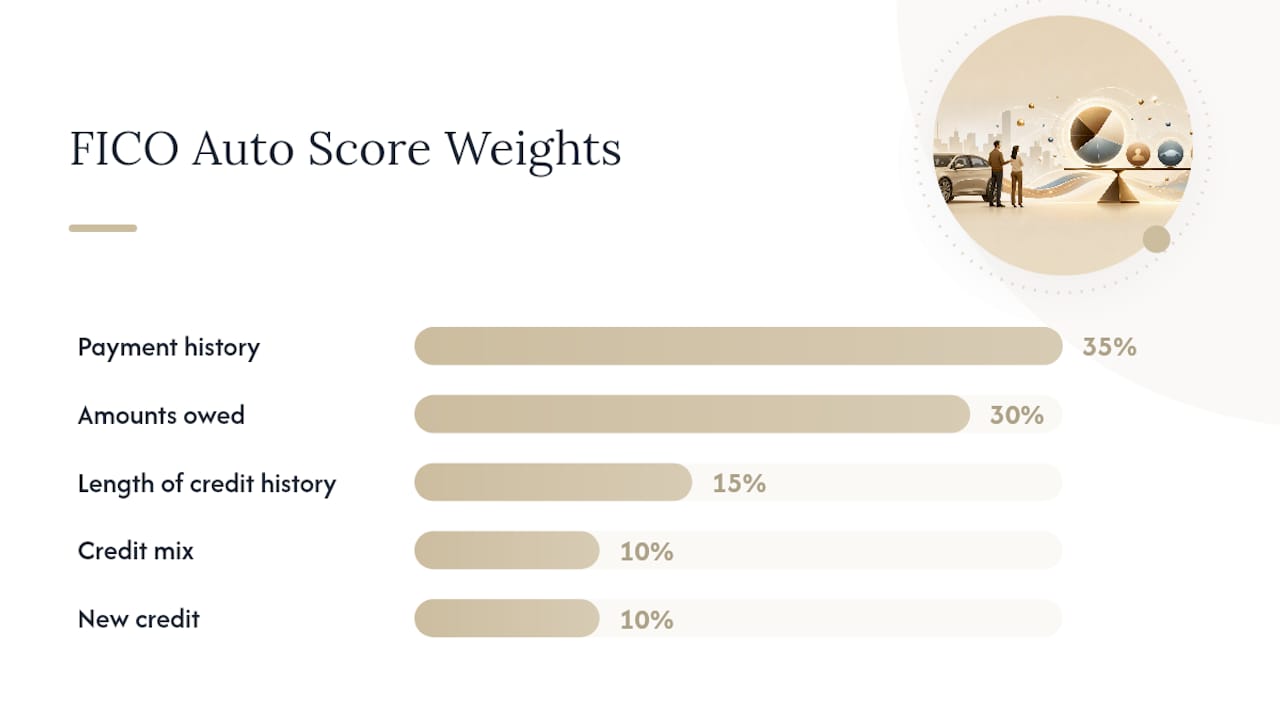
Payment history (~35%) is the single biggest lever. One missed auto payment can do more damage on an Auto Score than the same miss would on your base score, because the model treats auto-loan conduct as a stronger predictor.
Amounts owed (~30%) means your credit card utilization matters just as much here as anywhere else. Paying down revolving balances before you apply is one of the fastest ways to nudge your number up.
Length of credit history (~15%), credit mix (~10%), and new credit (~10%) round out the model. Opening a new credit card two weeks before applying for a car loan hits the “new credit” category and can shave points off right when you need them most.
How Do You Check Your Fico Auto Score Before You Shop?
Getting the exact Auto Score usually costs money. FICO and the credit bureaus sell direct access to industry-specific scores, and pricing varies by product. Investopedia notes that this paid access is the only reliable way to see your precise Auto Score number.
The free workaround most shoppers actually use:
- Check your base FICO score through your bank or credit card issuer, most of which offer it at no cost.
- Pull your full credit reports from AnnualCreditReport.com to catch errors before a lender does.
- Treat the base score as a directional proxy, not an exact match, since the Auto Score will typically land in the same general tier even if the number itself differs.
A free base score won’t tell you your precise Auto Score, but it’s close enough to plan around.
What Counts as a Good Fico Auto Score for Car Loans?
Lenders generally consider scores in solid territory for favorable auto rates, though exact thresholds can vary by lender. Thresholds shift by lender and loan type. The relationship between score and rate is steep: Experian’s research confirms that higher scores correlate strongly with lower APRs, but the score is never the only input.
Lenders also weigh:
- Loan-to-value ratio (how much you’re borrowing relative to the car’s worth)
- Vehicle age and mileage
- Loan term length
- Your income and existing debt load
That’s why two buyers with nearly identical credit scores can walk away with different rates. If you want a clearer picture of what your tier should actually cost, our breakdown of auto loan credit tiers and APR bands maps out realistic ranges, and our guide on what an 800 credit score should get you shows just how wide the gap gets at the top of the scale.
Does Rate Shopping for a Car Loan Hurt Your Credit?
Not if you do it right. Multiple auto loan inquiries within a short window, commonly around 14 days, are typically treated as a single hard inquiry rather than several separate ones. Experian’s guidance confirms this is standard practice built into the scoring models specifically to protect comparison shopping. Our deeper look at how multiple auto loan inquiries affect your credit walks through the mechanics in more detail.
A practical shopping sequence:
- Get soft-pull prequalification offers first wherever available, since these don’t touch your score at all.
- Cluster any hard-pull applications into a tight window, ideally within 14 days.
- Compare every offer side by side, including the APR, term, and any add-ons.
- Walk into the dealership with a target APR already in hand, based on your credit tier.
Pro Tip: Ask the finance manager for a written breakdown of your APR before you sign. If the number doesn’t match your researched target, say so directly and be ready to walk.
Turning Your Score Into Negotiating Leverage
Knowing your score matters less than knowing what to do with it. The real value comes from converting that number into a specific dollar target before you sit down at the dealership.
A workable sequence looks like this:
- Check your base FICO score (or paid Auto Score, if you have access).
- Estimate your expected APR band for your credit tier using resources like Baywall’s credit tier breakdown.
- Collect soft-pull prequalification offers from a few lenders, including credit unions, which often beat dealer rates.
- Benchmark the dealer’s actual quote against comparable transactions to see whether it’s great, fair, or high.
That last step is where most buyers leave money on the table. Baywall’s benchmarking tool compares your dealer’s quoted APR against real data from similar loans, same credit tier, same loan type, similar vehicle, and returns a target rate along with an estimated dollar savings figure.
Publisher Perspective: Stop Chasing the Perfect Score Number
Trying to guess which Auto Score version your lender will pull is a waste of energy. The behaviors that move every version, on-time payments, lower utilization, fewer new inquiries, are identical. Fix those fundamentals, use your base score as a proxy, then spend your remaining effort where it actually pays off: shopping multiple offers and negotiating against real market data instead of a dealer’s opening number.
— Baywall
Check Your Dealer’s APR Before You Sign
You’ve done the hard part: you know your credit tier, you’ve checked your score, and you understand how the rate-shopping window works. This tool closes the loop. Enter your credit score, vehicle, loan amount, term, and the dealer’s quoted APR, and the tool benchmarks that offer against real data from comparable deals.
The report tells you whether your offer is great, fair, or high, and provides a target APR to negotiate toward with an estimate of potential savings. It also shows current market pricing for similar vehicles to help with negotiating. If you’d rather understand your financial readiness before you even start shopping, PsyFi’s financial stress score tool is worth a look too. When you’re ready to see whether your dealer’s number holds up, run your loan through Baywall’s analysis tool before you sign anything.
This article is general information, not a substitute for advice from a qualified financial advisor. Consult a qualified financial professional about your own circumstances before acting on anything here.
Sources
- FICO® Auto Score
- What Is a FICO® Auto Score? | Experian
- FICO Score Types: Why Multiple Versions Matter for You | myFICO
- Understanding FICO Auto Scores: Key to Your Car Loan Approval | Investopedia