12 Finance Office Questions U.S. Car Buyers Must Ask

Demand the APR, loan term, and amount financed in writing before anyone mentions a monthly payment. Ask directly whether the quoted rate is the lender’s buy rate or includes a dealer markup. Decline every optional product by default until each one is itemized, priced separately, and explained.
TL;DR:
- Asking to see the lender’s approval sheet can reveal whether the dealer marked up the interest rate beyond the approved buy rate, which is typically 1% to 3%.
- Obtain and compare the specific APR, term, and total of payments in writing before signing to avoid hidden fees and inflated loan amounts.
- Check which credit bureau was used and review each score to prevent dealers from using the lowest score to justify a higher rate.
- Verify that any add-on products are itemized, priced separately, and only included if you explicitly agree to them.
- Use preapproval from a bank or credit union to establish a rate ceiling, and walk out if final approval is conditional or if numbers unexpectedly shift during signing.
Table of Contents
- What Finance Office Questions Should You Ask? A 12-Point Checklist
- How Buy Rates and Dealer Markups Actually Work
- Spotting Hidden Add-Ons and Inflated Loan Amounts
- Why Credit Pulls Deserve Their Own Question
- Scripts That Keep You in Control of the Conversation
- Why Exact Targets Beat Vague Negotiation Goals
- Get Your Target APR Before You Walk In
- Where These Numbers Come From
- Sources
- FAQ
What Finance Office Questions Should You Ask? A 12-Point Checklist
The finance office runs on momentum. The manager wants you focused on a monthly number that feels comfortable, because that number hides everything else, term length, markup, add-ons, rolled-in fees. Your job is to slow the conversation down and force each piece onto paper before you sign anything.
Here’s the script, in order:
- “Is that the buy rate or the sell rate?” Ask to see the lender approval sheet. This single question exposes whether the dealer padded the rate above what the lender actually approved.
- “Can I get the APR, term, amount financed, finance charge, and total of payments itemized?” Not the monthly payment. All five numbers, separately, in writing.
- “Which credit bureaus did you pull, and can I see each score?” Dealers sometimes use the lowest of two or three scores to justify a higher rate.
- “Is [PRODUCT] required to get this financing?” Ask this for every add-on mentioned, extended warranty, GAP insurance, appearance packages, anything.
- “What’s the cash price versus the financed cost of that product?” A $900 warranty often costs closer to $1,200 once it’s rolled into a 60- or 72-month loan with interest.
- “Who’s the provider, and what’s the cancellation policy?” You want a name, a phone number, and a refund window in case you decide to cancel within 30 or 60 days.
- “Is there a prepayment penalty on this loan?” Most modern auto loans don’t carry one, but confirm it rather than assume it.
- “How was my rebate or incentive applied, cash off the price, or toward the loan?” These get mixed up more often than buyers expect.
- “Is this approval final, or still conditional?” A “spot delivery” where you drive off before financing is locked can unravel days later.
- “Can you show me the buyer’s order line by line?” Every fee should have a name and a dollar figure next to it.
- “What’s the total amount I’ll pay over the life of this loan?” This number tells you more than the APR alone ever will.
- “Will you put all of this in writing before I sign?” If the answer is hesitant, that hesitation is information.
The CFPB’s auto loan guide backs nearly every question on this list, and for good reason: buyers who ask for numbers in writing catch problems before they become expensive mistakes.
How Buy Rates and Dealer Markups Actually Work
When a dealer sends your application to a lender, the lender comes back with a “buy rate,” the actual rate it’s willing to finance you at based on your credit and the deal terms. The dealer is then allowed to mark that rate up before presenting it to you, and pocket the difference as compensation.
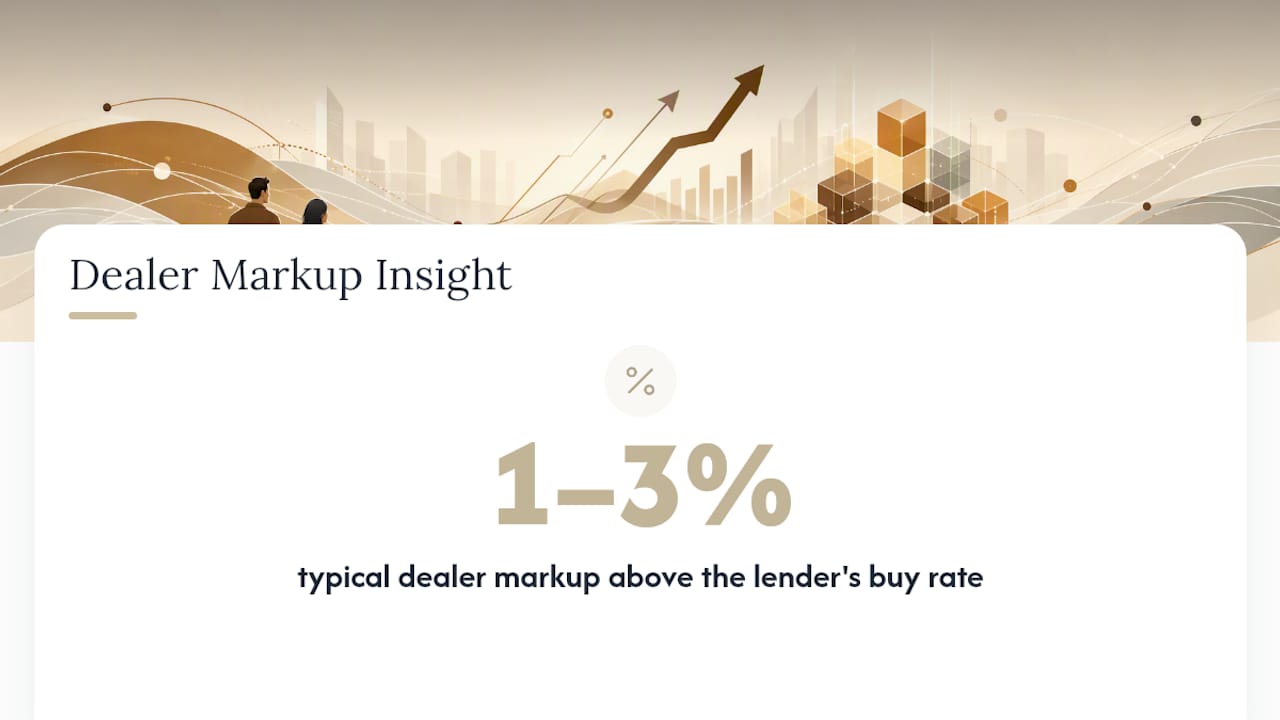
Dealers can mark up interest rates by roughly 1% to 3% above the lender’s approved buy rate, according to the CFPB, and that markup is negotiable. On a $30,000 loan over 60 months, even a 2-point markup adds well over $1,000 in extra interest.
That’s the gap you’re negotiating against. It’s not written on any sticker, and the finance manager isn’t required to volunteer it, but asking directly for the lender approval sheet usually gets it revealed.
This is where a preapproval from your bank or credit union becomes real leverage instead of just a backup plan. Walking in with a rate already locked sets a ceiling the dealer has to beat, or match. The exact phrasing matters here: “My preapproval is 6.5% for 60 months. Can you beat that on the same term, with nothing rolled in?” Notice the constraint, same term. A dealer who “beats” your rate by stretching the loan to 72 months hasn’t actually saved you anything; they’ve just moved the savings into future interest. Compare offers only when the amount financed and the term match exactly.
Spotting Hidden Add-Ons and Inflated Loan Amounts
Run this math before you sign anything: out-the-door price minus down payment minus trade-in value, plus any legitimate loan payoff, should equal your amount financed. If the number on your contract is higher than that, something got added without a clear conversation.
The usual suspects: extended warranties, GAP insurance, tire and wheel protection, theft deterrent packages, and inflated documentation fees that vary wildly by dealer and state.
If you catch a mismatch, work through it in order:
- Point to the specific line item that doesn’t match your math.
- Ask what it is, and whether you agreed to it.
- Request it be removed if you didn’t.
- Ask for corrected documents reflecting the new amount financed.
- Recheck the math before signing the revised paperwork.
Pro Tip: Take a photo of the buyer’s order before you leave for a break or a bathroom trip. Numbers occasionally shift between drafts, and a timestamped photo settles any dispute about what you actually agreed to.
Why Credit Pulls Deserve Their Own Question
Ask which bureau, or bureaus, the finance office pulled, and ask to see the actual scores. Dealers sometimes present the lowest score among two or three pulls to justify placing you in a higher rate tier. Experian’s guidance on car loan negotiation recommends pushing back if your middle or higher score would qualify you for a better bracket.
If you spot an error on any report, a paid-off account still showing a balance, an account that isn’t yours, pause before signing. Either get preapproved elsewhere while you dispute it, or ask the finance office to hold the deal until the correction posts.
Scripts That Keep You in Control of the Conversation
Work the room in this order: lock the vehicle price first, get every term in writing second, compare it against your preapproval third, decline add-ons fourth, and only then finalize the paperwork. Skipping ahead to “what’s my payment” undoes all of it.
Three scripts worth memorizing:
- “My preapproval is [X]% for [Y] months. Can you match or beat that with the same term and no rolled-in products?”
- “I did not agree to [PRODUCT]. Please remove it and give me corrected documents before I sign.”
- “Before we talk payment, I need the APR, term, and amount financed in writing.”
SuperMoney’s negotiation research points to the same core habit: walk in with three fixed numbers, your maximum out-the-door price, your maximum APR, and your maximum term, and refuse to let the conversation drift past them.
Why Exact Targets Beat Vague Negotiation Goals
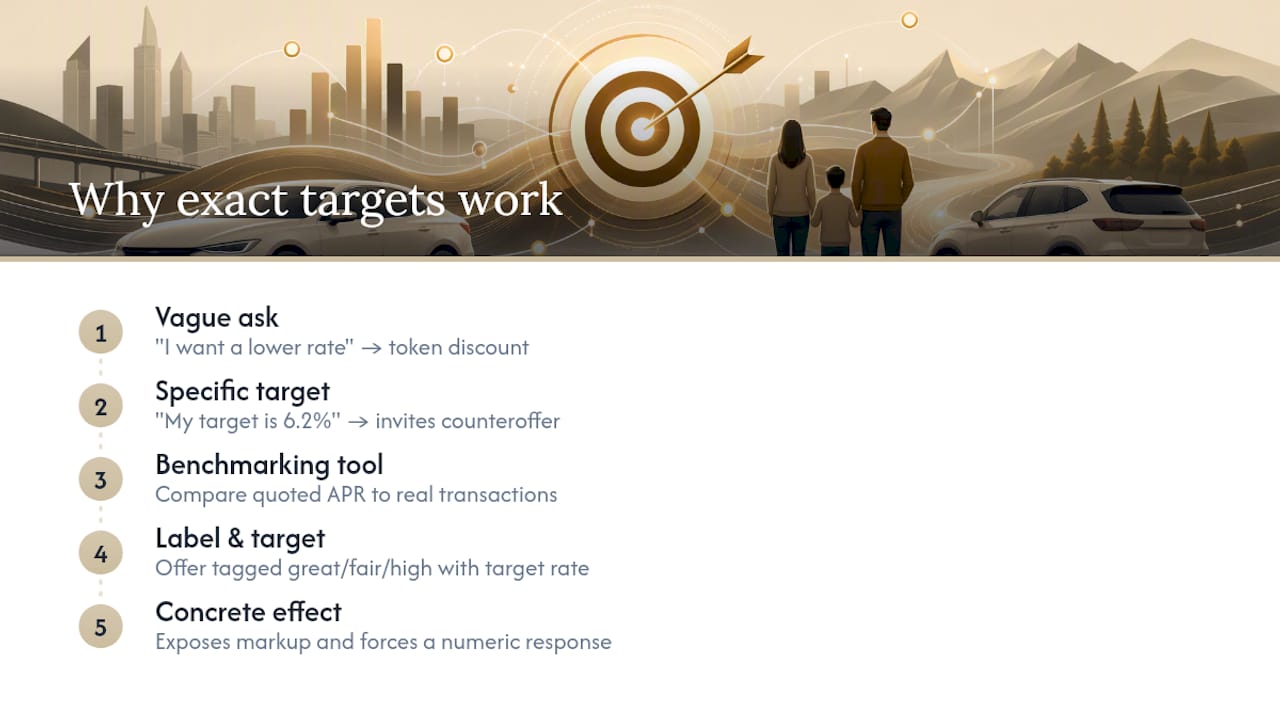
Telling a finance manager “I want a lower rate” invites a token discount and a smile. Telling them “my target is 6.2% based on my credit tier and this vehicle” invites an actual counteroffer, because you’ve removed the ambiguity they rely on.
A specialized tool builds that specificity by benchmarking a dealer’s quoted APR against real transactions from buyers with comparable credit scores, loan amounts, and vehicles, then labeling the offer great, fair, or high, with a target rate attached. A number that precise does something a general “shop around” tip never does: it exposes the exact size of the markup and gives the dealer a concrete figure to respond to, not a vague complaint to deflect.
— Baywall
Get Your Target APR Before You Walk In
This service turns the guesswork in the finance office into a number you can defend. Enter your credit score, the vehicle, loan amount, and term, along with the rate the dealer quoted, and it benchmarks that against real transactions from buyers in the same credit tier and loan type.
The report gives you three things worth having before you sit down at that desk: a target APR to negotiate toward, an estimate of your potential dollar savings, and current market pricing for similar vehicles so you know if the sticker price is fair too. A free basic version is available if you just want a quick read on your offer, and the full one-time report runs $2.99, which is a lot cheaper than a rate markup nobody flagged. Head to Baywall’s analyze tool and check your dealer’s quote before you sign anything. If you want deeper background on how APR interacts with loan term, Baywall’s APR versus interest rate guide walks through the math in plain terms.
Where These Numbers Come From
Every figure in this guide traces back to a source you can check yourself. The CFPB’s buy rate explainer and its auto loan consumer guide cover markup disclosure and buyer protections in detail. Experian and Phroogal offer practical negotiation walkthroughs, and dealer-side financing mechanics are covered by Loturn’s floor plan financing guide.
Sources
- What is a buy rate for an auto loan? CFPB
- Your guide to auto loans Consumer Financial Protection Bureau (PDF)
- How to negotiate auto loan terms Phroogal
- How to negotiate a car loan Experian
- How to negotiate auto loan rates with dealerships and banks SuperMoney
FAQ
Can I See the Dealer’s Buy Rate Before I Sign?
Dealers aren’t required to hand you the lender approval sheet, but asking for it directly, framed as “is this the buy rate or a marked-up rate,” often gets it shown. The CFPB confirms markups typically run 1% to 3% above what the lender actually approved, so it’s worth pushing for.
What If My Approval Says “Conditional” or “Pending Final Approval”?
Don’t drive off the lot, and don’t sign a final contract, until the finance office confirms the approval is complete. A conditional or “spot delivery” approval can fall through days later, sometimes forcing you back in for a worse rate or a returned vehicle.
Can I Walk Out and Come Back Later?
Yes, and it’s one of the strongest moves available to you. Leaving to check your numbers against a tool like Baywall, or to call your credit union for a preapproval, costs you nothing and often resets the negotiation in your favor.
Which Credit Bureaus Do Dealers Usually Pull?
It varies by dealer and lender network, which is exactly why you should ask. Experian recommends requesting to see every score pulled, since dealers can lean on the lowest one to justify a higher rate tier.
How Much Could a Dealer Markup Actually Cost Me?
On a typical loan, a 1 to 3 percentage point markup can add well over $1,000 in extra interest over the loan term, depending on the amount financed. A Baywall report gives you the specific target rate and dollar savings for your exact deal instead of a general range.