U.S. Buyers: F-150 Loan Rates, Baywall Benchmark & Negotiation Script

Most shoppers will see higher rates once their local dealer’s inventory and their own credit tier enter the picture. Before you sign anything, get a written quote and benchmark it against what comparable buyers actually paid.
TL;DR:
- Your credit score and loan term significantly influence your actual APR, often pushing the rate well above advertised promotional offers.
- Regional differences mean that incentives advertised nationally may not apply locally, so always ask for written confirmation of specific offers.
- Extending the loan term from 36 to 72 months can substantially increase the total interest paid, even if monthly payments decrease.
- Always obtain a written refinance or loan quote before negotiations and benchmark it with market data to ensure fairness.
- Comparing rebate offers against your available financing options requires calculating total interest costs, not just monthly payments.
Table of Contents
- What Are the Current Ford F-150 Loan Rates and Promotions?
- What APR Should You Expect Based on Your Credit Score?
- How Does Loan Term Length Change Your Total Cost?
- How Do You Verify a Dealer’s APR Quote Before Signing?
- What Should You Ask and Bring to the Dealership?
- Should You Choose 0% APR or the Cash Rebate?
- Where to Confirm Current Offers and Benchmark Rates
- Stop Negotiating Against a Number You Can’t Verify
- Sources
What Are the Current Ford F-150 Loan Rates and Promotions?
The gap between “as low as” and “what you’ll actually pay” is where most F-150 buyers lose money. Ford’s national incentives page typically advertises a handful of standout offers, and it’s worth knowing what they look like before you walk into a dealership.
Recent examples of widely advertised Ford F-150 financing deals include:
- 0.0% APR for a term of several months on select F-150 trims, a common play for moving inventory fast without cutting sticker price.
- Low single-digit APR for a longer term, which showed up during Ford’s Summer Sales Event on certain trims and regions.
- Deferred first-payment offers, sometimes bundled with a promotional APR, letting buyers skip a payment or two at the start of the loan.
- Cash rebates as an alternative to low APR, often listed side by side with the financing offer so buyers can pick one or the other.
Ford’s official incentives page lists these deals with specific expiration dates, usually tied to the end of a sales month or a broader seasonal event. Read the fine print.
Here’s the part that trips people up: these are national advertisements, not local guarantees. A truck sitting on a lot in Ohio might carry a different incentive package than the same trim in Texas, because Ford allocates promotional funding regionally based on inventory levels and sales targets. Reporting on Ford’s Summer Sales Event confirmed this kind of regional variability directly, noting that the advertised 2.9% and 0% offers weren’t uniformly available everywhere. If your dealer tells you the promo “doesn’t apply here” or “ran out,” that’s not automatically a sales tactic. It might genuinely be true. Either way, don’t take their word for it. Ask them to show you the specific offer code and its terms in writing.
What APR Should You Expect Based on Your Credit Score?
Advertised promotional rates are the exception, not the rule. Most F-150 financing lands somewhere in a range shaped almost entirely by credit tier and loan term, and knowing where you fall on that scale is more useful than memorizing the headline offer.
Broadly, here’s how new-vehicle APR bands tend to break down by credit profile, based on aggregated lender data for trucks like the F-150:
- Excellent credit (roughly 720 and above): Often eligible for the lowest advertised promos, or close to them, sometimes in the low single digits if a manufacturer incentive applies.
- Good credit (roughly 660 to 719): Typically sees APRs a few points above the promotional rate, often landing in the mid-single digits to around 8%.
- Fair credit (roughly 600 to 659): APRs commonly climb into the double digits, sometimes 9% to 13%, depending on the lender and term length.
- Subprime credit (below 600): Rates can run considerably higher, and approval itself becomes less certain without a larger down payment or co-signer.
Aggregated APR data from U.S. News shows this kind of spread across lenders and terms, and it lines up with what deal trackers report about promotional pricing being reserved for “well-qualified” buyers, a phrase that almost always maps to a credit score in the low 700s or better.
An APR for a Ford F-150 with 720 credit will look meaningfully different from the same truck financed at 640. That’s not a knock against fair-credit buyers. It’s just math lenders use to price risk. Anchor them to the good-credit band, and treat anything above that range as a starting point for negotiation, not a final answer.
How Does Loan Term Length Change Your Total Cost?
A lower APR doesn’t always mean a cheaper loan. Term length changes the math more than most buyers expect, and the interaction between APR and term is where a lot of “great deals” quietly become expensive ones.
Take a $45,000 loan with three different structures:
- 36 months at 5% APR: Monthly payment lands around $1,349, and total interest paid over the life of the loan comes to roughly $3,550.
- 60 months at 6% APR: Monthly payment drops to about $870, but total interest climbs to roughly $7,200, more than double the shorter term despite a similar rate.
- 72 months at 6.5% APR: Monthly payment falls further to around $760, yet total interest paid balloons past $9,700.
The pattern holds across almost any price point: stretching the term lowers the monthly hit but raises the lifetime cost, because you’re paying interest on a larger remaining balance for longer.
Down payment size and any trade-in equity change this picture further. A larger down payment shrinks the principal you’re financing, which lowers both the monthly payment and the interest charged, regardless of which term you choose. If a dealer runs your numbers, ask to see the amortization breakdown, not just the monthly figure. That’s the only way to compare apples to apples across term lengths.

How Do You Verify a Dealer’s APR Quote Before Signing?
Getting a fair rate on an F-150 isn’t about finding a secret discount. It’s about confirming the number in front of you against real market data, then using that gap, if one exists, as leverage.
Step 1: Get the written quote first. Before you talk trade-in value or down payment, ask the finance manager to write down the lender name, the APR, the loan term, and every incentive applied to reach that number. Dealer-focused reporting consistently flags this as the single most important habit for buyers, because verbal quotes can shift once trade-in negotiations start.
Step 2: Benchmark the quote against your actual credit tier. This is where a tool like Baywall earns its keep. Enter your credit score, the vehicle, loan amount, and term, and Baywall compares your dealer’s offer against real transactions from buyers in the same credit tier financing similar vehicles. You’ll get a label, great, fair, or high, along with a specific target APR and an estimated dollar savings if your quote is running above market.
Step 3: Use the benchmark as your negotiation script. If your quote comes back “high,” you have a concrete number to push toward, not just a gut feeling that you’re being overcharged. A workable approach:
- Tell the finance manager the target APR your benchmark returned and ask if they can match it.
- Mention any competing pre-approval you’ve secured from a bank or credit union, even a modest one, as leverage.
- If they won’t move on APR, ask whether the difference can be offset through a larger rebate or reduced fees instead.
Dealers have more flexibility than they usually let on, especially near the end of a sales period when they’re chasing volume targets.
Pro Tip: Time your negotiation around the end of the month, the end of a quarter, or when a dealer is visibly overstocked on a specific trim. Sales staff have quotas, and quota pressure is often the fastest way to unlock rate flexibility that “isn’t normally available.”
What Should You Ask and Bring to the Dealership?
Walking in prepared changes the entire tone of the negotiation. Here’s what actually matters once you’re sitting across from a finance manager.
- Ask which lender is financing the deal, and whether the advertised APR requires Ford Credit specifically. If it does, and you’d rather use your own bank, ask how the rate changes.
- Ask what credit score tier the quoted APR assumes. If your score is close to a cutoff, ask whether a slightly higher score would move you into a better bracket.
- Ask whether any rebate is being stacked with the APR offer, or if you have to choose one. Some incentives are mutually exclusive, and dealers don’t always volunteer that.
- Bring a pre-approval letter from a bank or credit union, even if you plan to finance through Ford Credit. It gives you a real number to compare against, not a hypothetical one.
- Bring a recent credit report summary so you’re not relying on the dealer’s version of your score, which can sometimes differ from what you’ve seen yourself.
Watch for a few red flags along the way: a finance manager who won’t put the APR in writing before discussing trade-in value, a quote that changes after you mention a competing offer, or pressure to sign quickly “before the promo expires” without giving you time to verify the math. Any one of those is a reasonable moment to pause, or walk.
Should You Choose 0% APR or the Cash Rebate?
- Calculate the total interest you’d pay on the loan amount at a typical market rate for your credit tier, then compare that figure directly to the rebate amount.
- Example: On a $40,000 loan over 60 months, a 6% market rate costs roughly $6,400 in total interest. If the rebate offered is $3,000 and the alternative APR from a credit union is 4%, taking the rebate and financing elsewhere often costs less overall.
- 0% Ford Credit financing usually wins when the rebate is small relative to the loan amount and your credit qualifies for the promotional rate outright.
- The rebate plus outside financing often wins when you have access to a competitive credit union rate and the rebate is large enough to offset the interest gap.
If you need the lowest possible monthly payment, run both scenarios through Baywall before deciding, since the better math isn’t always the better cash flow for your situation.
Where to Confirm Current Offers and Benchmark Rates
Check Ford’s incentives page and CarsDirect’s daily-updated listings for current promotions in your region. Then run your dealer’s quote through Baywall’s analysis tool to see your target APR.
Stop Negotiating Against a Number You Can’t Verify
Most advice on Ford F-150 loan rates stops at listing the promotional APRs and calling it a day. That’s not enough.
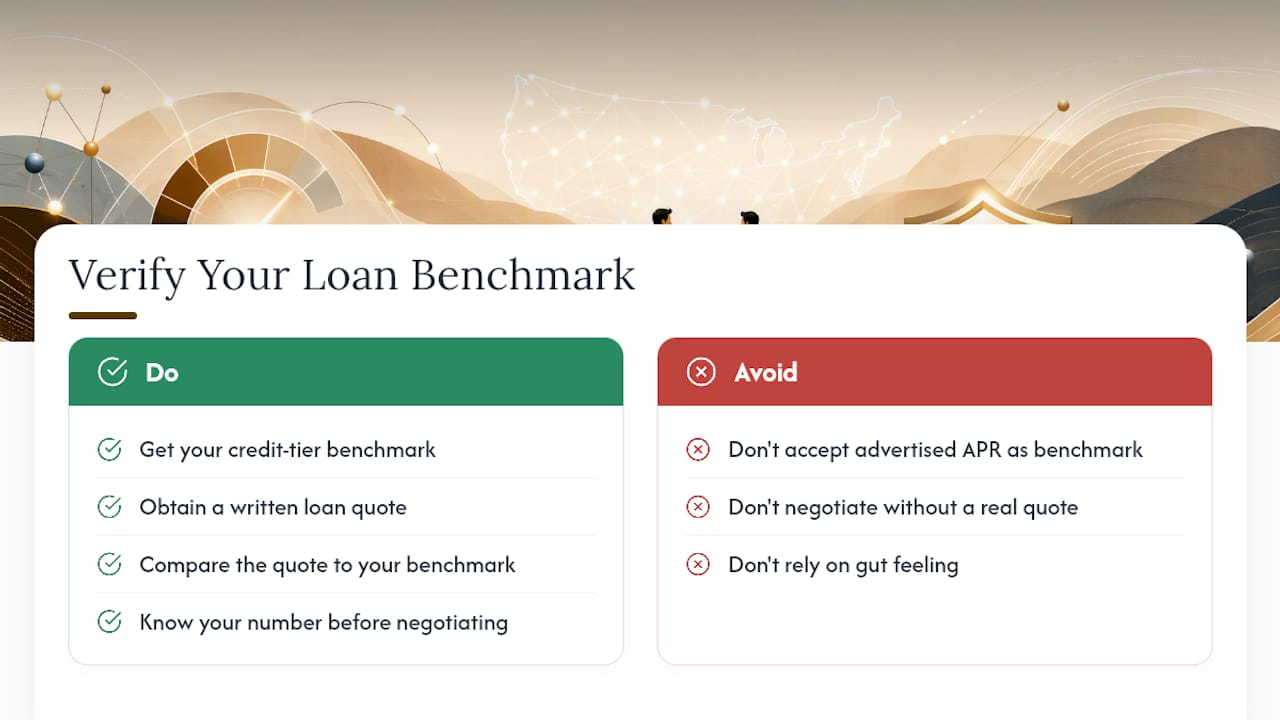
Conventional wisdom treats the advertised rate as the benchmark. We’d argue your credit tier is the benchmark, and the advertised rate is just one possible outcome within it. That comparison rarely happens at the dealership, because nobody there benefits from you seeing it.
If you take one thing from this, verify before you negotiate. A written quote plus a real benchmark, not a gut feeling, is what turns a guess into leverage. Everything else, the trim, the term, the rebate math, is secondary to knowing your actual number before you sit down.
— Baywall
Sources
- 2026 Ford F-150® Truck | Pricing, Leasing & Incentives
- Ford-trucks
- 2027 & 2026 Ford F-150 Prices, Financing Deals and Lease Specials | CarsDirect