Loan to Value on Auto Loans: What Borrowers Need to Know

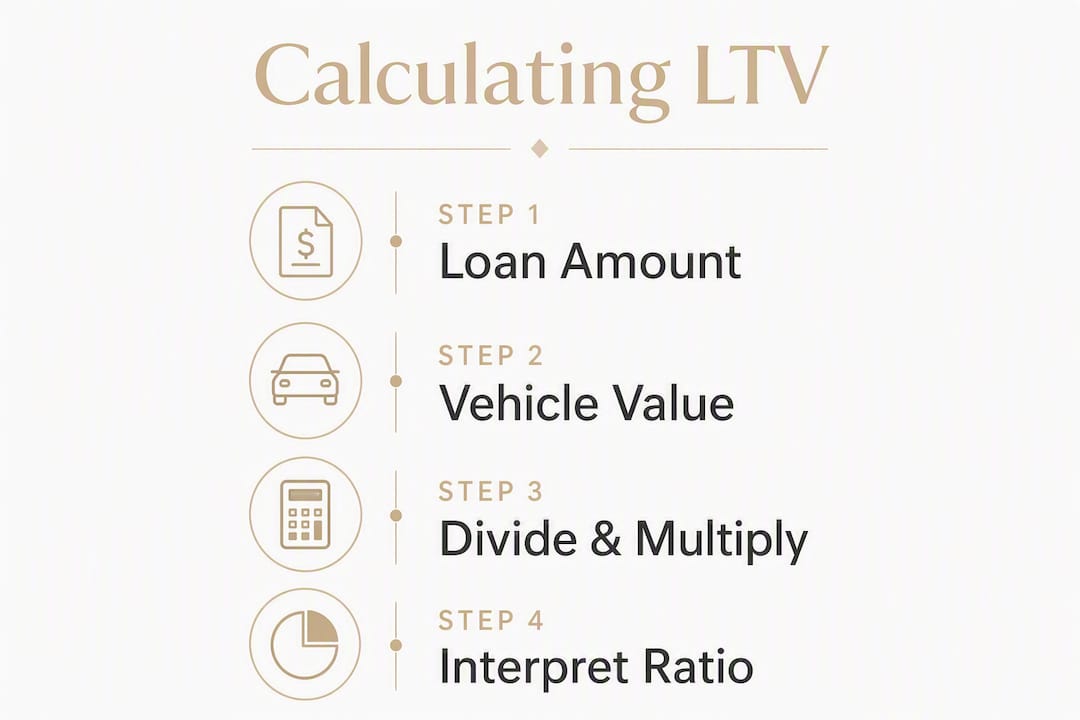
Your car loan LTV is the loan amount divided by the vehicle’s value, multiplied by 100. Borrow a large portion of the vehicle’s value for your loan, and your LTV reflects that proportion. That single number tells lenders how much cushion they have if the car gets repossessed or totaled — and it directly shapes your APR, your approval odds, and how much you’ll pay over the life of the loan. The higher the LTV, the more risk the lender carries, and the more of that risk gets passed to you as a higher interest rate.
At a glance: A loan-to-value ratio above 100% means you owe more than the car is worth. CFPB guidance flags this as a significant vulnerability because standard insurance pays only market value — leaving you on the hook for the gap unless you carry GAP coverage.
Table of Contents
- How to calculate your loan-to-value ratio
- How lenders use LTV to set your rate and approval odds
- What negative equity means and how GAP insurance protects you
- Concrete ways to lower your LTV before and after signing
- LTV bands and what they typically mean for your deal
- How Baywall turns your LTV knowledge into a negotiation target
- Key Takeaways
- The trade-off most buyers miss
- Check whether your dealer’s rate is actually fair
- Useful sources and further reading
How to calculate your loan-to-value ratio
The formula has two inputs: your loan amount and the lender’s vehicle value. Here’s how to run it:
- Find your loan amount. For a new loan, this is what you’re asking to borrow. For an existing loan, pull your most recent statement balance.
- Find the vehicle value. Use Kelley Blue Book, Edmunds, or J.D. Power as a starting point — but know that lenders often apply their own internal valuation, which can be lower than the retail asking price.
- Divide loan amount by vehicle value.
- Multiply by 100 to get the percentage.
Three worked examples:
- New purchase: $22,500 loan ÷ $25,000 vehicle = 90% LTV
- Rolled negative equity: You owe $3,000 on a trade-in worth $2,000. That $1,000 deficit rolls into a new $24,000 loan on a $25,000 car. New loan equals the vehicle’s value, so the LTV starts at 96%. (Calculation: $24,000 ÷ $25,000 × 100 = 96% LTV.)
- Refinance: Current balance substantially less than the car’s worth gives a lower LTV — which helps eligibility and rate.
A few things to watch:
- Lenders may use wholesale value, not retail sticker price, as the denominator. Ask explicitly which source they’ll use.
- Financing taxes, registration, or add-ons raises the loan amount without raising the collateral value, pushing LTV higher immediately.
- Your self-calculated LTV and the lender’s LTV can differ — sometimes by several percentage points.
Pro Tip: Ask the lender in writing which vehicle value source they’re using before you agree to terms. A $1,500 difference in their appraisal can shift your LTV by 5–7 points on a typical used car loan.
How lenders use LTV to set your rate and approval odds
Lenders treat LTV as a collateral protection metric. If you default and the car gets repossessed, they need to recover the loan balance through resale. A lower LTV gives them that buffer; a higher LTV shrinks it.

According to Experian, Lenders commonly set internal LTV ceilings for auto loans that may range over 100%, with some flexibility depending on lender policies. Exceed the ceiling and the loan is declined outright. Stay below it but above 100%, and you’ll typically face a higher APR and stricter terms.
LTV doesn’t work in isolation. Capital One notes that lenders combine LTV with credit score and debt-to-income ratio (DTI) when pricing a loan. Experian reports that auto lenders typically set a maximum DTI of 45%–50%. A borrower with a strong credit score can sometimes offset a higher LTV; a borrower with a thin credit file and a high LTV faces a compounding disadvantage. Check used car loan rate benchmarks to see how these factors interact across credit tiers.
Key lender behaviors to know:
- High LTV triggers a higher APR, even when credit score is good.
- Some lenders require a minimum down payment once LTV crosses a threshold.
- Used vehicles face tighter LTV limits than new ones because they depreciate faster.
- Vehicle age and mileage can lower the lender’s appraised value, raising your effective LTV.
Vehicles also depreciate quickly after purchase, which means an LTV that looks safe at signing can climb in the early months as the car loses value faster than the loan amortizes. That’s a risk worth factoring in before choosing a long term.
What negative equity means and how GAP insurance protects you
Negative equity occurs when your loan balance exceeds the car’s market value — LTV above 100%. It happens most often when buyers roll a prior loan balance into a new deal, finance a large add-on package, or choose a long loan term on a fast-depreciating vehicle.
Here’s a concrete rollover scenario: You trade in a car worth $12,000 but still owe $14,500. That $2,500 deficit gets added to your new $28,000 loan on a $30,000 vehicle. Your starting LTV is ($30,500 ÷ $30,000) × 100 = 101.7% — underwater from day one.
The CFPB’s negative equity report warns that using high-LTV loans to cover prior negative equity often creates a cycle that’s hard to break. Each rollover compounds the problem.
Where GAP insurance fits:
- Standard auto insurance pays the car’s actual cash value at the time of a total loss or theft — not your loan balance.
- If your LTV is above 100%, that payout leaves a gap between what insurance covers and what you still owe.
- GAP (Guaranteed Asset Protection) insurance covers that difference.
- It’s most relevant in the first 12–24 months of a high-LTV loan, when depreciation is steepest.
Understanding common auto insurance gaps can help you decide whether GAP coverage makes sense for your situation.
Pro Tip: Don’t roll GAP insurance into the loan itself — that raises your LTV further. Pay for it separately through your insurer or a credit union, where it’s typically cheaper than the dealer’s add-on price.
Concrete ways to lower your LTV before and after signing
Before you sign:
- Increase your down payment. Increasing your down payment by a moderate amount can meaningfully reduce your LTV on a typical vehicle purchase.
- Apply trade-in equity. Positive equity from your current car reduces the amount you need to finance.
- Negotiate the purchase price down. A lower vehicle price shrinks the loan needed for the same down payment.
- Pay taxes and fees out of pocket rather than rolling them in. Financing a $1,500 tax bill adds to your loan balance without adding to the car’s value.
After purchase:
- Make accelerated payments in the first year, when depreciation is steepest.
- Refinance once your LTV drops below 80% — lenders typically offer better rates at that threshold.
- Before refinancing, confirm the car’s current value using Kelley Blue Book or Edmunds, pull your payoff balance, and recalculate LTV. If it’s still above 100%, wait or pay down the balance first.
Knowing your APR versus interest rate distinction also matters here: when you refinance, compare APRs across lenders, not just the monthly payment, to see the true cost difference.
LTV bands and what they typically mean for your deal
| LTV Band | Typical Lender Response | Negotiation Margin |
|---|---|---|
| ≤80% | Strong approval odds, best available APR | High — you have real leverage |
| 81%–100% | Approved with standard terms; rate depends on credit | Moderate |
| 101%–120% | Higher APR, possible down payment requirement | Low |
| >120% | Near or above most lender ceilings; may require cosigner | Very limited |
Three scenarios that show how quickly LTV moves:
- Add-on financing: A $30,000 car with a $27,000 loan is 90% LTV. Adding extended warranties and taxes to your loan increases the loan balance without increasing vehicle value, pushing LTV toward or above 100%.
- Strong trade-in: Same $30,000 car, but you bring $5,000 in trade-in equity. Bringing trade-in equity lowers the financed amount and moves LTV into a favorable range.
- Negative equity rollover: Owe $4,000 more than your trade-in is worth. That $4,000 rolls into the new loan: Rolling negative equity increases the financed amount above the vehicle’s value, creating negative equity from the start.
How Baywall turns your LTV knowledge into a negotiation target
Understanding your LTV is the foundation. Knowing whether the APR you’re being quoted is actually fair for your LTV and credit profile is the next step — and that’s where Baywall comes in.
Baywall benchmarks a dealer’s quoted APR against real data from comparable transactions: same credit tier, similar vehicle, same loan term. You enter your credit score, vehicle details, loan amount, term, and the dealer’s rate. The tool tells you whether that offer is great, fair, or high — and gives you a specific target APR to negotiate toward, along with a dollar estimate of what you’d save over the loan term.
What the report shows you:
- A fairness label (great / fair / high) for your quoted APR
- The target APR based on comparable deals in your credit tier
- Estimated monthly and lifetime savings if you negotiate to that target
- Current market pricing for similar vehicles, so you can push back on the vehicle price too
Stat callout: Experian data shows lenders evaluate LTV alongside credit score and DTI — meaning a buyer who walks in knowing their LTV and their benchmark APR has two specific numbers to negotiate with, not just a vague sense that the rate feels high.
Baywall is particularly useful when your LTV sits in the 81%–100% band, where the rate outcome varies most by lender. See how APR benchmarks shift by credit score to understand what your profile should realistically command.
Key Takeaways
Your LTV is the single most controllable risk factor before you sign — calculate it, compare it against the bands above, and use it as a negotiation input alongside your APR benchmark.
| Point | Details |
|---|---|
| LTV formula | Loan amount ÷ vehicle value × 100; a $22,500 loan on a $25,000 car = 90% LTV. |
| High LTV costs more | LTV above 100% typically triggers a higher APR and may require a larger down payment. |
| Add-ons raise LTV fast | Financing taxes, fees, or warranties increases the loan balance without raising the car’s value; this can move LTV toward or above 100%. |
| GAP insurance matters | If LTV exceeds 100%, standard insurance won’t cover your full balance after a total loss. |
| Baywall benchmarks your offer | Enter your deal details and get a target APR based on comparable real transactions. |
The trade-off most buyers miss
The monthly payment is the number dealers want you to focus on. Stretch the term to 72 or 84 months and the payment looks manageable — but your LTV stays elevated for years longer, and depreciation keeps running. You can end up owing significantly more than the car is worth well into year three or four, which limits your options if you need to sell, trade, or refinance.
The smarter frame is to look at LTV alongside APR, term length, and whether you have three to six months of payments in reserve before you commit. A slightly higher monthly payment on a 48- or 60-month term often costs less in total interest and gets you to positive equity faster. Rolling in add-ons to keep the payment low is the move that looks affordable today and creates the most financial friction later.
Check whether your dealer’s rate is actually fair
You’ve done the work: you know your LTV, you understand how lenders price risk, and you know what band your deal falls into. The last step is confirming that the APR you’re being quoted reflects your actual borrower profile — not a markup the dealer added on top.
Baywall gives you a personalized rate benchmark in minutes. Enter your credit score, vehicle, loan amount, term, and the dealer’s quoted APR, and the report tells you exactly where that offer stands relative to comparable deals. You get a target rate, a dollar savings estimate, and vehicle market pricing — everything you need to negotiate with confidence or walk away knowing you got a fair deal. A basic check is free; the full personalized report is $2.99. Run your numbers at Baywall before you sign.
Useful sources and further reading
- CFPB — What is a loan-to-value ratio in an auto loan? — Primary definition, formula, and guidance on negative equity and borrower protections.
- CFPB — Negative Equity in Auto Lending Report — Data and analysis on how rolling negative equity creates cycles of financial risk.
- Experian — Auto Loan-to-Value Ratio Explained — Lender behavior, LTV ceilings (120%–125%), and how LTV interacts with credit score and DTI.
- Capital One Auto Navigator — Loan-to-Value Ratio — How LTV combines with credit score and DTI in underwriting decisions.
- Loanyzer — Auto Loan LTV Ratio — Practical examples of how financing add-ons and rollovers change LTV calculations.
- Baywall Blog — Used Car Loan Rates — Market benchmarks and negotiation targets by credit tier.