U.S. Buyers: Benchmarked Targets Lower Your Car Loan APR, Save $2K–$4K

Get preapproved by a credit union or online lender first, then use that buy-rate as leverage against whatever the dealer offers. Shop several lenders inside a short window so it counts as one credit pull, push for a shorter term or bigger down payment if your budget allows, and run the dealer’s number against a real market benchmark like Baywall before you commit. Those four moves catch nearly every dollar of savings available to you.
TL;DR:
- Credit unions typically offer the lowest APRs for auto loans, often below banks and dealer financing, and membership can be quickly obtained through various channels.
- Online lenders provide fast prequalifications with competitive rates for strong credit, but their offers generally do not beat credit union rates.
- Dealer financing may include manufacturer promotional rates but often comes with hidden markups and bundled add-ons that increase the total cost.
- Using Baywall’s transaction data helps establish a realistic benchmark and negotiation target, saving thousands in interest for your specific profile.
- Waiting to refinance makes sense only if your credit improves significantly or if a known promotional rate is imminent; otherwise, it is better to act quickly with preapproval and negotiate confidently.
Table of Contents
- What Determines Whether You Get a Lower Car Loan APR?
- Step-by-Step Playbook to Lower Your APR Before You Sign
- How Do You Negotiate a Lower APR at the Dealership?
- When Does Refinancing Actually Lower Your APR?
- What APR Should You Expect for Your Credit Tier?
- How Baywall Builds Your Target APR
- Should You Wait for a Better Rate or Buy Now?
- Get Your Negotiation Target Before You Sign Anything
- Sources
- FAQ
What Determines Whether You Get a Lower Car Loan APR?
The lender you choose matters more than almost anything else in this process, and the differences between lender types are not subtle. A borrower with identical credit, the same car, and the same loan term can see a real spread in APR depending on whether they finance through a credit union, an online lender, a bank, or the dealer’s finance office. Understanding where the lowest rates actually live is the first step toward getting one.
Credit unions consistently price lower than banks and dealers for comparable borrowers. Because they’re member owned and don’t answer to shareholders, credit unions typically price auto loans somewhat below banks and dealer financing for similar credit profiles (https://digitalcalculator.info/auto-loan-calculator/best-auto-loan-rate-guide/). Joining one is usually easier than people expect: many credit unions let you qualify through your employer, a family member’s membership, or a small donation to an affiliated association. Once you’re a member, getting preapproved takes maybe fifteen minutes online, and that rate becomes your negotiating floor. If you haven’t shopped a credit union yet, that’s the first call to make, and our guide on finding competitive credit union auto loans walks through which ones tend to beat dealer offers by the widest margin.
Online lenders trade a small rate premium for speed and convenience. Platforms in this category run a soft credit pull to show you a prequalified rate without touching your score, then move fast once you accept. They’re a strong option if your credit is strong and you value getting a decision in minutes rather than days. The tradeoff is that their rates, while competitive, don’t usually beat a good credit union offer for the same borrower.
Banks split the difference, often leaning on the relationship you already have. If you’ve banked somewhere for years and carry a decent balance, ask about a loyalty discount. It’s real at many institutions, typically a quarter to half a point, but it rarely closes the entire gap to a credit union rate.
Dealer financing is convenient, sometimes cheaper, and occasionally the most expensive option in the room. Dealers work with a network of lenders and can sometimes access manufacturer-subsidized promotional rates that beat everything else, particularly on new vehicles the manufacturer wants to move. But dealers are also legally allowed to mark up the wholesale “buy-rate” a lender quotes them before passing it to you, and that markup is where a lot of buyers lose money without realizing it. The CFPB’s shopping guidance exists largely because of this exact dynamic.
A benchmarking report tells you which number is actually fair. This is where Baywall fits into the picture. It doesn’t replace shopping multiple lenders. It tells you whether the best offer you’ve collected is actually good, or just good compared to a worse one.
| Source | Best for | How to access | Typical APR range | Main advantage |
|---|---|---|---|---|
| Baywall | Buyers who want a precise negotiation target before signing or refinancing | Enter credit score, vehicle, loan amount, and term at baywall.ai/analyze | Benchmarked to your exact profile, not a flat range | Transaction-based target APR plus dollar-savings estimate |
| Credit unions | Buyers seeking the lowest ongoing APR who can qualify for membership | Join online or through an affiliated group, then apply for preapproval | Somewhat below bank and dealer rates | Member-owned pricing with no markup incentive |
| Online lenders | Buyers who want fast, soft-pull prequalification | Apply directly through the lender’s site | Competitive for strong credit, slightly above credit unions | Rapid decisioning without a hard credit inquiry |
| Banks | Existing customers with a strong relationship discount | Apply in branch or online, ask about loyalty pricing | Mid-range, varies by relationship | Possible loyalty discount for account holders |
| Dealer financing | Buyers eligible for a manufacturer promotional rate | Apply at the dealership during purchase | Wide range, from 0% promos to marked-up rates | Convenience and occasional subsidized promo rates |
A few practical notes worth keeping in mind as you shop:
- Preapproval offers are typically valid for 30 to 60 days, so get them close to your actual shopping window.
- A soft-pull prequalification from an online lender won’t affect your score, but the hard pull that follows once you accept an offer will.
- Dealer promotional rates are usually restricted to specific trims, model years, and top-tier credit scores, so confirm you actually qualify before assuming it beats your preapproval.
Step-by-Step Playbook to Lower Your APR Before You Sign
Getting a lower rate isn’t about one clever trick. It’s a sequence, and skipping steps is how buyers leave money on the table.
- Prequalify with three sources before you ever visit a dealer. Start with a credit union, add an online lender for a fast comparison point, and check your primary bank if you have an existing relationship. This gives you a real spread instead of a single data point to negotiate against.
- Pull your documents together in advance. You’ll typically need a government-issued ID, recent pay stubs or proof of income, proof of residence, an active insurance quote, and, if you’re trading in a vehicle, an independent appraisal so you’re not relying on the dealer’s number alone.
- Address anything obvious on your credit report first. If your credit utilization is high, paying down even one card by a meaningful amount before applying can move your score enough to matter. Disputing a clear error, like a payment marked late that wasn’t, can also help, though corrections sometimes take a few weeks to reflect.
- Decide how you’re presenting your down payment and trade-in. A down payment of roughly 20% is a common benchmark lenders look for, and it lowers your loan-to-value ratio enough that some lenders offer explicit rate discounts for larger down payments(https://www.consumerfinance.gov/ask-cfpb/how-does-a-down-payment-affect-my-auto-loan-en-773/) for hitting it. If you’re using a trade-in instead of cash, get that appraisal locked in separately so the dealer can’t fold it into the negotiation as a vague number.
- Pick your term length based on the total cost, not the payment. A 72-month loan drops your monthly bill but stretches out interest payments and raises your APR compared to a 48-month term on the same loan amount, according to CFPB guidance on comparing auto loan offers. Run both numbers before you decide. On a $30,000 loan, moving from 72 months to 48 months can easily save several thousand dollars in total interest, even though the monthly payment goes up.
Pro Tip: Finish all your rate shopping within about two weeks. Most credit scoring models treat multiple auto loan inquiries made in a tight window as a single inquiry, so you can compare five lenders without taking five separate score hits.
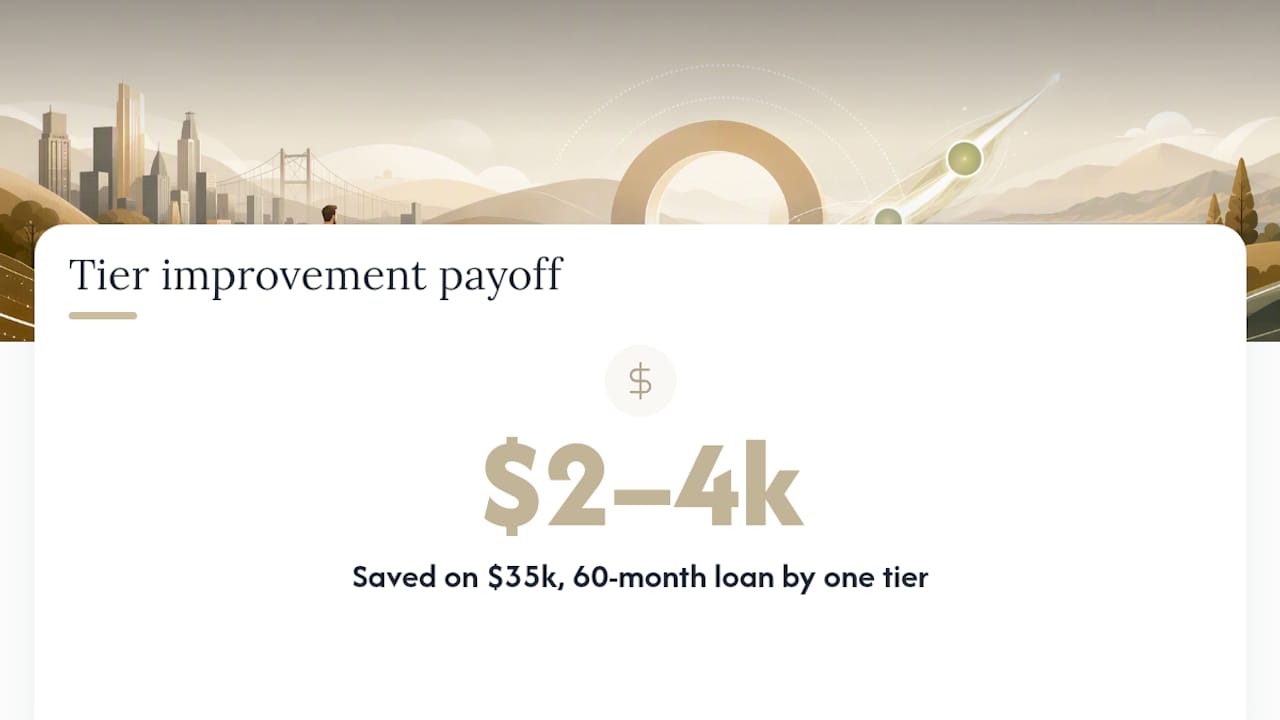
The credit tier you land in determines almost everything about your offer, and it’s worth understanding before you apply anywhere. If you’re within striking distance of the next tier up, whether that means paying down a card or waiting sixty days for a late payment to age off your report, moving up even one tier can save $2,000 to $4,000 in total interest on a $35,000, 60-month loan. That’s a bigger lever than almost any negotiation tactic you’ll use at the dealership. Our breakdown of auto loan credit tiers and how to move between them covers the specific actions that move the needle fastest.
One more thing worth clarifying before you apply anywhere: APR and interest rate aren’t the same number, and dealers sometimes lean on that confusion. APR wraps in certain fees along with the interest rate, which is why two loans with the same interest rate can carry different APRs. If you want the full breakdown, our guide on APR versus interest rate on car loans walks through exactly what gets folded into that number and why it’s the figure you should be comparing, not the sticker rate.
How Do You Negotiate a Lower APR at the Dealership?
Here’s the uncomfortable truth about dealer financing: the salesperson quoting you a rate often isn’t quoting the lender’s actual price. Dealers can add a markup, sometimes called “dealer reserve,” on top of the rate a lender approved, and that markup is legal in every state. It’s also negotiable, but only if you know to ask.
Ask for the buy-rate directly. The buy-rate is the wholesale rate the lender approved before any dealer markup. You can simply say: “What’s the buy-rate on this loan, and what’s your markup?” Dealers aren’t always required to volunteer this, but a direct question puts them on notice that you understand how the pricing works.
Lead with your preapproval, not your interest. Walk in already holding a written offer from a credit union or online lender and say: “I’m preapproved at [X]% through my credit union. Can you beat that rate, or should I finance through them?” This reframes the entire conversation. You’re no longer asking for a favor, you’re giving the dealer a number to compete against, which is exactly the leverage preapproval is designed to provide.
Refuse anything that gets bundled into the loan without explanation. Extended warranties, gap insurance, and paint protection packages sometimes get rolled into the financing itself, quietly raising your loan amount and your total interest paid. If a line item shows up you didn’t ask for, say: “Remove that. I only want to finance the vehicle price.”

Watch for payment-only framing. If a salesperson keeps steering the conversation back to “What monthly payment works for you?” instead of discussing the rate, that’s often a sign they’re trying to stretch your term or pad the price rather than negotiate the APR itself. Redirect every time: “I want to talk about the APR and total interest, not just the payment.”
Get everything in writing before you sign anything. Ask for an itemized financing worksheet showing the APR, the term, the total interest over the life of the loan, and any add-ons separately listed. If a dealer won’t produce that in writing, or gets evasive when you ask, that’s a real signal to walk and finance through your preapproval instead.
- Ask directly: “What’s the buy-rate, and what’s the markup?”
- Present your preapproval and ask the dealer to match or beat it
- Refuse bundled add-ons you didn’t request
- Insist on an itemized worksheet showing APR, term, and total interest
- Walk out if the dealer won’t put the numbers in writing
Pro Tip: If a dealer’s offer comes back close to what Baywall’s benchmark says is fair for your profile, that’s a legitimately good sign. If it’s noticeably higher, you now have a specific number to push back with instead of a vague feeling that something’s off.
When Does Refinancing Actually Lower Your APR?
Refinancing makes sense when three things line up: your credit score has genuinely improved since you took out the original loan, current market rates have dropped or you were overpriced from the start, and enough of your loan term remains that the savings outweigh any refinance fees. If your credit score climbed 60 or more points, or you financed through the dealer at a rate you never got to compare, refinancing is worth checking.
Timing matters more than most buyers realize. Most experts suggest waiting 60 to 90 days after your original loan closes before refinancing, mainly because your original loan needs time to fully report to the credit bureaus and stabilize your file. The exception is a loan you know was priced well above market from day one. In that case, there’s little reason to wait once your credit supports a better offer.
The math is straightforward. Take your remaining balance, compare your current APR to a realistic new offer, and multiply the difference by your remaining term. Here’s what that looks like on a few common loan sizes:
These figures are directional estimates based on typical amortization patterns, not a promise for any specific loan, but they illustrate the pattern clearly: the bigger the rate gap and the more term remaining, the more refinancing pays off. If only a handful of payments are left on your original loan, though, fees and paperwork can eat most of the gain, so run your own numbers before applying.
What APR Should You Expect for Your Credit Tier?
There’s no single “good” APR that applies to everyone, and chasing a national average is the wrong goal. The right question is whether you’re beating the typical rate for your own credit tier. Industry rate surveys put average 60-month new-car APRs in the mid-to-high single digits as of mid-2026, with used-car averages running several points higher, but those are blended averages across every credit tier combined. Your actual target depends entirely on where your score falls.
Superprime borrowers, generally those with scores above 780, see the lowest rates in the market, sometimes low single digits on new vehicles. Prime borrowers, roughly 661 to 780, land a few points higher. Nonprime and subprime tiers, below 660, see APRs climb steadily, sometimes into double digits, and deep subprime borrowers can see rates several times higher than superprime buyers for the same vehicle. Used vehicles carry a premium over new at every tier, partly because of higher default risk and partly because used-car loans often carry shorter terms with higher relative interest costs. Our used car APR breakdown by credit tier covers those specific bands in more detail.
Here’s what a tier improvement actually looks like in dollars on common loan sizes at 60 months:
Moving up a single credit tier on a $35,000, 60-month loan often saves $2,000 to $4,000 in total interest, which is close to the price of a decent used motorcycle or a year of car insurance for most drivers. That’s not a rounding error. If you’re within a few points of the next tier up, and you have any flexibility on timing, that gap is usually worth chasing before you sign anything.
How Baywall Builds Your Target APR
Baywall works from actual transaction data rather than published rate tables that blend every borrower into one average. When you enter your credit score, the vehicle, your loan amount, and your term, Baywall compares your profile against people who financed similar vehicles under similar terms and credit tiers, then produces a target APR based on what those comparable buyers actually paid.
The report gives you three things you can use immediately:
- A target APR benchmarked to your specific credit tier, vehicle type, and loan structure, not a generic national average
- An estimated dollar savings figure showing what you’d save by hitting that target instead of accepting the dealer’s quote
- Current market pricing context for similar vehicles, useful if you’re still deciding between two cars
You can bring the report straight into a dealership negotiation, holding up the target rate as evidence of what comparable buyers are actually paying, or use it while shopping refinance lenders to know whether a new offer genuinely beats your current loan. Baywall doesn’t sell or share the information you enter with lenders or dealers, so running your numbers through it doesn’t put you on anyone’s marketing list or trigger unwanted calls.
Should You Wait for a Better Rate or Buy Now?
Here’s where I’ll push back on the instinct to wait indefinitely for a perfect rate. If you’re close to crossing into the next credit tier, meaning a specific, identifiable move like paying down utilization or waiting for a late payment to age off, waiting usually pays. The math from the tier-jump savings above makes that clear.
But waiting purely on hope, with no specific credit trigger in sight, usually costs more than it saves. Vehicle prices and rates both drift, and a manufacturer’s promotional 0% offer, when you genuinely qualify, can beat almost any benchmark you’d chase by delaying. The rule that actually holds up: if a concrete, quantifiable improvement is imminent, delay. If not, get your preapproval, check the dealer’s number against a real benchmark, negotiate hard, and move forward.
Before you sign, run through this: preapproval in hand, dealer’s buy-rate disclosed, add-ons removed, term chosen for total cost rather than payment size, and the APR checked against your credit tier’s realistic range.
— Baywall
Get Your Negotiation Target Before You Sign Anything
Most rate advice tells you to “shop around,” which is true but incomplete, because it never tells you what number you’re actually shopping toward. Baywall closes that gap by benchmarking the dealer’s quoted APR against real transactions from buyers with your credit tier, your vehicle, and your loan structure, then handing you an exact target rate and a dollar figure for what hitting it would save.
Enter your credit score, the vehicle, your loan amount, and term, and you get a report labeling the dealer’s offer great, fair, or high, along with the negotiation number to push back with. Baywall offers a one-time report for a small fee, as well as options for ongoing access and a free version for initial evaluation. Either way, you walk into the finance office, or into a refinance application, already knowing what a fair deal actually looks like for your exact situation. Generate your report at Baywall before you sign anything.
Sources
The directional APR figures and negotiation guidance in this article draw from CFPB consumer guidance on comparing auto loan offers, industry rate surveys tracking 2026 auto loan pricing, and credit-tier savings analysis from Zolve’s auto loan APR guide. For negotiation tactics beyond car loans, ExpressPlanner’s guide to negotiating lower interest rates covers transferable strategies worth knowing. Baywall’s own transaction-benchmarked reports, generated at Baywall, supply the comparable-transaction pricing referenced throughout.
This article is general information, not a substitute for advice from a qualified financial advisor. Consult a qualified financial professional about your own circumstances before acting on anything here.
FAQ
Is it possible to get a 3% interest rate on a car right now?
Only for superprime borrowers, generally scores above 780, and usually on new vehicles with a manufacturer promotional offer or a very strong credit union relationship. For most credit tiers in 2026, that rate is well below the current market averages.
What’s the lowest APR for a car loan right now?
The lowest available rates sit in the low single digits and are reserved for superprime credit and, often, manufacturer-subsidized promotions on specific new models. Your realistic lowest rate depends on your credit tier, so a Baywall benchmark tells you what’s actually achievable for your profile rather than the market’s absolute floor.
Can I get a 1.9% interest rate on a car loan?
Rates that low almost always come from limited-time manufacturer promotions on new vehicles, restricted to buyers with excellent credit and specific vehicle trims. They’re real, but they’re the exception, not something every superprime borrower can count on finding.
Can I get my APR lowered on my car loan after I’ve already signed?
Yes, through refinancing, provided your credit has improved or your original rate was above market. Most buyers see the clearest savings when refinancing 60 to 90 days after origination, once their credit score has had time to reflect the new loan.
How much does a Baywall report cost?
A one-time benchmarking report costs $2.99, and a free basic version is available if you want an initial read on your offer. Weekly access for ongoing checks runs $8.99 per week, both available at Baywall.