Money Factor vs. APR: Why APR Is the Number to Trust

APR is the number you use to judge a dealer’s auto loan quote. Not the interest rate, not the monthly payment, and not the “money factor” you might have seen floating around online, which is a lease term with no bearing on a car loan. The Truth in Lending Act requires lenders to disclose APR before you sign, and it’s the figure Experian uses to track what buyers actually pay by credit tier. Tools like Baywall exist specifically to check that number against the market.
Here’s what to do the moment a dealer quotes you a rate:
- Write down the exact APR, not just the monthly payment
- Ask for the written APR disclosure and a full fee breakdown
- Run the number against a market benchmark before you sign anything
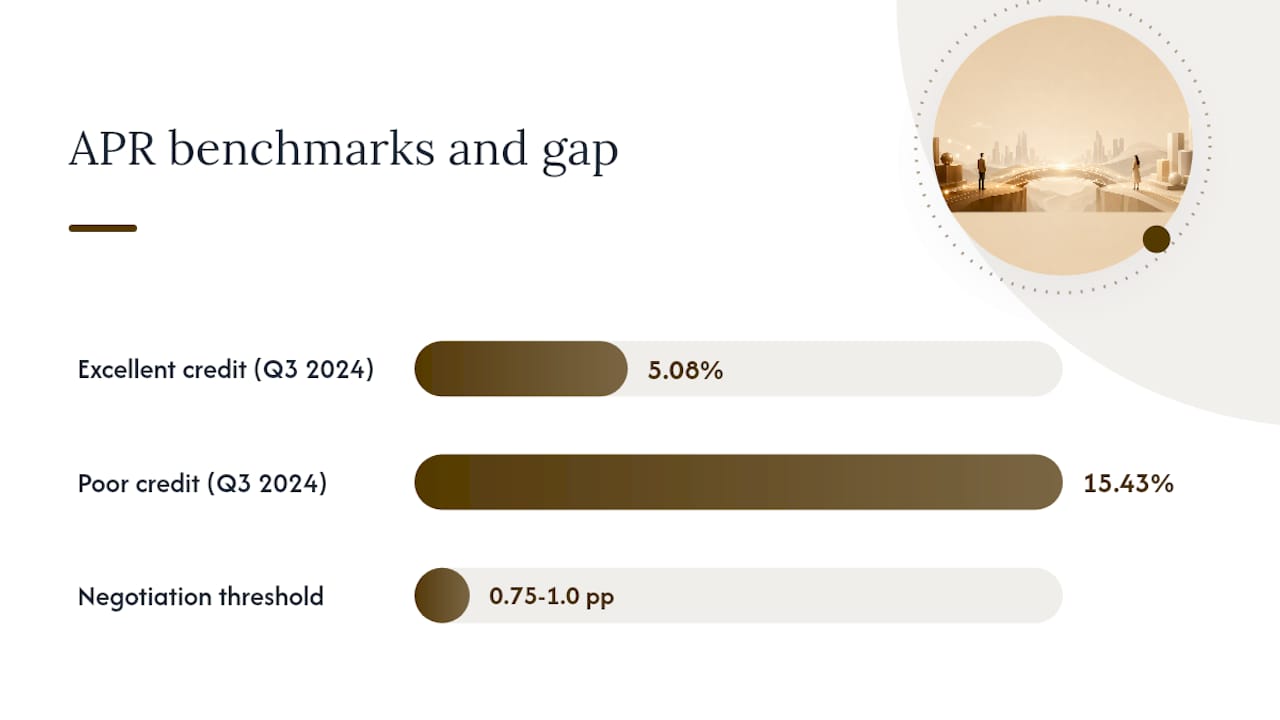
Pro Tip: In Experian’s Q3 2024 data, new-car buyers with excellent credit averaged 5.08% APR, while buyers with poor credit averaged 15.43%. If your quote is nowhere near your tier’s range, that’s your opening to negotiate.
Key Takeaways
APR, not the base interest rate or monthly payment, is the legally standardized number that determines whether a car loan offer is genuinely fair.
| Point | Details |
|---|---|
| APR includes fees | Interest rate plus qualifying fees equals APR, which is why APR is usually the higher, more accurate number. |
| Get it in writing | TILA requires lenders to disclose APR before you sign, so always request the written disclosure. |
| Know your benchmark | Experian’s Q3 2024 data shows excellent credit averaging 5.08% APR versus 15.43% for poor credit. |
| Act on a real gap | A gap over 0.75 to 1 percentage point above your benchmark is worth negotiating or walking away from. |
| Use Baywall to verify | Baywall benchmarks your quoted APR against comparable transactions and gives you a specific target rate and dollar savings estimate. |
Where to Verify These Numbers Yourself
- CFPB auto loan guidance: your legal rights under TILA
- Experian’s rate data: current averages by credit tier
- Car and Driver’s APR formula: the math worked out step by step
- Chase’s APR explainer: why APR beats rate for comparisons
- PNC’s APR overview: when APR and interest rate actually match
Table of Contents
- APR vs. Interest Rate: What’s Actually Different
- Six Steps to Check a Dealer’s APR Before You Sign
- What APR Ranges Actually Look Like Right Now
- How APR Is Actually Calculated
- How Baywall Turns Your Quote Into a Negotiating Tool
- Check Your Quote Before You Sign Anything
- Frequently Asked Questions
- Sources
APR vs. Interest Rate: What’s Actually Different
The interest rate is what the lender charges you to borrow money. APR is that rate plus certain fees and prepaid finance charges, all expressed as one annual percentage. When there are no extra charges rolled in, the two numbers are identical. Add an origination fee or a documentation charge, and APR climbs above the base rate, sometimes by a noticeable margin.
- Interest rate: the raw cost of borrowing, nothing else included
- APR: interest rate plus qualifying fees, which is why it’s usually the higher figure
The Consumer Financial Protection Bureau requires this distinction to be disclosed in writing under the Truth in Lending Act, before you’re legally obligated to the loan. That’s not a courtesy. It’s federal law.
The Consumer Financial Protection Bureau notes that comparing loans on interest rate alone can be misleading, since APR folds in the fees that interest rate leaves out. APR to APR is the only fair comparison.
Why does this matter at the dealership? Because two lenders can quote the same interest rate and produce very different APRs once fees enter the picture. If you’re only comparing the base rate, you could miss a few hundred dollars in hidden cost stacked on top. PNC’s breakdown of car loan APR confirms the same principle: no fees, no gap between the two numbers. Fees show up, the gap opens.
Six Steps to Check a Dealer’s APR Before You Sign
Run through this checklist while you’re still at the table, not after you’ve driven off the lot.
- Get the written APR disclosure. The dealer must show you this in writing before you sign, per TILA.
- Ask for the itemized fee breakdown. Find out exactly what’s rolled into the APR beyond interest.
- Request the finance charge and total of payments. This shows the real cost across the full loan term, not just the monthly bite.
- Confirm the loan term and amount. A longer term can lower your payment while raising your total interest paid.
- Ask whether the APR includes a dealer markup. Dealers sometimes add a margin on top of the buy rate the lender offered them.
- Compare against a market benchmark, whether that’s a credit union preapproval or a report like the one Baywall generates for your exact credit tier and vehicle.
A few negotiation lines worth having ready:
- “What’s the buy rate the lender gave you, before any markup?”
- “Can you match the rate my credit union preapproved me for?”
- “Can you remove that fee from the APR calculation?”
As a general rule, a gap of half a percentage point above your benchmark is worth a conversation. A gap over one full point is usually worth walking away from, especially if you already have a credit union preapproval in hand. Keep every disclosure document. If the dealer claims they’re offering a “banked” rate from the manufacturer’s captive lender, ask to see the actual rate sheet. That single request separates a real answer from a stall tactic.
What APR Ranges Actually Look Like Right Now
Credit tier drives your rate more than almost anything else you control. Based on Experian’s Q3 2024 findings, new-car APRs ranged from roughly 5% for excellent credit up to over 15% for buyers with poor credit. These are illustrative bands, not guarantees. Your exact number depends on lender, region, term length, and the specific vehicle.
- Excellent credit (720+): rates in the mid single digits are typical for new vehicles
- Good credit (660 to 719): modestly higher, still well below double digits in most cases
- Fair credit (620 to 659): solidly double digit territory becomes common
- Poor credit (below 620): rates climb well into the teens, sometimes higher
Used vehicles run a point or two above new-vehicle rates in the same credit tier, largely because lenders price in higher default risk on older cars. Term length matters too. A 72 or 84 month loan can carry a different rate than a 48 month loan, even for the same buyer and vehicle. If you’re shopping used inventory specifically, price that in before you compare quotes.
The rule of thumb is simple: if your dealer’s quoted APR sits more than 50 to 100 basis points above the benchmark for your credit tier and loan type, that’s your cue to negotiate or look elsewhere.
How APR Is Actually Calculated
The math isn’t mysterious once you see it laid out. Car and Driver’s formula essentially takes your total interest plus qualifying fees, divides that by the loan principal and term, then annualizes the result into a percentage.
Car and Driver’s worked example shows how a loan with a modest origination fee added on top of the base interest rate produces an APR noticeably higher than the sticker interest rate alone. The fee is what does the work.
Here’s a simplified version of that math in action:
- Start with a $30,000 loan at a 6% nominal interest rate over 60 months.
- Add a $500 origination fee rolled into the financed amount.
- That fee, spread across the loan term, pushes the effective annual cost above 6%, often landing closer to 6.3% or 6.4% APR depending on how it’s amortized.
Origination fees and prepaid interest are the usual culprits behind that gap. Check your disclosure for both. Note too that APR and total interest paid aren’t the same measurement. A lower APR on a longer term can still mean more total interest paid over the life of the loan.
How Baywall Turns Your Quote Into a Negotiating Tool
A dealer’s quote only means something once you know what similar buyers actually paid. That’s what a Baywall report does: it benchmarks your quoted APR against real transactions from buyers with your credit tier, similar vehicle, and comparable loan term.
The report gives you:
- A fairness label: great, fair, or high, based on where your quote lands against the comparable data
- A target APR to negotiate toward, not just a vague “ask for less”
- An estimated dollar savings if you land at that target instead of the dealer’s number
- A confidence band showing how tight or loose the comparable data set is
That gap is your argument. You’re not guessing, you’re pointing to a number and asking the dealer to close it.
Pro Tip: Run your quote through Baywall before the finance office starts printing paperwork. A written benchmark report in your hand carries more weight at the table than a verbal “I think that’s too high.”
What Dealers Do, and What’s Actually Worth Fighting Over
The most reliable leverage you have is a preapproval, a Baywall benchmark report, and a willingness to wait. Watch for a few patterns: fees quietly rolled into the APR without explanation, reluctance to hand over the written disclosure, a vague answer about the buy rate, or pressure to sign before you’ve had time to check anything.
- Unexplained fees stacked into the APR
- No written APR disclosure offered upfront
- Vague or dodged answers about the buy rate
- Pressure to finalize paperwork immediately
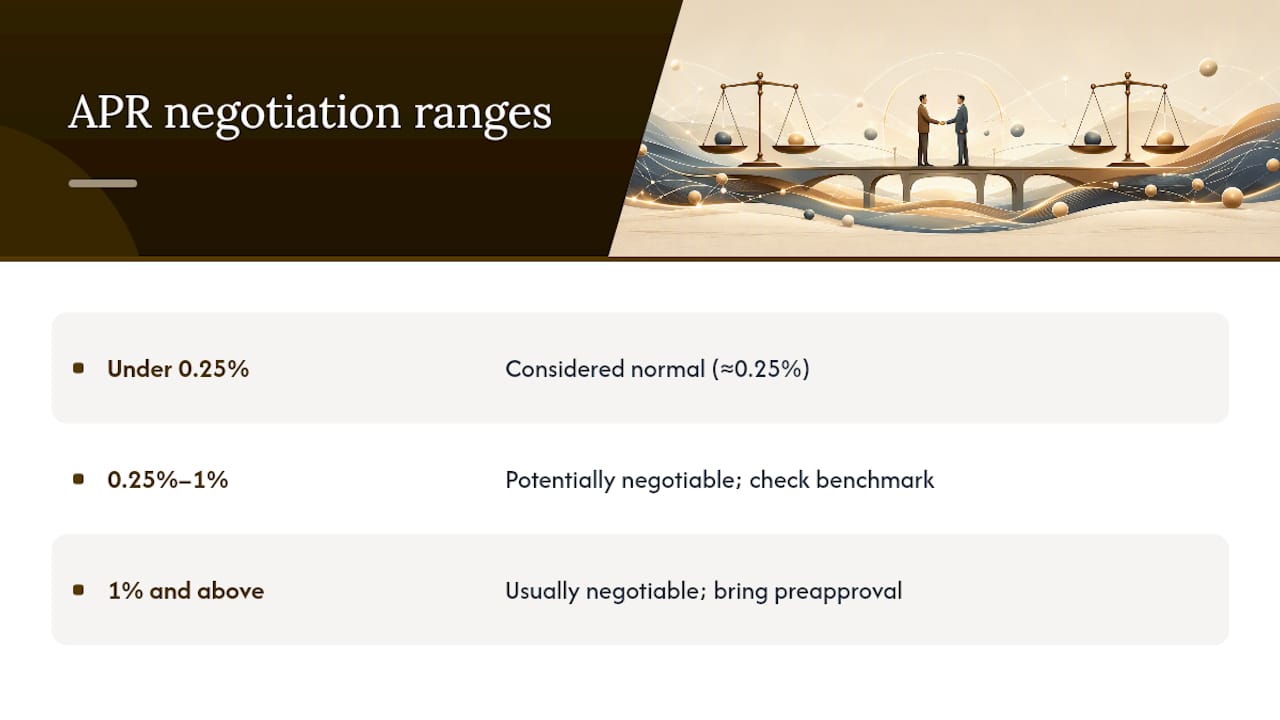
A quarter-point wiggle is normal and rarely worth a fight. A gap north of 0.75 to 1 full point is worth pushing back on, and often worth walking away from if the dealer won’t move.
Check Your Quote Before You Sign Anything
Baywall benchmarks the APR your dealer quoted against what buyers with your credit tier, vehicle, and loan term actually paid, then hands you a specific number to negotiate toward instead of a guess.
Type in your quoted APR, credit score range, vehicle, and loan term, and the report shows whether your offer lands as great, fair, or high, along with the estimated dollars you’d save at the target rate. A basic check is free. A full detailed report with the fairness label, target APR, and savings estimate runs $2.99, delivered instantly. If you’ve already got a dealer’s paperwork in hand, run the numbers through Baywall’s analyzer before you sign, while you still have room to negotiate.
Frequently Asked Questions
Is APR the same as the buy rate? No. The buy rate is what the lender offers the dealer before any markup. The dealer can add a margin on top of that buy rate, and the final APR you’re quoted may reflect that markup rather than the true buy rate.
What’s a good APR for an 800 credit score? Buyers with scores in that range typically land in the same territory as Experian’s excellent-credit tier, averaging around 5.08% for new vehicles in recent data. If your quote runs meaningfully higher, ask why.
Can APR and interest rate ever be the same number? Yes. If your loan has no origination fee, no prepaid finance charges, and no other qualifying costs, APR and interest rate are identical. Add any fee, and APR rises above the base rate.
How much can I actually negotiate on APR? It depends on the gap between your quote and the market benchmark for your credit tier and vehicle. A small gap, a quarter point or so, is normal. A gap of a full point or more is usually negotiable, especially with a preapproval or benchmark report in hand.
Does loan term affect my APR? Yes. Longer terms often carry different pricing than shorter ones, and even at the same APR, a longer term means more total interest paid over the life of the loan.
This article is general information, not a substitute for advice from a qualified financial advisor. Consult a qualified financial professional about your own circumstances before acting on anything here.
Sources
- Auto loan answers | Consumer Financial Protection Bureau
- Interest rate on a car loan | Experian
- How to calculate APR for auto loan | Car and Driver
- What is APR on a car? | PNC