Multiple Auto Loan Inquiries: Do They Hurt Your Credit?

Short answer: multiple auto loan inquiries usually count as one hard pull if you shop within your rate-shopping window, generally 14 to 45 days depending on the scoring model. A single hard inquiry typically costs around five points, and that dent fades from your score’s calculation within about a year, even though the inquiry stays visible on your report for two years. Two situations break this protection:
- You shop for different loan types (an auto loan and a mortgage, for example) — the CFPB confirms these count separately, always.
- You spread your applications out past the window, letting weeks turn into months between lender visits.
Stay inside the window, stick to one loan type, and rate-shopping barely moves the needle.
Key Takeaways
Rate-shopping for an auto loan protects your credit as long as every application lands within the same 14 to 45 day window and stays within the same loan type.
| Point | Details |
|---|---|
| Inquiries bundle within a window | Auto loan applications made within roughly 14 to 45 days generally count as one inquiry. |
| Impact is small and temporary | A hard inquiry costs about five points on average and stops affecting your score after about 12 months. |
| Different loan types don’t bundle | Shopping for a mortgage and an auto loan at the same time always creates separate inquiries. |
| Dealers shotgun applications | Multiple lender names can appear fast after a dealer visit but still count as one pull if timed right. |
| Preapprovals give you leverage | Getting soft-pull quotes before visiting a dealer tells you your target rate ahead of negotiation. |
Table of Contents
- What a Hard Inquiry Does to Your Credit Score
- The 14 to 45 Day Rate-Shopping Window, Explained
- Why Dealers Trigger So Many Inquiries at Once
- How to Shop Multiple Auto Loans Without Dinging Your Score
- Using Baywall to Know Your Target Rate Before You Authorize a Pull
- What the Rate-Shopping Rules Miss
- Sources
What a Hard Inquiry Does to Your Credit Score
A hard inquiry happens the moment you formally apply for credit and a lender pulls your full report to make a decision. A soft inquiry, by contrast, happens when you check your own score or a lender pre-screens you without your applying. Soft pulls never touch your score. Hard pulls do, though the hit is smaller than most people fear.
Typical impact: about five points. myFICO’s own data puts the average hard-inquiry hit at roughly five points, and the exact number shifts depending on how thick or thin your credit file already is. Someone with two accounts and a short history feels an inquiry more than someone with fifteen years of on-time payments across six accounts.
Both FICO and VantageScore build in a rate-shopping exception for installment loans like auto financing, treating a cluster of similar inquiries as a single event rather than penalizing you for each one. The timing rules differ by model version, which matters more than most guides admit.
Duration matters, too. An inquiry sits on your report for up to 24 months, but most scoring models only factor it into your number for about 12 months. After a year, it is dead weight on paper. After two years, it disappears entirely.
The 14 to 45 Day Rate-Shopping Window, Explained
Credit scoring didn’t always treat rate shopping kindly. Older FICO models gave you just 14 days to cluster your auto loan applications before extra inquiries started counting separately. Newer FICO versions stretched that to up to 45 days, and VantageScore has its own version of the same buffer, though the exact length varies by release.
Here’s the practical problem: you rarely know in advance which scoring version a given lender will pull. That uncertainty is why the safe move is to shop fast.
- If you want a rule that works no matter which model is in play, finish all your applications within 14 days.
- If you’re confident lenders are using a recent FICO version, 30 days is usually safe.
- Never assume a 60 or 90-day gap gets bundled. It won’t.
Credit bureaus don’t know your intent. They see a pattern of applications and apply the dedup logic that matches the loan type and the calendar dates on the pulls, nothing more.
Pro Tip: Set a start date the day you get your first quote, then treat everything after day 14 as a fresh clock. Booking test drives and dealer visits inside that window keeps every application bundled together.
Why Dealers Trigger So Many Inquiries at Once
Walk into a dealership, sign the finance paperwork, and you might see five or six lender names hit your credit report within an hour. This is called “shotgunning,” and it’s standard practice, not a mistake. The finance department submits your application to a batch of lenders simultaneously because speed helps them close the deal, and casting a wide net increases their odds of landing you an approval, sometimes at a rate that pads their own markup.
The good news: if those pulls land on the same day or within your shopping window, credit bureaus generally still treat them as one inquiry. The catch is the authorization you sign. Protect yourself with three steps:
- Read the finance authorization form before signing. Some dealers ask for blanket permission to shop your application anywhere they choose.
- Ask which lenders they plan to submit to, and request they limit it to a reasonable number.
- Bring your own preapprovals so the dealer has less incentive to shotgun in the first place.
How to Shop Multiple Auto Loans Without Dinging Your Score
Rate-shopping the right way is a five-step sequence, and skipping the order is where most buyers get burned.

Step 1: Check your credit first. Pull your free report at Annualcreditreport or use a soft-pull service so you know your credit tier walking in. This costs you nothing and doesn’t touch your score.
Step 2: Collect preapprovals before you set foot on a lot. Banks, credit unions, and online lenders will often give you a conditional offer using a soft pull or a single hard pull. Credit unions frequently beat dealer-arranged financing on rate alone, which gives you real leverage later.
Step 3: Cluster your hard-pull applications. Once you’re ready to apply for real, get everything done inside your 14-day safety window. Don’t trickle applications out over a month while you “think about it.”
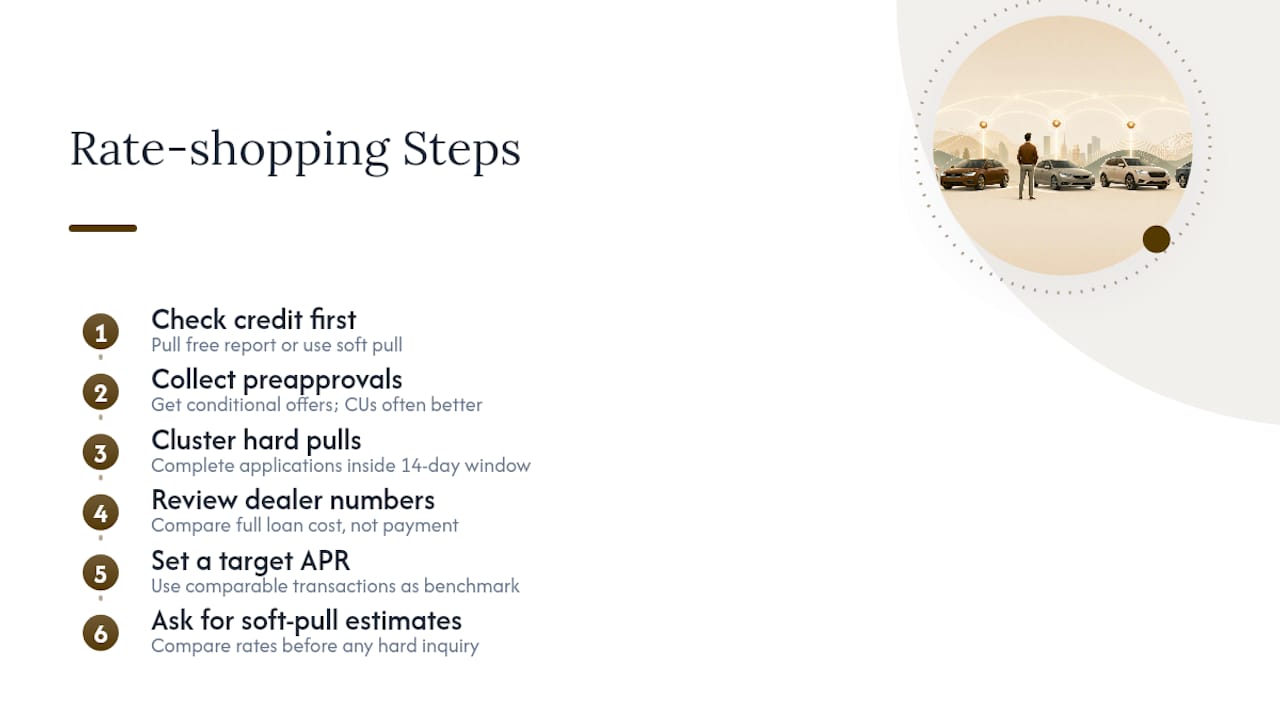
Step 4: At the dealer, ask to see the numbers before authorizing anything new. Compare full loan cost, not just the payment. APR and nominal interest rate aren’t the same thing, and a low monthly payment can hide a longer term or padded fees.
Step 5: Use a benchmark to know your target APR before you negotiate. Walking in with a number pulled from comparable transactions, not guesswork, changes the entire conversation with a finance manager.
Pro Tip: Ask every lender you talk to whether they can give you a rate estimate with a soft pull first. Many credit unions and online lenders will, and it lets you compare options before a single hard inquiry hits your report.
Using Baywall to Know Your Target Rate Before You Authorize a Pull
You’ve done the hard part: preapprovals in hand, applications clustered inside your window. Now you need to know if the number the dealer just quoted is actually fair. That’s the exact gap Baywall closes.
Enter your credit score, the vehicle, loan amount, and term, plus the dealer’s quoted APR, and Baywall benchmarks it against real transactions from buyers in your same credit tier financing similar vehicles. The report gives you:
- A target APR based on what comparable buyers actually paid, not a generic average.
- A great, fair, or high label on the dealer’s specific offer.
- Your potential dollar savings if you negotiate down to the benchmark.
That means you walk into the finance office already knowing your number, rather than hoping the dealer’s first offer is close to fair. If it’s high, you have the data to push back or walk. Run your numbers before you sign anything.
What the Rate-Shopping Rules Miss
The 14 to 45 day rule gets repeated everywhere, and it’s accurate, but it treats rate-shopping like a compliance checklist instead of a negotiation. Knowing your window matters less than knowing your number. A buyer who clusters five applications perfectly inside 10 days but has no idea what a fair APR looks like for their credit tier still walks into the dealership blind.
The overlooked piece is sequencing: preapproval first, benchmark second, dealer visit last. Most advice tells you to protect your score, then stops. It rarely tells you what to do with the leverage that protection buys you. A tight shopping window only pays off if you use the resulting offers to negotiate, not just to compare.
That’s the gap Baywall is built for. A target APR pulled from real comparable transactions turns “don’t apply too many times” into “here’s the number to hold the line on.” Protecting your score gets you to the table. Knowing your benchmark is what wins there.
Sources
- How will shopping for an auto loan affect my credit? | Consumer Financial Protection Bureau
- How to Rate Shop and Minimize the Impact to Your FICO® Scores | myFICO
- Take control of your auto loan: A step-by-step guide | CFPB
- Impact on credit scores of inquiries for an auto loan | Experian