Negative Equity Car Loan: What Car Buyers Need to Know

A negative equity car loan means you owe more on your vehicle than it’s currently worth. If your payoff balance is $22,000 and the car’s market value is $17,000, you’re $5,000 underwater. Here’s what to do right now:
- Calculate the gap first. Get your exact payoff from your lender, then check your vehicle’s trade-in value on Kelley Blue Book, NADA Guides, or Edmunds. Subtract market value from payoff.
- Keep the car and pay down principal if you can afford extra monthly payments. This is the lowest-cost path for most borrowers.
- Avoid rolling the balance into a new loan unless you have no other option. The CFPB found that financed negative equity is linked to larger loans, higher monthly payments, and higher repossession rates.
Auto loan debt in the U.S. reached $1.68 trillion by the end of 2025, with average new-loan origination balances around $33,519. More American borrowers are underwater today than at any point in recent memory.
Key Takeaways
Negative equity on a car loan is manageable, but the remedy you choose determines whether you escape it or compound it — paying down principal is the lowest-cost path, while rolling the balance into a new loan at a high APR is the most expensive.
| Point | Details |
|---|---|
| Definition | You have negative equity when your loan payoff exceeds your vehicle’s current market value. |
| Calculate the gap | Subtract your KBB/NADA/Edmunds trade-in value from your lender’s 10-day payoff figure. |
| Best first remedy | Extra principal payments close the gap fastest and cost the least in total interest. |
| Rolling negative equity risk | The CFPB found financed negative equity is linked to larger loans, higher payments, and higher repossession rates — mean amounts were $5,073 (new) and $3,284 (used). |
| Baywall’s role | Baywall benchmarks your dealer’s APR against comparable real transactions, giving you a target rate and dollar savings figure before you sign a new loan. |
Table of Contents
- How a negative equity car loan happens in the first place
- How to calculate exactly how much negative equity you have
- Your options for handling negative equity, ranked by long-term cost
- What rolling negative equity into a new loan actually costs you
- How to prepare and negotiate before you trade in, refinance, or buy
- A worked example: paying down negative equity faster
- Voluntary surrender: what it really means and when it’s a last resort
- How negative equity affects your credit score and future loan eligibility
- Tax implications when selling or trading in a vehicle with negative equity
- Baywall’s take on what actually matters when you’re underwater
- Know your APR before you sign anything
- Sources
How a negative equity car loan happens in the first place
Depreciation is the primary driver. A new vehicle typically loses a substantial portion of its value in the first year alone, while your loan balance drops slowly because early payments are weighted toward interest. The gap between what you owe and what the car is worth is widest in months 1–24.
Loan structure makes it worse. Long loan terms of multiple years keep monthly payments low but stretch out principal repayment, meaning depreciation outruns payoff for years. A low or zero down payment means you start the loan already close to — or past — the vehicle’s value. A high APR compounds the problem by directing more of each payment to interest rather than principal.
Add-ons inflate the loan balance further. Extended warranties, GAP insurance, paint protection, and dealer fees rolled into financing can add thousands to your principal on day one. If you also rolled a prior loan’s negative equity into the current loan, you may have started underwater before you drove off the lot.
Used vehicles depreciate more slowly than new ones, which gives used-car buyers a slight advantage. But a used car purchased at a high APR with a long term and minimal down payment can still go underwater quickly, especially if the dealer’s asking price was above market value.
How to calculate exactly how much negative equity you have
Follow these three steps to get a precise number before making any decisions.
-
Get your current payoff amount. Call your lender or log into your account portal and request the 10-day payoff figure. This is the exact amount needed to close the loan today, including any accrued interest. It will be slightly higher than your stated balance.
-
Get your vehicle’s trade-in value. Use at least two of the three major tools: Kelley Blue Book, NADA Guides, or Edmunds. Select the trade-in value, not the private-party value. Dealers will offer trade-in value, so that’s the conservative and realistic figure to use when calculating your position.
-
Subtract market value from payoff. The difference is your negative equity.
Worked example:
| Item | Amount |
|---|---|
| Loan payoff (10-day) | $22,500 |
| KBB trade-in value | $17,000 |
| Negative equity | $5,500 |
Pro Tip: Dealer trade-in offers typically run $500–$2,000 below KBB trade-in estimates. If a dealer quotes you $15,500 on a car KBB values at $17,000, that’s normal — but it widens your effective negative equity at the dealership. Always know your KBB number before you walk in.
Private-party sale values on KBB and Edmunds run $1,000–$3,000 higher than trade-in values, which is one reason selling privately can reduce or eliminate the gap you’d otherwise roll into a new loan.
Your options for handling negative equity, ranked by long-term cost
Each remedy below has a different cost profile and timeline. The right choice depends on how large your gap is, how long you plan to keep the vehicle, and what your cash flow looks like.
| Option | Best When | Main Risk |
|---|---|---|
| Keep car, pay extra principal | Gap is under $5,000; stable income | Takes time; car must stay reliable |
| Refinance to shorter term | Credit improved; rates dropped | Higher monthly payment |
| Sell privately | Gap is manageable; time available | More effort; need bridge financing |
| Trade in and roll over | Urgent need to change vehicles | Starts new loan already underwater |
| Pay gap with savings/personal loan | Gap is small; savings available | Depletes emergency fund |
| Voluntary surrender | All other options exhausted | Severe credit damage |
Keep the car and pay down principal. Making even $100–$200 in extra principal payments each month accelerates equity recovery significantly. Financial experts recommend this approach because vehicle depreciation is fastest in the first two years, so early extra payments have the greatest impact.
- Pros: No new loan, no rolling debt, lowest total interest paid.
- Cons: Requires patience and a reliable vehicle.
- When to choose: Gap is under $6,000 and you can afford $100+ extra per month.
Refinance to a shorter term or lower APR. If your credit score has improved since origination or market rates have dropped, refinancing to a shorter term can reduce total interest and build equity faster. Check current used car loan rate benchmarks before approaching lenders.
- Pros: Lower APR means more of each payment hits principal.
- Cons: Lenders may decline if your loan-to-value (LTV) is too high; shorter term raises monthly payment.
- When to choose: Credit score improved by 40+ points or rates dropped at least 1.5 percentage points.
Sell privately. A private sale typically nets $1,000–$3,000 more than a dealer trade-in. If the gap is small enough, you may be able to cover it from the sale proceeds plus modest savings. See private party auto loan rates if you need bridge financing between selling and buying.
- Pros: Best net value for your vehicle.
- Cons: Time-consuming; you need to cover the loan payoff before transferring title.
- When to choose: Gap is under $3,000 and you have time to list and negotiate.
Trade in and roll the balance. Fast and convenient, but you start the new loan already underwater. The FTC warns that dealer “we’ll pay off your loan” language almost always means the balance gets added to your new financing.
- Pros: Solves the immediate need to change vehicles quickly.
- Cons: Higher new loan balance, higher monthly payment, and you may be underwater again immediately.
- When to choose: Only when the vehicle is unsafe or unreliable and no other option is feasible.
Pay the gap with savings or a personal loan. Covering the difference at the point of sale avoids rolling it into vehicle financing. A personal loan typically carries a lower APR than a rolled-in auto loan balance, and it keeps your new vehicle’s LTV clean.
Voluntary surrender is covered in its own section below. Treat it as a last resort.
What rolling negative equity into a new loan actually costs you
The numbers from the CFPB’s 2024 report on negative equity in auto lending are worth sitting with. The mean negative equity amount was $5,073 for new-vehicle financing and $3,284 for used-vehicle financing. Loans that financed negative equity were associated with larger loan balances, higher monthly payments, and higher repossession assignment rates.
By the numbers: A borrower rolling $5,000 of negative equity into a new 72-month loan at 9% APR adds roughly $80 per month to their payment and pays approximately $900 in additional interest over the life of the loan — on debt that produced zero vehicle value.
The Century Foundation’s reporting reinforces this: financing negative equity can push buyers into a cycle of longer-term, higher-cost debt that’s difficult to escape. Each trade-in that rolls a balance forward resets the depreciation clock while the debt grows.
Rising loan sizes compound the risk. With average origination balances near $33,519 and aggregate auto debt at $1.68 trillion, more borrowers are starting loans at or near their vehicle’s value, leaving almost no cushion before they’re underwater.
How to prepare and negotiate before you trade in, refinance, or buy
Walk into any dealer or lender conversation with four things in hand.
- Your current loan payoff (10-day figure from your lender).
- KBB, NADA, and Edmunds trade-in values printed or saved on your phone.
- A preapproval from a credit union or bank — this gives you a real APR benchmark before the dealer quotes you anything. Credit unions consistently offer lower APRs than dealer-arranged financing for most credit tiers.
- Your most recent loan statement showing the remaining term and current balance.
Negotiate trade-in and purchase as separate transactions. Dealers prefer to bundle them because it obscures the real numbers. Get a firm trade-in offer in writing before you discuss the new vehicle’s price or financing. The FTC specifically recommends this approach to prevent hidden costs from being buried in the monthly payment.
Watch for these dealer red flags:
- “We’ll take care of your old loan” with no written breakdown of how.
- A focus on monthly payment rather than total loan amount and APR.
- A new loan term that’s longer than your remaining current term.
- Add-ons presented as required for financing approval.
Pro Tip: Ask the dealer to show you the new loan’s total amount financed, not just the monthly payment. If the total includes your rolled negative equity, you’ll see it as a line item. If they won’t show you, that’s a signal to slow down. Consumer-legal resources on how to avoid crooked dealer tactics can help you recognize pressure plays before they cost you.
Shop at least three APR quotes: your preapproval, the dealer’s offer, and one more from a bank or credit union. The spread between the best and worst offer is often 2–4 percentage points, which translates to hundreds or thousands of dollars over a 60–72 month term.
A worked example: paying down negative equity faster
Scenario: You owe $22,500 on a vehicle worth $17,000. Your negative equity is $5,500.
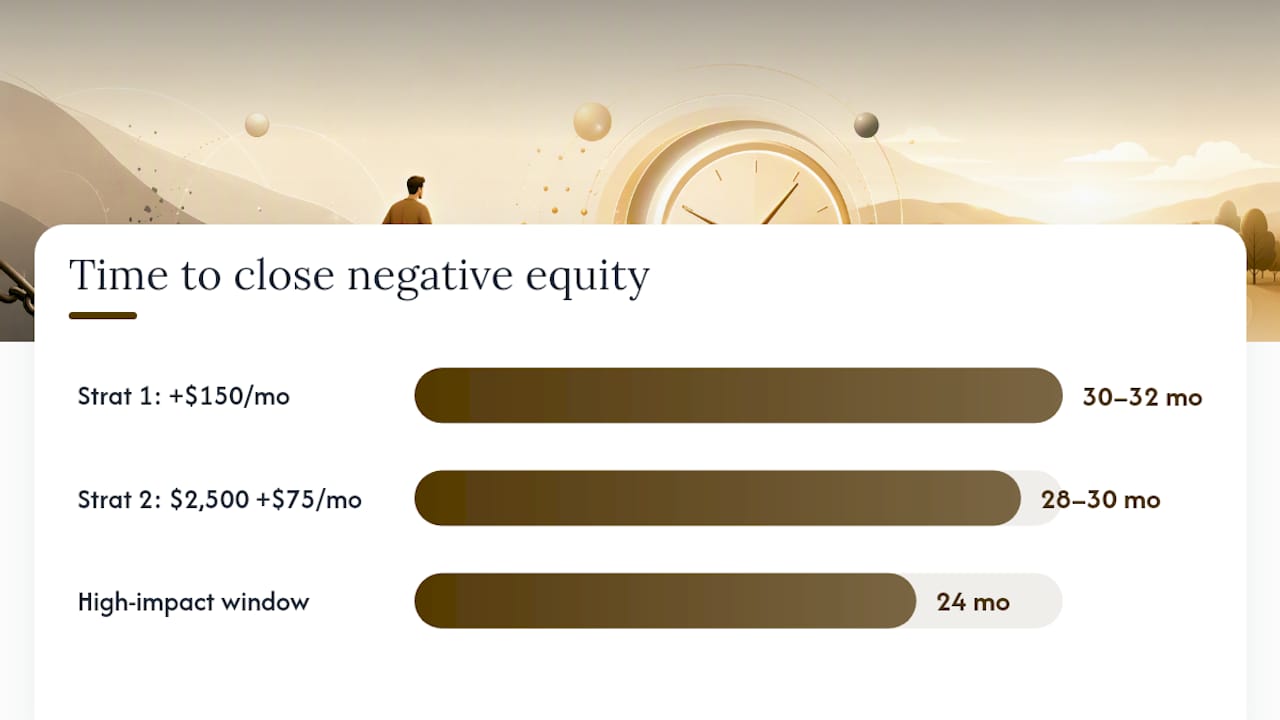
Strategy 1: Add $150/month to principal.
- Current monthly payment: $420 (regular) + $150 (extra principal) = $570 total.
- Extra $150 goes entirely to principal each month.
- At this rate, you eliminate the $5,500 gap in roughly 30–32 months, assuming the vehicle holds its value reasonably.
- You also pay off the loan about 10 months early, saving several hundred dollars in interest.
Strategy 2: One-time lump-sum payment of $2,500 plus $75/month extra.
- Apply $2,500 to principal immediately, reducing negative equity to $3,000.
- Add $75/month to every subsequent payment.
- The gap closes in roughly 28–30 months.
Paying down principal early is most powerful in the first 24 months of a loan, when the vehicle is depreciating fastest and interest charges are highest. A $2,500 lump sum applied in month 6 saves more than the same $2,500 applied in month 36 because it reduces the balance on which interest compounds.
Pro Tip: When making extra payments, confirm with your lender that the additional amount is applied to principal, not to your next scheduled payment. Some servicers default to advancing your due date rather than reducing your balance. A quick call or written instruction prevents this.
If your current APR is above 10%, refinancing to a lower rate while also making extra payments can accelerate equity recovery faster than either strategy alone. The key is that the new term must be shorter than your remaining term, not longer.
Voluntary surrender: what it really means and when it’s a last resort
Voluntary surrender means you return the vehicle to the lender before they repossess it. It is not a clean exit. The lender sells the vehicle at auction, typically for less than its retail market value, and you remain responsible for the deficiency balance — the difference between the auction proceeds and your remaining loan balance.
Consequences you need to understand:
- A voluntary surrender appears on your credit report and damages your score significantly, similar to an involuntary repossession.
- The deficiency balance can be sent to collections or result in a lawsuit.
- Most lenders report the account as a charge-off, which stays on your credit report for seven years.
- Future auto loan approvals become harder and more expensive for several years.
Voluntary surrender is not a way to walk away from negative equity. It is a way to trade a large ongoing payment for a smaller deficiency balance — and serious credit damage. The math only works in your favor if the cost of keeping the vehicle (repairs, insurance, payments) genuinely exceeds the deficiency you’d owe.
If surrender is unavoidable:
- Contact your lender before missing payments. Some lenders offer hardship programs or deferral options.
- Get the surrender terms in writing, including the lender’s process for selling the vehicle and how the deficiency will be calculated.
- Consult a nonprofit credit counselor (NFCC member agencies offer free or low-cost guidance) before signing anything.
How negative equity affects your credit score and future loan eligibility
Negative equity by itself does not appear on your credit report and does not directly lower your score. What damages credit is how you respond to it. Missing payments because the loan feels unaffordable, defaulting, or surrendering the vehicle all create negative marks that can drop your score by 100 points or more.
Carrying a high loan balance relative to the original loan amount can signal risk to lenders reviewing your profile, even without a missed payment. When you apply for a new loan while underwater on an existing one, lenders see the high LTV on your current vehicle. Many will either decline or offer a higher APR to compensate for the perceived risk. Understanding how LTV affects your loan terms before applying for refinancing gives you a clearer picture of what lenders are evaluating.
If you do roll negative equity into a new loan and then miss payments on that loan, the credit damage compounds. The CFPB’s data linking financed negative equity to higher repossession rates reflects exactly this pattern.
Tax implications when selling or trading in a vehicle with negative equity
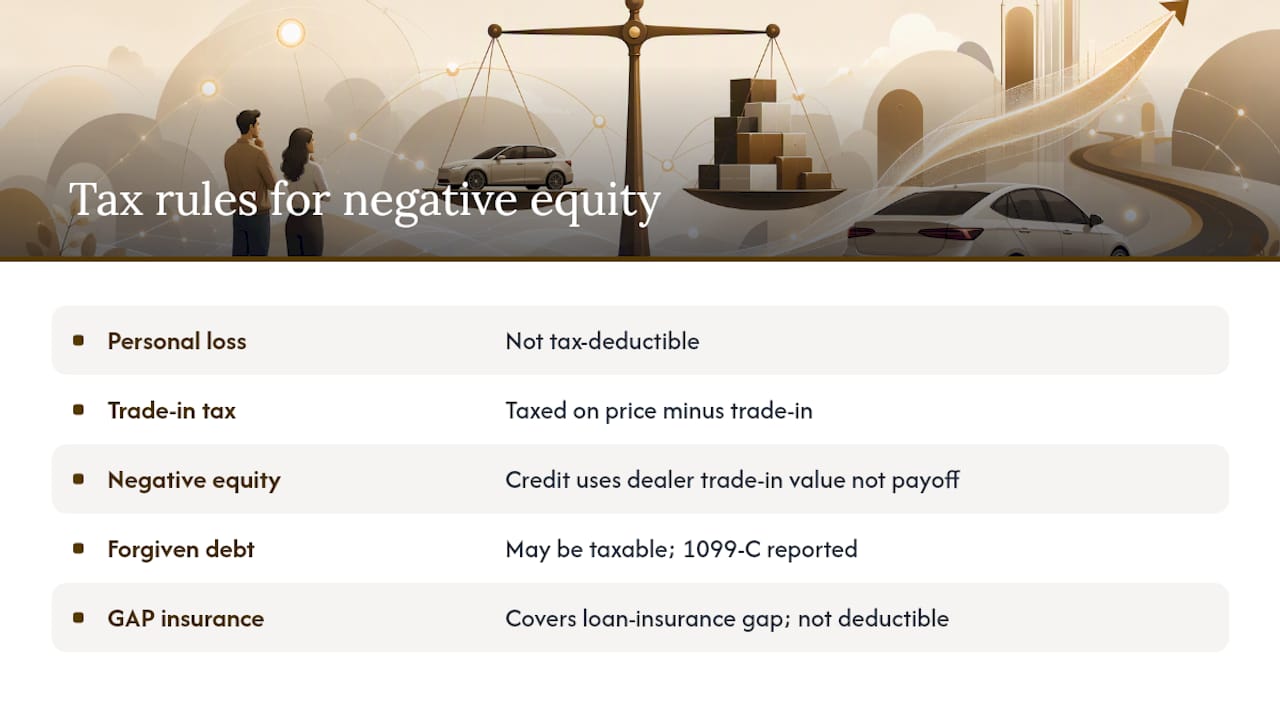
When you sell a personal-use vehicle at a loss — which is what selling an underwater car amounts to — the IRS does not allow you to deduct that loss. Personal vehicle losses are not tax-deductible. You simply absorb the financial hit.
If you trade in a vehicle, most states allow you to pay sales tax only on the difference between the new vehicle’s price and the trade-in value, not on the full purchase price. This trade-in tax credit can save several hundred to a few thousand dollars depending on your state’s sales tax rate and the vehicle’s value. However, if your negative equity is rolled into the new loan, the trade-in credit is calculated on the trade-in value the dealer assigns, not on your payoff amount.
One scenario worth flagging: if a lender forgives a deficiency balance after a repossession or short sale, the forgiven amount may be treated as cancellable debt income and reported to the IRS on a 1099-C. You may owe income tax on that amount unless you qualify for an insolvency exclusion under IRS rules. Consult a tax professional if you receive a 1099-C after a vehicle surrender or repossession.
GAP insurance covers the difference between your loan payoff and the insurance payout after a total loss. Without it, you owe the remaining balance out of pocket. GAP coverage is not tax-deductible for personal vehicles, but it can prevent a total-loss event from turning into a multi-thousand-dollar tax and debt problem simultaneously.
Baywall’s take on what actually matters when you’re underwater
Most advice on negative equity focuses on the vehicle side of the equation: depreciation, trade-in values, payment strategies. That’s correct as far as it goes. But there’s a second lever that gets far less attention: the APR on whatever loan you end up with next.
When a dealer rolls $5,000 of negative equity into a new loan, the damage isn’t just the $5,000. It’s the $5,000 financed at whatever rate the dealer quotes you, for whatever term they suggest, with whatever markup they’ve added above the rate you actually qualify for. A borrower who negotiates the rolled balance down by $500 but accepts an APR that’s 2 points above market has often made the worse trade.
The priority order should be: first, avoid rolling negative equity if any realistic alternative exists. Second, if you must roll it, minimize the balance through a private sale or lump-sum payment. Third, and this is where most buyers leave money on the table, negotiate the APR on the new loan as aggressively as the purchase price. A preapproval from a credit union sets your floor. Knowing the market rate for your credit tier and vehicle type sets your target. The dealer’s offer should be measured against both.
Know your APR before you sign anything
When negative equity is involved, the APR on your next loan matters as much as the balance you’re rolling. Baywall benchmarks the dealer’s quoted rate against real transactions from buyers with your credit score, vehicle type, loan amount, and term. The report tells you whether the offer is great, fair, or high, gives you a specific target APR to negotiate toward, and shows your potential dollar savings.
For buyers rolling negative equity into a new loan, that target APR is the number that determines how much extra the rolled balance actually costs over time. Baywall’s report quantifies that difference in dollars so you walk into the negotiation knowing exactly what’s at stake.
Check your dealer’s APR offer with Baywall before you sign. The report costs $2.99 and takes minutes.
Sources
- Negative Equity in Auto Lending
- Auto trade-ins and negative equity: When you owe more than your car is worth
This article is general information, not a substitute for advice from a qualified financial advisor. Consult a qualified financial professional about your own circumstances before acting on anything here.