New Car Loan Interest Rate: 2026 Benchmarks and Negotiation Targets

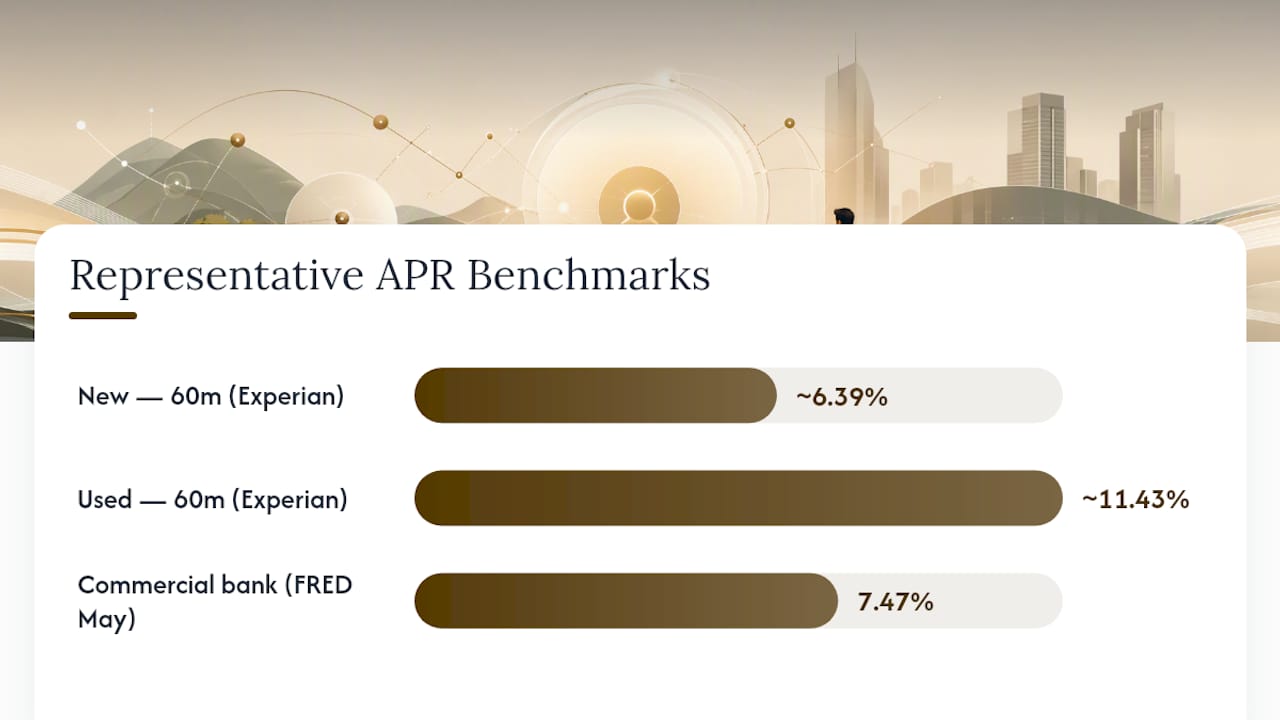
The average new car loan interest rate sits at 6.39% APR as of the first quarter of 2026, according to Experian’s automotive finance data. That number is your starting point, not your ceiling. If a dealer quotes you anything meaningfully above that, and your credit is solid, you have room to push back.
Here’s what to do with that number right now: ask the finance manager for the exact APR in writing, then compare it against your own preapproval from a bank or credit union before you sign anything. Dealers mark up rates more often than most buyers realize, and the only way to catch it is to know your target before you walk in.
Three numbers to keep in your pocket:
- Market benchmark, 60-month new-car loan: around 6.39% APR
- Excellent credit example: rates as low as 3.39% to 5% at some credit unions for highly qualified borrowers
- Fair credit example: often 9% to 12% or higher, depending on the lender and loan-to-value
Pro Tip: Never let a dealer anchor the conversation on your monthly payment alone. Ask specifically for the APR in writing, then say, “My credit union preapproved me at [X]%, can you beat it?” That single sentence puts the burden on them to justify their number.
Key Takeaways
Verifying your dealer’s quoted APR against a credit-tiered benchmark, rather than accepting the number at face value, is the single most effective way to avoid overpaying on a new car loan.
| Point | Details |
|---|---|
| Know the market average | New-car loans averaged 6.39% APR in Q1 2026, according to Experian, with used-car loans nearly double at 11.43%. |
| Target by credit tier | Super-prime borrowers should aim for mid-single-digit APRs; subprime borrowers often see double digits regardless of negotiation. |
| Term length changes total cost | A 72-month loan lowers your payment but can add thousands in extra interest compared to a 60-month term. |
| Separate price from APR negotiation | Negotiate the vehicle price and the loan APR as two distinct conversations to avoid one masking the other. |
| Verify before you sign | Use a tool like Baywall to benchmark your dealer’s quoted APR against real comparable transactions and get a specific target rate to counter with. |
Table of Contents
- What Is the Current New Car Loan Interest Rate by Term?
- What Counts as a Good APR for a New Car Loan?
- What Factors Determine Your Auto Loan Interest Rate?
- How Do You Shop for and Negotiate the Best Car Loan Rate?
- How Much Do Monthly Payments Change With Different APRs?
- Where Should You Get a Car Loan: Bank, Credit Union, or Dealer?
- Should You Choose a Shorter or Longer Auto Loan Term?
- APR vs. Interest Rate: What’s the Real Difference?
- When Does Refinancing a Car Loan Make Sense?
- Where Do These Car Loan Rate Benchmarks Come From?
- How Can You Check and Improve Your Credit Score Before Applying?
- How Baywall Thinks About Rate Benchmarking Before You Buy
- How Do You Check If Your Dealer’s Rate Is Fair?
- Where Can You Find More Data on Current Car Loan Rates?
- Frequently Asked Questions About New Car Loan Interest Rates
- Sources
What Is the Current New Car Loan Interest Rate by Term?
New car loan interest rates vary by term length, and the gap between a 36-month loan and a 72-month loan can run more than a full percentage point. Shorter terms typically carry lower APRs because lenders take on less long-term risk, while longer terms spread that risk out and price it in.
The table below reflects national averages compiled from Experian’s Q1 2026 State of the Automotive Finance Market report and FRED’s monthly finance-rate series for new autos at commercial banks, which recorded a rate of 7.47% in May 2026 for one of its tracked series.
| Loan Term | Average New-Car APR | Average Used-Car APR | Notes |
|---|---|---|---|
| 36 months | Lower than 60-month average | Higher across all terms | Shortest common term, typically the cheapest APR |
| 48 months | Slightly above 36-month rate | Higher than new-car equivalent | Popular mid-length option |
| 60 months | ~6.39% (Experian Q1 2026 average) | ~11.43% (Experian Q1 2026 average) | Most common new-car loan term |
| 72 months | Typically highest among common terms | Rarely offered for older used vehicles | Lower payment, more total interest |
The used-car gap is the number that surprises most first-time buyers. Experian’s data puts average used-car APRs at 11.43%, nearly double the new-car average, a spread DAX Street also flagged in its coverage of the same Experian dataset. If you’re weighing new versus used, that rate gap alone can offset a chunk of the sticker-price savings on a used vehicle. Our used car loan rate breakdown digs deeper into that comparison if you’re cross-shopping.
Why might your quote differ from these averages? A few reasons come up constantly. Your credit score is the single biggest lever, but loan-to-value ratio (how much you’re financing versus the car’s value), the vehicle’s age and mileage, and even your existing relationship with a bank or credit union all shift the number up or down. A dealer with a strong relationship with a captive finance arm, like a manufacturer’s in-house lender, might also have promotional rates unavailable elsewhere.
These figures are market averages, not individual offers. Your actual rate depends on the full picture a lender pulls together, not a single published benchmark.
What Counts as a Good APR for a New Car Loan?
A “good” new car loan interest rate depends entirely on your credit tier. What’s excellent for a subprime borrower would be a poor deal for someone with a 780 credit score, so treat these as tiered targets rather than one universal number.
- Super-prime (typically 720+): Target APRs in the mid-single digits, often several points below the 6.39% market average. Some credit unions, like Navy Federal, advertise “as low as” rates in this range for well-qualified members.
- Prime (typically 660 to 719): Expect APRs close to or slightly above the market average, generally in the 6% to 8% range.
- Near-prime (typically 620 to 659): APRs climb noticeably here, often into the 9% to 12% range.
- Subprime (below 620): Double-digit APRs are common, sometimes well above 15%. If you’re quoted 20% or higher, it’s worth reading through what to do about a 20% APR car loan before you sign.
Match it or I’ll finance elsewhere." Dealers often have flexibility they don’t volunteer unless pressed.
Pro Tip: Get a preapproval letter from a bank or credit union before you ever step onto a lot. It’s not just a backup plan, it’s your leverage. A dealer who knows you have a real alternative in hand negotiates differently than one who thinks you’re locked in.
What Factors Determine Your Auto Loan Interest Rate?
Lenders don’t pull your rate out of thin air. The CFPB explains that pricing comes down to a combination of borrower risk and loan characteristics, weighed together in an underwriting model.
- Credit score and credit history: The single biggest factor, and the one with the widest swing in outcome.
- Loan-to-value ratio: A bigger down payment lowers what you’re financing relative to the car’s value, which reduces lender risk.
- Vehicle age, mileage, and model year: Newer vehicles typically qualify for better rates than older ones, even within new-car financing.
- Loan term: Longer terms usually carry higher APRs than shorter ones.
- Income and debt-to-income ratio: Lenders want assurance you can absorb the payment alongside your other obligations.
- Dealer or lender relationship: A strong existing relationship, or a manufacturer incentive program, can shift the offer.
- Prevailing market rates: Macro conditions, like the finance rate on commercial bank auto loans that FRED tracks monthly, set the floor everyone prices around.
Experian’s credit-tier breakdown shows just how wide that swing can be. Super-prime borrowers land in mid-single digits, while subprime borrowers face double-digit APRs on the same car, at the same dealership, in the same week.
Watch out for 0% promotional financing offers, too. They’re real, but they usually apply only to specific models, require top-tier credit, and often exclude other rebates or incentives. Read the fine print before assuming the advertised number applies to you.
How Do You Shop for and Negotiate the Best Car Loan Rate?
Getting the best new car loan interest rate is a sequence, not a single conversation. Follow these steps roughly in order, and you’ll walk into any dealership with more control than most buyers ever have.
- Pull your credit score and report first. Know your tier before you talk to anyone. A free annual report from each bureau gives you the full picture, not just a score.
- Get two or three preapprovals. Try a credit union, a national bank, and an online lender. Compare the best credit union auto loan options against a traditional bank quote to see where you land.
- Estimate your target APR using the benchmarks above. Know your tier’s realistic range before you negotiate anything.
- Bring your preapproval printout and a Baywall benchmark report to the dealership. Physical proof of a competing offer changes the tone of the conversation immediately.
- Negotiate the vehicle price and the APR separately. Dealers sometimes soften one number by inflating the other. Don’t let the two conversations blur together.
- Ask for the APR in writing before you sign anything. A verbal number means nothing once you’re at the signing table.
A few lines that actually work at the finance desk: “Can you match or beat my credit union’s rate of [X]%?” forces a direct comparison instead of a vague counteroffer. “I’d like to see the APR broken out separately from the monthly payment” stops a dealer from burying a rate hike inside a longer term.
This is exactly the gap Baywall closes. You enter your credit score range, the vehicle, the loan amount, the term, and the APR the dealer quoted. Baywall benchmarks that offer against real transactions from buyers in a comparable credit tier, loan type, and vehicle category, then tells you whether the number is great, fair, or high. It gives you a specific target APR to counter with and an estimated dollar amount you’re leaving on the table if you accept the offer as is.
Pro Tip: Run the numbers before you’re sitting across from a finance manager, not while he’s waiting for an answer. Decisions made under time pressure at a dealership rarely favor the buyer.
How Much Do Monthly Payments Change With Different APRs?
A one or two percentage point difference in APR sounds small until you see it in dollars. On a typical loan, the gap between an excellent rate and a market-average rate can total thousands over the life of the loan, a point market analysts have noted when comparing 2026 financing costs across credit tiers.

Here’s how that plays out on three common loan amounts at 60 months, comparing an excellent-credit rate against the market average:
That’s not a rounding error. That’s a real vacation, a semester of tuition, or a healthy dent in your next down payment, sitting on the table because of a rate difference that felt small on paper.
If you want to run your own numbers with a different loan amount or term, an auto loan rate calculator lets you plug in the specifics of your deal. And if you’re unclear on how APR interacts with fees to produce these totals, our guide on APR versus interest rate walks through the math in plain terms.
Where Should You Get a Car Loan: Bank, Credit Union, or Dealer?
Each lender type has a different pricing model, and knowing which one to approach first depends on your credit profile.
- Credit unions: Often the lowest APRs for members, especially at the prime and super-prime tiers. Downsides: membership requirements and sometimes slower approval processes.
- National and regional banks: Competitive rates for existing customers, wide availability, and established reputations. Downsides: rates can run higher than credit unions for the same credit tier, and approval can hinge on your existing banking relationship.
- Online lenders and marketplaces: Fast preapprovals and rate shopping without leaving your couch. Downsides: some charge higher rates to offset the convenience, and not all disclose fees as transparently upfront.
- Dealer financing (captive finance): Convenient, and sometimes the only place to access manufacturer promotional rates like 0% APR offers. Downsides: dealers can mark up the rate a lender approves behind the scenes, padding their own profit into your APR.
If you have strong credit, a credit union is usually your best first stop. If your credit is thinner or you need speed, an online lender preapproval gives you a fast baseline to negotiate against. Dealer financing is worth checking last, specifically to see if a manufacturer incentive beats what you’ve already secured elsewhere.
Sometimes the tradeoff for that headline rate is giving up a cash rebate you’d otherwise qualify for, which can cost more than the interest you’re saving.
Should You Choose a Shorter or Longer Auto Loan Term?
Loan term length changes three things at once: your monthly payment, your total interest paid, and your risk of owing more than the car is worth.
- Longer terms (72 months or more) lower your monthly payment but stretch out interest payments, and often carry a higher APR to begin with.
- Shorter terms (36 to 48 months) mean a higher monthly payment but meaningfully less total interest, and they reduce the window where you’re upside down on the loan.
- Negative equity risk grows with longer terms because the car depreciates faster than you pay down the balance in the early years.
You save about $86 a month and pay over $2,000 more for the privilege.
Pro Tip: A longer term makes sense if cash flow is genuinely tight and the alternative is stretching your budget dangerously thin every month. It rarely makes sense just to afford a more expensive car than you’d otherwise buy.
APR vs. Interest Rate: What’s the Real Difference?
Your interest rate is the cost of borrowing the principal, expressed as a percentage. Your APR rolls that interest rate together with certain lender fees, giving you a more complete picture of what the loan actually costs. When you’re comparing two offers, APR is the number that matters, not the sticker interest rate.
Before you sign, check the contract for these:
- Loan origination fees charged by the lender for processing the loan.
- Dealer processing or documentation fees, sometimes negotiable, sometimes not.
- GAP insurance and extended warranty upsells, often pitched at the finance desk and rarely required.
- Prepayment penalties, which can eat into the savings of an early refinance.
- Whether the quoted APR already includes fees, or whether they’re layered on top.
Ask the finance manager directly: “Does this APR already reflect all fees, or are there additional costs I should factor in?” That single question has saved buyers from signing loans that looked competitive on the surface but carried hidden costs underneath.
When Does Refinancing a Car Loan Make Sense?
Refinancing can save real money, but only under the right conditions. Watch for these triggers:
- Benchmark rates drop meaningfully since you signed your original loan.
- Your credit score improves, moving you into a better tier than when you first financed.
- You need to remove a co-signer from the loan.
- You originally financed through the dealer and can now qualify for a lower credit union rate.
A simple break-even formula: divide your refinance closing costs by your monthly savings to find how many months it takes to recoup the cost. If refinancing saves you $40 a month and costs $200 in fees, you break even in five months. Anything beyond that point is pure savings.
Pro Tip: The best window to refinance is usually six to twelve months after purchase, once your credit has had time to reflect on-time payments but before too much interest has already accrued on the original balance.
Where Do These Car Loan Rate Benchmarks Come From?
The figures throughout this guide come from a mix of market-wide surveys and government data, each serving a different purpose.
- Experian’s State of the Automotive Finance Market provides quarterly APR averages broken out by credit tier for both new and used vehicles.
- FRED (St. Louis Fed) tracks monthly finance-rate series for new-auto loans at commercial banks, offering a macro benchmark independent of any single lender.
- CFPB publishes consumer-facing guidance explaining how lenders price loans and what shopping around does to your credit.
- Bankrate’s weekly rate survey rounds out the picture with lender-reported rate snapshots across the market.
- Baywall takes those market averages and matches them against transaction-level data for your specific credit tier, loan type, and vehicle, producing a personalized benchmark rather than a national average.
The figures cited reflect Q1 2026 data from Experian and May 2026 data from FRED. Rates shift by month and by region, so treat every number here as a snapshot, not a permanent target.
How Can You Check and Improve Your Credit Score Before Applying?
Check your credit score and full report before you ever start shopping, not after a dealer pulls it. Each of the three major bureaus, Equifax, Experian, and TransUnion, offers free access to your report, and reviewing all three matters because lenders don’t always report to every bureau equally.

Look for errors first. Incorrect late payments, accounts that aren’t yours, or outdated balances can drag your score down without your knowledge, and disputing them is often the fastest score improvement available to you.
Beyond that, a few practical moves in the months before applying can shift your tier meaningfully. Pay down revolving credit card balances, since utilization is one of the heaviest weighted factors in your score. Avoid opening new credit accounts right before you apply, since each hard inquiry dings your score slightly and new accounts lower your average account age. Keep older accounts open even if you don’t use them often.
If you’re on the border between two tiers, even a 20 to 30 point improvement can shift you from near-prime into prime pricing, which on a typical loan can mean a full percentage point or more off your APR. That’s worth the two or three months it might take to get there before you sign anything.
How Baywall Thinks About Rate Benchmarking Before You Buy
Every dealer quote deserves the same question: is this number based on my actual credit profile, or on what the dealership can get away with charging? Baywall was built around that question. Instead of comparing a dealer’s APR to a national average that may not reflect your situation, the benchmarking model matches it against real transactions from buyers in a similar credit tier, with a similar loan type and vehicle.
On a $35,000 loan, that gap alone can translate to well over $1,500 in avoidable interest over the loan term. That’s the kind of number Baywall is designed to surface before you sign, not after.
Run the check before you’re at the signing table, not after. And whatever number a dealer gives you verbally, get it in writing before you decide anything.
How Do You Check If Your Dealer’s Rate Is Fair?
Everything in this guide points toward one action: verify the number before you sign. Baywall exists for exactly that moment, when a finance manager slides a rate across the desk and you need to know in seconds whether it’s actually competitive for your situation.
Here’s what a Baywall report gives you. Enter your credit score range, the vehicle, the loan amount, the term, and the APR the dealer quoted. Baywall benchmarks that offer against real transactions from buyers with a comparable credit tier and similar loan type, then labels it great, fair, or high. You get a specific target APR to negotiate toward, an estimated dollar figure showing what you’d save by hitting that target, and pricing data on comparable vehicles so you know if the car itself is priced fairly too.
The workflow takes a few minutes. Input your details, submit the dealer’s quoted APR, and get an immediate benchmark report back. The basic check is free, and it’s built for exactly the moment you’re in right now, weighing whether to sign or push back. If you want a fully documented report to bring back to the finance desk or keep for your records, the paid version gives you that written verification.
Before you commit to a new car loan interest rate a dealer hands you, run your numbers through Baywall and see exactly where you stand.
Where Can You Find More Data on Current Car Loan Rates?
A few sources cover different pieces of the car loan rate picture, and knowing which does what helps you interpret any number you come across.
- Bankrate’s weekly rate survey tracks lender-reported rate snapshots across the market on a rolling basis.
- Experian’s State of the Automotive Finance Market breaks down quarterly APR averages by credit tier for new and used vehicles.
- FRED’s finance rate series offers a monthly macro benchmark for new-auto finance rates at commercial banks.
- CFPB’s consumer guidance explains how lenders set pricing and what shopping around does to your credit profile.
- Baywall’s blog covers deeper dives on related topics, including loan-to-value ratios and SUV-specific rate benchmarks.
The first four are market-wide benchmarks, useful for understanding where rates stand broadly. Baywall’s report is different: it’s a transaction-level verification tool built to answer whether your specific offer is fair, not just where the market average sits.
Frequently Asked Questions About New Car Loan Interest Rates
What is a good interest rate for a new car loan right now? A good rate depends on your credit tier.
Why is my dealer’s quoted rate higher than the national average? Dealers sometimes mark up the rate a lender approves behind the scenes, and your specific credit profile, down payment, and vehicle may also differ from the national averages. Comparing your quote against a benchmark for your exact tier, rather than a broad average, gives you a clearer picture.
Does a bigger down payment lower my interest rate? Yes, generally. A larger down payment lowers your loan-to-value ratio, which reduces the lender’s risk and can result in a better APR, in addition to lowering your monthly payment.
It can be, but only if you qualify and don’t need the cash rebate that’s often the tradeoff.
How much does loan term affect my total interest paid? Significantly. Stretching a loan from 60 to 72 months lowers your monthly payment but often adds thousands of dollars in total interest, especially when the longer term also carries a higher APR.
Should I get preapproved before visiting a dealership? Yes. A preapproval from a bank or credit union gives you a real number to negotiate against and prevents a dealer from controlling the entire financing conversation.
This article is general information, not a substitute for advice from a qualified financial advisor. Consult a qualified financial professional about your own circumstances before acting on anything here.
Sources
- Consumer Financial Protection Bureau (CFPB) — How will shopping for an auto loan affect my credit?
- FRED | Finance Rate on Consumer Installment Loans at Commercial Banks, New Autos (various term series)
- Experian — The Latest Used Car Loan Interest Rates for 2026
- AutoThink — New Car Loan Rates in 2026: Current Averages & Tips