Avoid 20%+ APRs on No Credit Car Loans for U.S. Buyers

If you have no credit or a thin file, expect dealer-quoted APRs anywhere from the mid-teens to mid-20s, with deep subprime offers sometimes higher. The fix isn’t waiting for good credit to magically appear. It’s getting a credit union or online preapproval before you set foot on a lot, then benchmarking whatever number the dealer hands you against what similar buyers actually paid.
TL;DR:
- No credit or thin-file buyers should expect dealer-quoted APRs from mid-teens to mid-20s, often higher for used cars and in deep subprime tiers.
- Borrowers with deep subprime credit face average APRs of 16.01% for new cars and 21.77% for used cars, significantly increasing total interest costs over the loan.
- Shopping through credit unions or online lenders offers lower baseline APRs and better qualification criteria, especially if you can verify income and stability.
- Bringing a substantial down payment, opting for shorter loan terms, and obtaining preapproval improves your chances of securing a better APR.
- Comparing dealer quotes using benchmarking tools like Baywall before signing can help ensure you get a fair rate and avoid overpaying.
Table of Contents
- What Are Realistic No Credit Car Loan Rates Right Now?
- Where Should You Shop First for a No Credit Auto Loan?
- How Do Lenders Actually Price a No Credit Car Loan?
- What’s the Fastest Way to Lower Your No Credit Car Loan Rate?
- How Baywall Helps You Negotiate a Fair APR
- Buy Now or Wait: An Editor’s Take for No Credit Buyers
- Check Your Dealer’s APR Before You Sign Anything
- Where to Verify Rates and Lenders Yourself
- Sources
- FAQ
What Are Realistic No Credit Car Loan Rates Right Now?
Your credit tier decides your starting point, and the gap between the best and worst tiers is enormous. Superprime buyers finance new cars around 4.55% APR. Deep subprime buyers, the tier most no-credit and thin-file shoppers land in, see average new-car APRs near 16.01% and used-car APRs around 21.77%, according to NerdWallet’s summary of Experian’s Q1 2026 data.
That’s not a typo, and it’s not a scare tactic. It’s the actual spread lenders build into their pricing models based on default risk.
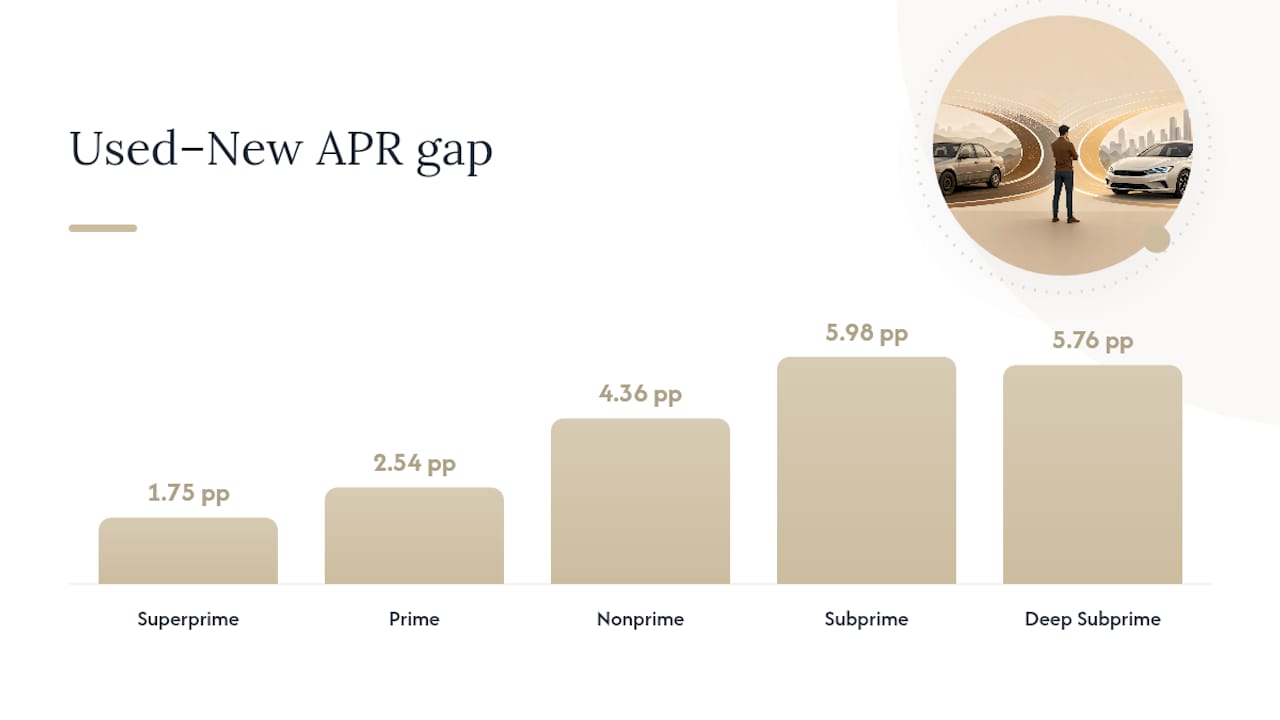
Statistic callout: A deep subprime buyer financing a used car at 21.77% APR pays thousands more in interest over the loan than a prime buyer financing the identical car at 8.77%. On a $25,000 loan over 60 months, that gap alone can equal several years of car payments in extra interest.
Here’s how the tiers break down, based on Experian’s data as reported by NerdWallet:
| Credit Tier | Average New-Car APR | Average Used-Car APR |
|---|---|---|
| Superprime | 4.55% | 6.30% |
| Prime | 6.23% | 8.77% |
| Nonprime | 9.67% | 14.03% |
| Subprime | 13.44% | 19.42% |
| Deep Subprime | 16.01% | 21.77% |
No-credit and thin-file buyers don’t fit neatly into this chart because lenders can’t score what they can’t see. In practice, most no-credit applicants get treated like subprime or deep subprime borrowers by default, unless they can prove income and stability strongly enough to shift the lender’s risk math. That’s the entire game: proving you’re a better bet than your file suggests.
Notice the used-versus-new gap in every tier. Used cars carry higher APRs across the board because they depreciate faster and carry more mechanical uncertainty, which raises the lender’s risk exposure. U.S. News & World Report’s rate tracking shows this spread holds consistently across different market snapshots, not just as a one-time anomaly.
A few things drive that new-versus-used spread beyond age alone:
- Used vehicles have less predictable resale value, so lenders price in more cushion.
- Older cars carry higher mechanical failure risk, which raises the lender’s exposure if you default and they repossess.
- Used-car loans often carry shorter remaining useful life relative to the loan term, which worries underwriters.
If you’re shopping used, which most no-credit buyers do because used cars cost less upfront, expect your quoted rate to run several points above whatever number you see in general market headlines about “average” auto loan rates. Those headlines are usually blending new and used, prime and subprime, into one misleading average.
Where Should You Shop First for a No Credit Auto Loan?
Dealer finance desks are rarely your best first stop, even though they’re the easiest. Credit unions and select online lenders tend to post lower baseline APRs because they’re often working with a different profit model and sometimes a member-first mandate that dealer finance networks don’t share. CNBC Select’s coverage of lenders for credit-challenged buyers notes these lenders frequently weigh proof of income and job stability more heavily than a raw credit score, which works in your favor if your file is thin rather than damaged.
CU SoCal’s credit-challenged auto loan program is a useful real-world example. Their page for buyers with less-than-perfect credit emphasizes flexible qualification criteria and frames on-time payments as a path to rebuilding your file, rather than treating a low score as a dead end. Automaker first-time buyer programs work similarly, sometimes accepting thin-file applicants who can show steady income even without a scoreable history.
Before you approach any lender, gather your documents:
- Recent pay stubs or proof of steady income, ideally covering two to three months.
- Proof of residence, such as a lease or utility bill in your name.
- Proof of your down payment funds, whether that’s a bank statement or a cashier’s check.
- A government-issued ID and, if applicable, a co-signer’s matching documentation.
One detail trips up a lot of first-time shoppers: the difference between soft and hard credit inquiries. A soft pull, which many credit unions and online prequalification tools use, doesn’t affect your score at all. A hard pull does, but auto loan inquiries made within a focused shopping window, typically 14 to 45 days depending on the scoring model, usually get bundled as a single inquiry rather than penalizing you for each one. That means you can shop multiple lenders without stacking damage on your file, as long as you compress your search into a short window.
When comparing preapproval offers, check these four things side by side:
- The APR itself, not just the monthly payment.
- The loan term and how it affects total interest paid.
- Any origination or documentation fees baked into the offer.
- Whether the lender reports your payments to all three credit bureaus, since some smaller or buy-here-pay-here lenders don’t.
How Do Lenders Actually Price a No Credit Car Loan?
Lenders build your APR from a handful of inputs, and understanding which ones you can influence changes how you negotiate. Credit-file depth matters most, obviously, but a thin file isn’t automatically treated the same as a damaged one. Income verification and your debt-to-income ratio carry heavy weight here because they’re the best substitute data a lender has when a credit score doesn’t exist.
Loan-to-value ratio matters too. The more you put down relative to the car’s price, the less exposed the lender is if you default, and that shows up directly in your quoted rate. Vehicle age and mileage factor in similarly to how they affect new-versus-used pricing tiers generally. And your chosen loan term interacts with all of this in a way that surprises a lot of buyers: a longer term lowers your monthly payment, but it usually raises your total interest paid, and for thin-file borrowers it can sometimes push the APR itself higher too, since lenders view longer exposure windows as riskier.
Adding a qualified co-signer with an established credit history is one of the few levers that can meaningfully shift your pricing bracket overnight.
Watch for two dealer practices that quietly inflate your total cost without touching the headline APR:
- Add-on products bundled into the loan, like extended warranties or gap insurance, that pad your loan amount and your monthly interest.
- Inflated origination or “doc” fees rolled into the financed amount rather than disclosed upfront.
Pro Tip: Ask for the APR and the total finance charge in writing before you discuss monthly payment at all. Dealers who lead with payment amount are usually hiding a longer term or a higher rate behind a number that sounds affordable.
What’s the Fastest Way to Lower Your No Credit Car Loan Rate?
Not every tactic saves you the same amount of money, so prioritize in this order.
- Save a down payment of at least 10%, ideally 10 to 20%. This single move does more to shift your APR than almost anything else, because it directly lowers the lender’s loan-to-value risk.
- Choose the shortest term you can comfortably afford, ideally 36 to 48 months. Shorter terms usually pull lower APRs and always cut your total interest paid, even when the rate stays flat.
- Bring a qualified co-signer if one is available. A co-signer with established credit can move you into a meaningfully better pricing tier.
- Get preapproved through a credit union before you visit a dealer. Walking in with a firm offer in hand gives you a real number to hold the dealer to, rather than negotiating blind.
Once you have that preapproval offer, use it as leverage rather than a fallback. Demand the dealer’s APR in writing before discussing payment. Compare it directly against your preapproval rate, not against a payment number that can hide a longer term. And confirm, in writing if possible, that your payments will be reported to all three credit bureaus, since some smaller lenders and most buy-here-pay-here dealers skip this entirely, which defeats the entire point of building your file.
Pro Tip: Run the numbers on a 72 or 84 month term before you sign one. A lower monthly payment on an 84 month loan can cost you thousands more in interest than a 48 month loan on the same car, even at an identical APR, because you’re paying interest for years longer.
Be especially wary of zero-down loans paired with long terms. That combination maximizes your negative equity risk, meaning you owe more than the car is worth for a much longer stretch of the loan.
How Baywall Helps You Negotiate a Fair APR
A tool benchmarks the dealer’s quoted APR against real transactions from buyers in a comparable position: same credit tier, similar loan amount and term, similar vehicle. Entering your credit score, the vehicle, loan amount, term, and the rate the dealer quoted produces a report that shows where that offer actually falls.
This comparison can produce useful information for negotiation, including:
- A verdict on the dealer’s offer: great, fair, or high.
- A target APR to aim for.
- An estimate of potential savings and current pricing data for comparable vehicles.
None of this requires you to already have strong credit or a long file. It just requires the numbers the dealer already gave you.
Buy Now or Wait: An Editor’s Take for No Credit Buyers
If your car still runs and you can wait three to six months, use that window to build a thin file or grow your down payment. Either move can shift you into a meaningfully lower pricing tier. If the purchase can’t wait, lean hard on the highest-impact levers available to you now: the biggest down payment you can manage, the shortest term you can afford, and written confirmation the lender reports to all three bureaus. Save every offer you get. Once your credit improves, refinancing the same car at a better rate is often faster and cheaper than you’d expect.
— Baywall
Check Your Dealer’s APR Before You Sign Anything
Baywall gives you a straight answer on one question: is the rate your dealer quoted fair, or are you leaving money on the table? Enter your credit score, the vehicle, loan amount, and the dealer’s quoted APR, and the report benchmarks it against real deals from buyers in your situation, then hands you a target rate and a dollar savings estimate.
Run it from your phone in the dealer’s parking lot before you walk in, or the night before if you want time to think it over. Either way, walk into that finance office already knowing the number you should be getting, not the number they’d prefer you accept. Check your current dealer APR chart or start your benchmark now at Baywall.
Where to Verify Rates and Lenders Yourself
Before you sign with any lender, confirm they’re legitimately licensed through NMLS Consumer Access, which lists registration details for consumer lending companies operating in the U.S. For current benchmark APRs by credit tier, NerdWallet’s Experian-based rate tables are updated regularly. And if you want a real example of a credit union’s credit-challenged program, CU SoCal’s page for buyers with less-than-perfect credit shows exactly how these offers are typically structured.
This article is general information, not a substitute for advice from a qualified financial advisor. Consult a qualified financial professional about your own circumstances before acting on anything here.
Sources
- Best Auto Loan Rates and Financing: Compare Lenders — NerdWallet
- 6 Best Car Loans for Bad Credit — CNBC Select
- Get a car loan, even with a low credit score — CU SoCal
- NMLS Consumer Access
FAQ
Is It Possible to Get a 3% Interest Rate on a Car?
Only if you have superprime credit, since average new-car APRs for that tier sit around 4.55% according to Experian’s data. A no-credit or thin-file buyer won’t see 3% without a strong co-signer or a rare promotional program.
Can I Still Get a Car Loan With No Credit?
Yes. Credit unions and some online lenders will approve no-credit applicants based heavily on income and employment stability, as CNBC Select notes, though you should expect a subprime-range APR until you build a payment history.
Can I Get a 1.9% Interest Rate on a Car Loan?
Rates that low almost always come from manufacturer-subsidized promotions for buyers with excellent credit, not standard market financing. No-credit and thin-file buyers should benchmark expectations against the deep subprime range instead, roughly 16% to 22% depending on new or used.
Does Anyone Do 0% Financing on Cars?
Automakers occasionally offer 0% APR promotions, but these are reserved for prime or superprime credit tiers and specific vehicle models. A no-credit buyer is very unlikely to qualify for one without a qualified co-signer.
How Do I Know If My Dealer’s Rate Is Fair?
Compare it against Experian’s published tier averages first, then benchmark it against real comparable transactions using a tool like Baywall to see whether your specific offer is priced as great, fair, or high.