U.S. Buyers: Rate Shop Auto Loans and Save $1,000+

Rate shopping auto loans will not meaningfully hurt your credit as long as you cluster your applications inside a focused window, and the credit bureaus generally treat those inquiries as a single search rather than several. Your move right now: line up two or three preapprovals within a focused shopping window, then compare offers by APR and total loan cost, not the monthly payment the dealer hands you. A tool like this can turn a dealer’s quoted rate into an actual negotiation number once you know where you stand, helping you compare effectively.
TL;DR:
- Clustering two to three auto loan preapprovals within two weeks minimizes credit score impact, typically resulting in fewer than 10 points of temporary damage.
- Comparing offers should focus on APR, total interest, loan amount, term, and fees, not just monthly payments or apparent rates.
- Using benchmark tools like Baywall helps identify fair target APRs based on comparable transactions, improving negotiation leverage.
- Secured auto loans usually offer lower APRs because the vehicle serves as collateral, unlike rare unsecured auto loan options with higher rates.
- Preparing your credit, dispute errors, and timing your application window are essential to avoid unnecessary score dips and maximize loan terms.
Table of Contents
- How Rate Shopping Affects Your Credit Score
- Steps To Shop Auto Loan Rates Without Wrecking Your Credit
- APR vs. Interest Rate: What Actually Determines Your Total Cost
- Dealer Buy Rate vs. Outside Financing: Who Actually Sets Your APR
- Choosing Lenders and Reading the Market Correctly
- Baywall in Practice: Turning a Dealer Quote Into a Negotiation Target
- When Should You Start Shopping Rates?
- How To Read Your Auto Loan Disclosure Documents
- Secured vs. Unsecured: Why Your Auto Loan Type Changes the Rate
- Baywall’s Point of View: Why Real Transaction Data Changes the Negotiation
- Check Your Dealer’s APR Before You Sign
- Sources
- FAQ
How Rate Shopping Affects Your Credit Score
Every time a lender pulls your credit to make a lending decision, that’s a hard inquiry, and it can knock a few points off your score. A soft inquiry, by contrast, happens when you check your own score or when a lender prequalifies you without a firm commitment. Soft pulls never touch your score. Hard pulls do, but only slightly, and the damage is smaller than most buyers assume.
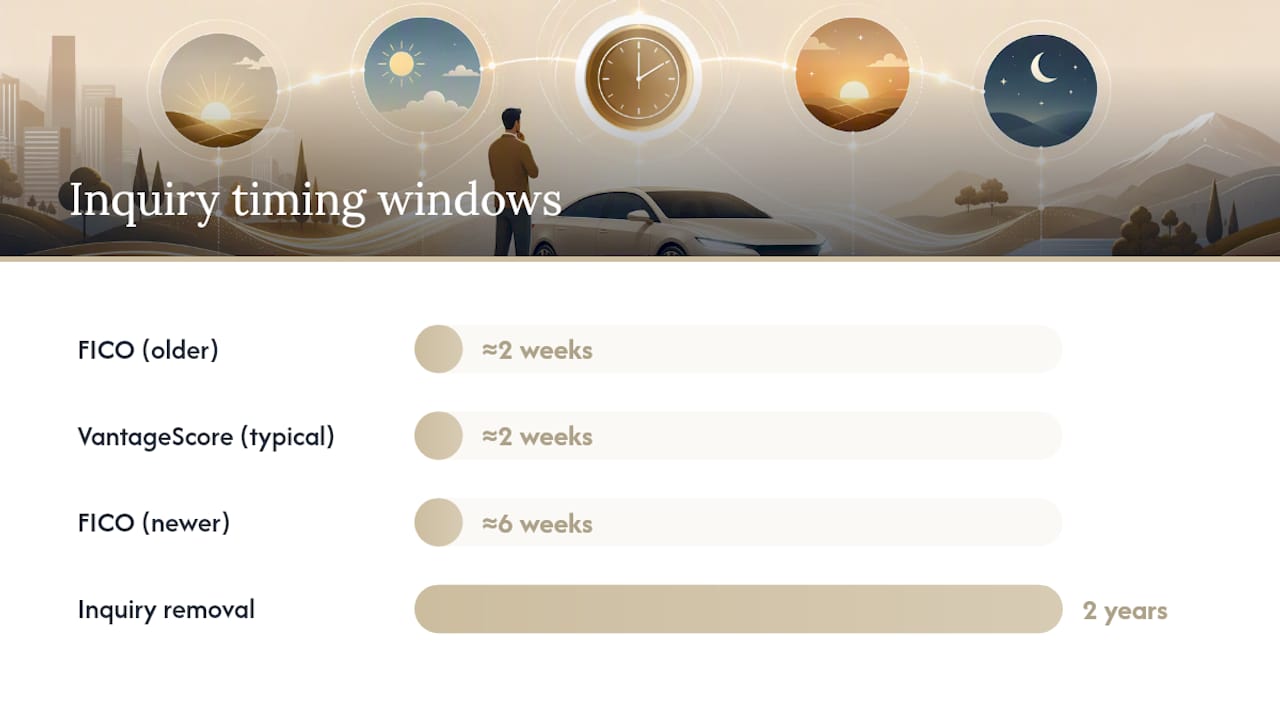
The Consumer Financial Protection Bureau explains that shopping for an auto loan generally has little to no impact on your credit when multiple hard inquiries for the same loan happen close together. FICO and VantageScore both build in a deduplication window for this exact reason. Apply to five lenders in two weeks and most scoring models count that as a single shopping event, not five separate credit checks.
Here’s where it gets specific:
- FICO’s older models use a shorter window around two weeks; newer ones extend that to about six weeks.
- VantageScore models typically use a shorter window of roughly two weeks regardless of version.
- Because the window varies by model, a safer practice is to keep your hard-pull applications within about two weeks if you’re unsure which scoring model applies.
- A cluster of auto loan inquiries typically costs you fewer than 10 points, and that dip is usually temporary.
Score recovery normally happens within a few months once you make on-time payments, and the inquiry itself drops off your report entirely after two years. The short-term dip is a footnote. The long-term risk comes from a different mistake: spreading applications out over weeks or months, which registers as separate inquiries and stacks up real damage. If you want more detail on how multiple applications get scored, Baywall’s breakdown of multiple auto loan inquiries walks through the mechanics.
Steps To Shop Auto Loan Rates Without Wrecking Your Credit
A little preparation before you touch a single application saves you both points and dollars. Here’s the order that works:
- Pull your credit reports at Annualcreditreport and check your FICO Auto Score if your bank or card issuer provides it. Auto lenders often price off this industry-specific score rather than your general FICO score, and it can run several points higher or lower.
- Dispute any errors you find, like an account that isn’t yours or an outdated balance. Errors can drag your tier down and cost you a full percentage point or more on your APR.
- Set a firm budget, including an out-the-door number that accounts for tax, title, registration, and any dealer fees, not just the sticker price.
- Collect soft prequalifications from a few banks, credit unions, and online lenders. These give you a rough sense of your rate without touching your score.
- Convert your best two or three prequalifications into formal preapprovals inside a tight window, ideally 14 days. Ask each lender directly whether the preapproval involves a hard pull.
- Save every quote as a screenshot or PDF, including the APR, term, and amount financed, so you can compare them side by side later.
Pro Tip: Treat prequalification numbers as estimates and preapprovals as your real bargaining chips. A soft-pull number that looks great can shift once the lender runs a full application, so don’t walk into a dealership relying on it as gospel.
For a closer look at how prequalification actually works behind the scenes, Baywall’s guide to soft pull auto loans covers what lenders check and what they don’t.
APR vs. Interest Rate: What Actually Determines Your Total Cost
The number that matters is APR, not the interest rate printed in bold on a dealer’s worksheet. APR wraps in certain fees and finance charges alongside the interest rate, giving you the true annual cost of borrowing. Two loans with the same interest rate can carry different APRs once fees enter the picture, which is exactly why APR, not the sticker rate, is the number to compare across offers.
Term length and amount financed move the needle just as much as the rate itself. Stretch a loan from 60 to 72 months and your monthly payment drops, but you’ll pay meaningfully more in total interest over the life of the loan, even at an identical APR. Financial guides consistently warn that comparing loans by monthly payment alone is misleading precisely because a longer term can mask a worse deal.
Financed add-ons are another distortion. Extended warranties, gap insurance, and paint protection packages rolled into the loan amount inflate what you’re financing and, with it, your total interest paid, even when the APR itself looks reasonable.
When comparing offers, hold these constant across every quote:
- Amount financed (the vehicle price minus your down payment and trade-in)
- Loan term in months
- APR, not the base interest rate
- Total interest paid over the full term
- Any fees rolled into the loan versus paid up front
Use an auto loan worksheet or calculator that lets you enter amount financed, term, and APR side by side. Baywall’s explainer on APR versus interest rate breaks down the math further if you want to run your own numbers before you shop.
Dealer Buy Rate vs. Outside Financing: Who Actually Sets Your APR
Dealers rarely lend you their own money. Instead, they submit your application to a network of lenders, get back a buy rate, which is the wholesale rate the lender approves for your credit tier, and then mark that rate up before presenting it to you as your APR. That markup is the dealer’s profit on the financing side, and it’s legal and disclosed only in general terms, not broken out as a specific dollar figure on your paperwork.
This is exactly why walking in with an outside preapproval changes the conversation. A firm offer in hand from a bank or credit union gives the finance manager a real number to beat instead of a number to invent. Dealers can often match or undercut a solid outside offer because they still have room inside their own buy rate.
A few things worth saying directly at the table:
- “I have a preapproval at [X]% APR from [lender]. Can you beat that, or should I go with them?”
- “I’d like to see the APR before we talk about add-ons. What’s the base rate without the extras?”
- “I’m not financing the extended warranty or gap insurance into this loan. Please recalculate without those.”
If the finance manager won’t disclose the APR clearly, hedges every question with “let’s talk payment instead,” or pressures you to sign before you’ve reviewed the paperwork, that’s your signal to lean on the outside offer you already secured.
Choosing Lenders and Reading the Market Correctly
Credit unions, banks, online lenders, and captive finance arms (the lending divisions of automakers) each play a different role in your search. Credit unions frequently post the most competitive APRs for buyers in good standing, partly because they’re member owned rather than profit driven on the loan itself. Baywall’s research on credit union auto loans digs into when that advantage actually holds. Captive finance companies, meanwhile, sometimes beat everyone on new vehicles through manufacturer-subsidized promotional rates, but rarely on used inventory.
Your credit tier still does most of the work in determining your baseline. Experian’s Q1 2026 data put the average new-car APR around 6.39% and the average used-car APR around 11.43%, a gap driven by vehicle age, resale risk, and loan-to-value differences that lenders price into used financing.
Broader market conditions set the floor under every quote you’ll see. Federal Reserve data shows the finance rate on new-auto 48 month loans at commercial banks running around 7.47% as of May 2026, giving you a sense of where “average” sits before your own credit profile adjusts it up or down.
A few levers can improve your offer beyond just shopping harder:
- Adding a creditworthy co-signer can push you into a better tier, especially with thin credit history.
- A larger down payment lowers your loan-to-value ratio, which some lenders reward with a better rate.
- Shortening your term from 72 to 60 or 48 months often unlocks a lower APR outright, on top of cutting total interest.
Baywall in Practice: Turning a Dealer Quote Into a Negotiation Target
Say a dealer quotes you 8.9% APR on a used SUV. Is that fair for your credit tier, or is it padded with markup? Baywall answers that by comparing your deal against real transactions from buyers in a similar position.
You enter your FICO Auto Score, vehicle type, loan amount, term, and the dealer’s quoted rate. Baywall benchmarks those inputs against comparable transactions, same credit tier, same loan type, similar vehicle, to see where your offer actually falls.
- The report labels your offer great, fair, or high relative to what similar buyers paid.
- It hands you a specific target APR to negotiate toward, not a vague range.
- It calculates your potential dollar savings if you push the rate down to that target.
- It shows current market pricing on comparable vehicles, useful leverage if the vehicle price itself is inflated too.
A buyer with strong credit shopping a five-year loan might discover their 8.9% quote sits well above the benchmark for their tier, with a fair target closer to 6.8%. That gap, run through the loan terms, can translate into over a thousand dollars in avoided interest. The tool states it does not sell or share your data with lenders or dealers, so the number you walk in with is yours to use as leverage, not a lead the finance office already knows about.
When Should You Start Shopping Rates?
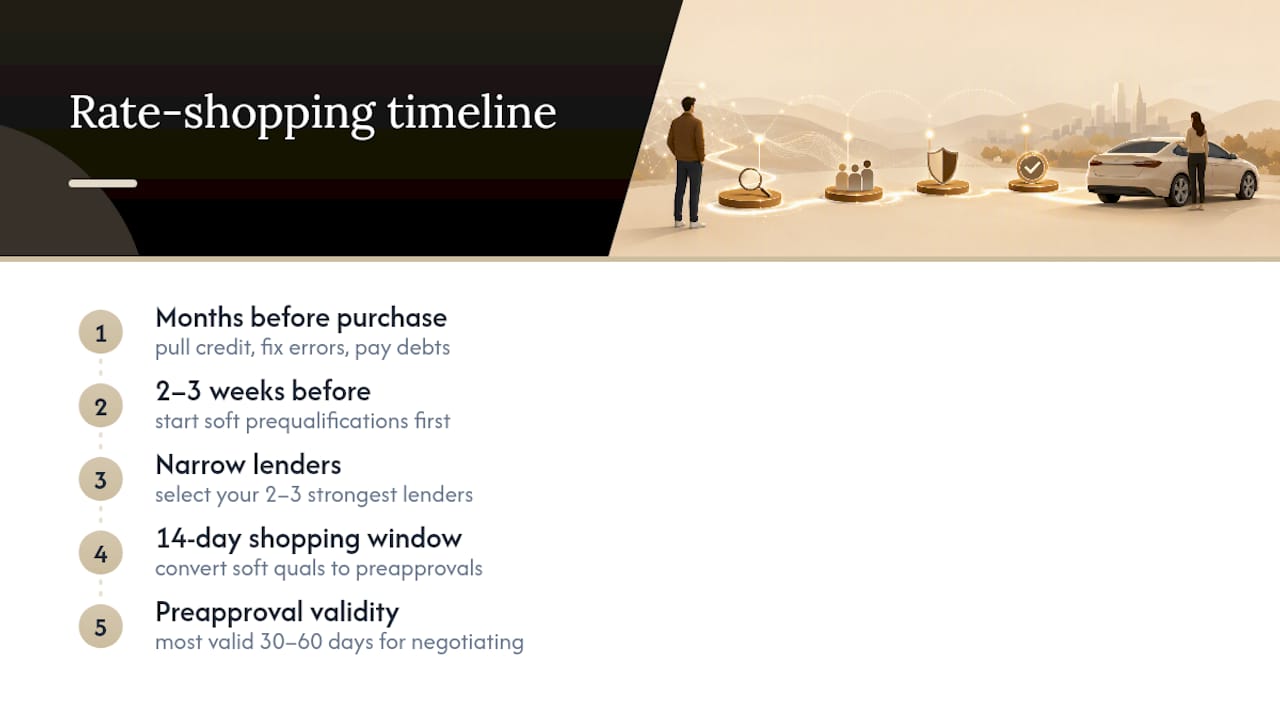
Rate shopping works best when it’s compressed into a short, deliberate window right before you’re ready to buy, not spread across months of casual browsing. If your purchase is still three or four months out, hold off on formal preapplications. Instead, spend that time pulling your credit report, correcting errors, and paying down revolving balances, all of which can move you into a better tier before a single lender ever runs a hard pull.
Once you’re within two to three weeks of an actual purchase, that’s your signal to start the real shopping window. Get your soft prequalifications first, narrow to your strongest two or three lenders, and convert those to preapprovals within that 14-day stretch. Most preapprovals are valid for 30 to 60 days, which gives you enough runway to negotiate at the dealership without the offer expiring mid-conversation.
Buying sooner than planned because you already have inquiries on file is a mistake worth naming directly. If your preapprovals lapse before you find the right vehicle, you’ll need fresh ones, and reapplying weeks or months later resets the clock on the shopping window instead of extending it. Coordinate your credit prep, your test drives, and your financing search so they land in the same tight stretch. That alignment, more than any single tactic, is what keeps your credit intact while still giving you real offers to compare.
How To Read Your Auto Loan Disclosure Documents
Every auto loan you sign comes with a Truth in Lending Act disclosure, a standardized form required by federal law that lays out the real cost of the loan in plain numbers. Four figures matter most on that page: the APR, the finance charge, the amount financed, and the total of payments.
The finance charge is the total dollar cost of borrowing over the life of the loan, essentially all the interest and any finance-related fees combined. The amount financed is what you’re actually borrowing after your down payment and trade-in are subtracted from the price. The total of payments adds the amount financed and the finance charge together, giving you the full number you’ll pay by the time the loan is retired.
Cross-check every one of these figures against the quote you were given verbally or in writing before you signed anything. A dealer who quoted 7% APR should show 7% APR on the TILA disclosure, not a number that’s crept upward once the paperwork appears. If you see an add-on you didn’t agree to, an extended warranty, GAP coverage, paint sealant, financed into the amount financed line, that’s your cue to stop and ask for a revised document before signing. The TILA disclosure exists specifically so you don’t have to take the finance office’s word for it.
Secured vs. Unsecured: Why Your Auto Loan Type Changes the Rate
Nearly every auto loan you’ll encounter is a secured loan, meaning the vehicle itself serves as collateral. If you stop paying, the lender can repossess the car to recover its losses. That collateral backing is exactly why auto loan APRs run lower than most other consumer credit products: the lender’s risk is capped by the car’s resale value, so they can afford to price the loan more aggressively.
Unsecured auto loans exist, but they’re far less common and considerably more expensive. Without collateral, the lender has no direct claim on an asset if you default, so they price in that added risk with a materially higher APR, often closer to personal loan territory than typical auto financing. You’ll mostly encounter unsecured options through personal loan products marketed for vehicle purchases, or in niche cases like financing an older car that doesn’t qualify for standard secured auto financing.
For the overwhelming majority of buyers, a secured auto loan is both the default and the better economic choice. The lower rate more than offsets the fact that the lender holds a lien on the title until the loan is paid off. Know which type you’re being offered before you sign. A shockingly low-looking rate on an “unsecured” product marketed as auto financing deserves a second look at the fine print.
Baywall’s Point of View: Why Real Transaction Data Changes the Negotiation
We built Baywall because dealers hold every advantage in the financing conversation, and buyers walk in with vague advice about “shopping around” but no actual number to anchor to. Vague ranges don’t win negotiations. Specific target APRs, drawn from comparable transactions, do.
Buyers who use comparable-transaction data stop wondering whether 7.5% is fair for their credit tier and vehicle, because they can see what buyers just like them actually paid. That clarity is the leverage a finance manager can’t talk you out of.
Before you sign anything, run your dealer’s quote through a real benchmark. It takes a few minutes and could save you thousands.
— Baywall
Check Your Dealer’s APR Before You Sign
This service gives you the one thing most rate-shopping advice can’t: a specific number pulled from what buyers in your exact situation actually paid, not a generic range that leaves you guessing at the dealership.
The free version shows you where your dealer’s quote likely falls, great, fair, or high, based on your credit tier, vehicle, and loan terms. The $2.99 one-time report goes further: a detailed benchmark against comparable transactions, a specific target APR to negotiate toward, your estimated dollar savings, and current pricing data on similar vehicles so you know if the sale price needs work too. Buyers who want ongoing access across multiple deals can also choose the $8.99 weekly plan.
Running the numbers takes a few minutes. Enter your FICO Auto Score, the vehicle, your loan amount and term, and the dealer’s quoted rate, then bring the resulting target APR straight into the finance office. Head to Baywall’s analysis tool and check your offer before you sign anything.
This article is general information, not a substitute for advice from a qualified financial advisor. Consult a qualified financial professional about your own circumstances before acting on anything here.
Sources
- How will shopping for an auto loan affect my credit? — CFPB
- Take control of your auto loan: A step-by-step guide — CFPB
- Finance Rate on Consumer Installment Loans at Commercial Banks, New Autos 48 Month Loan | FRED
FAQ
Can I Get a 1.9% Interest Rate on a Car Loan?
Rates that low are typically manufacturer-subsidized promotional offers on new vehicles for buyers with excellent credit, not standard market rates. Experian’s data shows the average new-car APR sitting around 6.39%, so such an offer usually comes from a captive finance arm running a limited promotion rather than a bank or credit union.
Who Offers the Best Auto Loan Rates Right Now?
Credit unions frequently post the most competitive APRs for well-qualified buyers, though captive finance companies can beat everyone on new vehicles during promotional periods. Rather than guessing which lender is cheapest, benchmark your specific offer against comparable transactions to see where it actually stands for your credit tier and vehicle.
Is 7% APR for a Car Loan High?
It depends heavily on the vehicle’s age and your credit tier. Experian’s Q1 2026 figures put average new-car APR at 6.39% and used-car APR at 11.43%, so 7% is roughly in line for a new car but could be a strong rate for a used one, depending on your credit standing.
What Interest Rate Can I Get With an 800 Credit Score?
Buyers in the top credit tiers typically qualify for rates well below the market average, often several points under the general new-car APR average. Because the exact number depends on vehicle age, loan term, and lender, running your specific deal through a benchmarking tool gives you a firmer answer than a generic range.
How Many Auto Loan Applications Can I Submit Without Hurting My Credit?
Apply to as many serious lenders as you want, as long as they fall inside the same shopping window, generally 14 days to be safe. CFPB guidance confirms that clustered inquiries for the same loan type are treated as a single credit check by most scoring models, so three or four applications in two weeks carry roughly the same score impact as one.