Rebate vs Low APR: Which Saves You More Money?

Low APR usually wins when the dealer’s promotional rate sits three or more percentage points below what you’d pay outside, and the rebate usually wins when that gap is smaller or your credit tier can’t access the promo rate at all. The variables that decide it: rebate size, the APR gap, your loan amount, term, and credit-score eligibility. Run your own numbers in the calculation below before you decide.
TL;DR:
- Rebate benefits are more significant for smaller, shorter loans where interest accrual is limited, while low APR savings dominate on larger, long-term loans.
- Qualifying for the promotional low APR typically requires a super-prime credit score, making rebate options more accessible for most buyers.
- When the interest rate gap is three percentage points or more, low APR usually results in greater savings, especially on larger balances and longer terms.
- Always compare total costs in writing for both scenarios before signing, ensuring the same loan term, down payment, and fees apply.
- Using real market data and prequalification can better inform negotiations and prevent overpaying for less competitive offers.
Table of Contents
- Rebate vs Low APR: How Each One Actually Changes Your Loan
- The Math: A Reusable Method and a Worked Example
- What Changes Which Option Wins
- Get Both Scenarios in Writing Before You Sign
- How Baywall Turns This Comparison Into a Negotiating Number
- Where Most Buyers Get This Decision Wrong
- Sources
Rebate vs Low APR: How Each One Actually Changes Your Loan
A rebate lowers the price of the car before financing even starts. If a $32,000 truck carries a $2,500 rebate, you finance $29,500 instead of the sticker price, and every dollar of interest gets calculated against that smaller number. A low APR, by contrast, doesn’t touch the price. It reduces the rate applied to the full loan balance over time. Both routes save you money. They just save it in different places, at different speeds.
Promotional APRs almost always come from the manufacturer’s captive lender, not your local bank, and captive lenders reserve those rates for their strongest applicants. Experian notes that promotional financing is typically limited to “well-qualified” buyers, which in practice means super-prime credit. The rebate has no such gate. Nearly anyone who qualifies for the loan at all can take the cash discount.
That asymmetry is why several auto-finance calculators lean on a rough rule of thumb: if the dealer’s promo rate is roughly three percentage points or more below your outside rate, the low APR option tends to save more, especially on larger loans and longer terms. Below that gap, or when the rebate is a meaningful share of the loan, the cash discount tends to come out ahead. Neither rule replaces doing the math for your specific numbers, but it tells you which direction to lean before you open a spreadsheet.
| Decision factor | Favors rebate | Favors low APR |
|---|---|---|
| Rate gap (promo vs. outside rate) | Under 3 points | 3+ points |
| Loan amount | Smaller loans | Larger loans |
| Loan term | Shorter terms | Longer terms |
| Credit score | Any qualifying tier | Super-prime only |
| Rebate size relative to loan | 8% or more of loan | Small rebate, deep rate cut |
- Rebate advantage shows up fastest on smaller, shorter loans where interest never accumulates enough to outweigh the upfront discount.
- Low APR advantage compounds on larger balances stretched over five or six years, where even a small rate difference multiplies.
The Math: A Reusable Method and a Worked Example
Before running any numbers, lock down the terms that have to stay identical across both scenarios. Otherwise you’re not comparing rebate vs low APR at all. You’re comparing two unrelated loans.
Assumptions to hold constant:
- Same loan term (say, 60 months) for both scenarios.
- Same down payment applied to both.
- Same treatment of sales tax and fees, since some states tax the pre-rebate price.
- Separate out principal, total interest paid, and total cost (principal plus interest) for each scenario.
Calculation steps:
- Scenario A (rebate): subtract the rebate from the vehicle price to get your financed amount, then calculate total interest at your outside rate over the agreed term.
- Scenario B (low APR): use the full vehicle price as your financed amount, then calculate total interest at the dealer’s promo rate over the same term.
- Add principal and interest for each scenario to get total cost.
- Compare the two total-cost figures. The lower number wins, regardless of which one has the lower monthly payment.
Here’s a worked example using a $30,000 vehicle, a 60-month term, and a $2,000 rebate.
Scenario A, rebate plus outside loan: you finance $28,000 at 7% for 60 months. Total interest lands around $5,250, for a total cost near $33,250.
Scenario B, dealer’s 1.9% promo: you finance the full $30,000 at 1.9% for 60 months. Total interest comes to roughly $1,480, for a total cost near $31,480.
The takeaway: in this example, the low APR option saves about $1,770 more than the rebate, even though the rebate looked like the bigger discount on paper. Flip the rate gap to just one or two points, though, and the rebate often pulls back ahead. Calculator lets you rerun this exact comparison with your own figures in a couple of minutes.
What Changes Which Option Wins
The math above assumes you can actually get the promo rate. That’s the biggest variable most buyers overlook.
- Credit tier eligibility: Captive lenders typically reserve their lowest advertised rates for super-prime borrowers, often scores in the mid-700s and up, according to Experian’s guidance on auto financing. If your score sits lower, that headline 1.9% may never be offered to you, which makes the rebate the realistic option by default.
- Loan term: Longer terms amplify the effect of any APR difference, since interest has more months to compound. A 2-point rate gap barely matters over 36 months but adds up fast over 72.
- Rebate as a share of the loan: A rebate worth 8% to 10% or more of your financed amount tends to beat modest rate cuts unless the APR gap is unusually wide.
- Taxes, fees, and prepayment terms: Some states calculate sales tax on the pre-rebate price, which shrinks the rebate’s real value. Ask whether the promo loan carries a prepayment penalty if you plan to refinance or pay it off early, since that can quietly erase savings you thought you’d locked in.
Pro Tip: Always compare total cost, not monthly payment, and build a fallback scenario before you negotiate. If the dealer counters with a non-promo rate once you’ve settled on financing, you want a second total-cost comparison ready so you’re not caught doing math on the spot.
Get Both Scenarios in Writing Before You Sign
Dealers will quote you a payment. Your job is to get the full picture on paper, in both directions, before anything gets signed.
- Ask for an itemized buyer’s order for two separate scenarios: the cash rebate financed through your outside lender, and the dealer’s promotional APR with no rebate. InvoicePricing’s guidance on this exact request is worth following closely.
- Confirm the promo’s eligibility rules in writing: credit tier required, eligible trims or models, maximum term, minimum down payment, and the lender’s name.
- Bring your outside preapproval and ask the dealer to match or beat it. Compare both written offers side by side before you commit to either.
- If the promo is 0% or close to it, confirm there’s no prepayment penalty and ask whether the rebate can be combined with the low rate or if the two are mutually exclusive. Many manufacturer programs won’t let you stack them.
That last point trips up more buyers than any other part of this decision. A 0% offer sounds unbeatable until you learn the rebate disappears the moment you take it.
How Baywall Turns This Comparison Into a Negotiating Number
Running the rebate-versus-APR math tells you which incentive should win in theory. It doesn’t tell you whether the dealer’s quoted rate is actually competitive for someone with your credit profile. That’s a separate question, and it’s the one Baywall answers.
Enter your credit score, the vehicle, loan amount, loan term, and the dealer’s quoted APR, and Baywall benchmarks that offer against real transactions from buyers in your credit tier with similar loan types and vehicles.
- The report labels the offer great, fair, or high relative to comparable deals.
- It gives you a specific target APR to push toward in negotiation.
- It calculates your estimated dollar savings if you land that target rate instead of the dealer’s initial number.
Instead of guessing whether 1.9% is actually a deal for your credit profile, you walk in with a number backed by market data.
Where Most Buyers Get This Decision Wrong
The conventional advice treats rebate vs low APR as a math problem you solve once and forget. It isn’t. It’s a math problem wrapped inside a qualification problem, and most explainers skip the second part entirely.
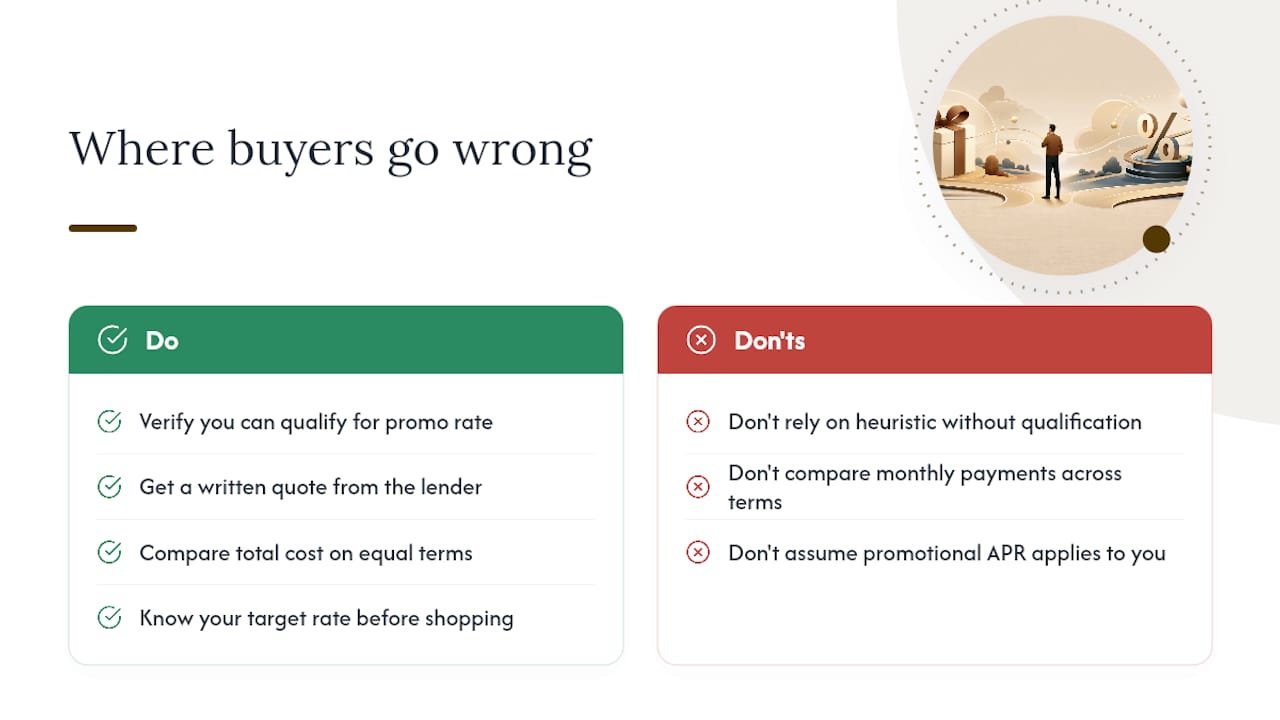
Here’s what the research actually supports: the 3-point rate-gap heuristic is a genuinely useful shortcut, but it’s worthless if you never verify whether you can qualify for the promo rate in the first place. Experian’s data makes clear that promotional APRs skew toward buyers who, frankly, need the least help. If your credit sits in the near-prime range, spend less time comparing hypothetical rates and more time getting a real, written quote from the dealer’s lender before you build any spreadsheet.
The other overlooked piece: total cost beats monthly payment, every time, no exceptions. A dealer stretching your term to make either option look cheaper on a monthly basis is the oldest trick in the showroom. Do the comparison on equal terms, get both offers in writing, and know your target rate before you walk in.
— Baywall
Sources
- Rebate vs low-interest: Which saves more? | FinCalcs
- Calculator
- Cash rebate vs 0% APR calculator | InvoicePricing