3–5 Point APR Gap? U.S. Buyers Should Benchmark and Negotiate

If your dealer quoted an APR more than a few percentage points above the benchmark for your credit tier and vehicle type, it’s probably too high, and you have every right to push back before signing. Your next move is simple: get a competing preapproval from a bank, credit union, or online lender, then benchmark the dealer’s number against real comparable deals using a tool like Baywall before you commit to anything.
TL;DR:
- If your dealer’s quoted APR exceeds the benchmark for your credit tier by three to five percentage points, it is likely worth negotiating or walking away.
- Bringing a preapproval from a bank, credit union, or online lender and benchmarking your offer against real transactions helps determine if the rate is fair.
- A rate markup from the dealer is usually the main cause of higher APRs, not your credit risk, and can often be negotiated down if you ask for the lender’s buy rate.
- Using a benchmarking tool can identify whether your APR is fair compared to similar buyers, saving you potentially thousands over the loan term.
- If negotiation fails, refinancing or adjusting your credit profile may be necessary, as dealer markups differ from genuine credit risk and might justify higher rates.
Table of Contents
- What Counts as a Too High Car APR for Your Credit Tier?
- What to Bring to the Dealership Before You Negotiate
- How to Push Back on Dealer APR Markup
- What If the Dealer Won’t Lower the Rate?
- How a benchmarking tool tells you if your rate is actually fair
- When Negotiation Won’t Fix a High Rate
- Get Your Dealer’s APR Benchmarked Before You Sign
- Sources
- FAQ
What Counts as a Too High Car APR for Your Credit Tier?
APR, or annual percentage rate, is the number you should compare, not the plain interest rate. APR wraps in lender fees on top of interest, so two loans with the same interest rate can carry different APRs depending on what’s bundled in, according to NerdWallet. Comparing interest rate alone is how buyers get fooled.
Here’s where the benchmarks matter. In the second quarter of 2024, the average APR was around 6.84% for new cars and 12.01% for used cars, according to Experian. That gap alone tells you vehicle type changes what “normal” looks like. Credit score changes it even more:
- Super-prime borrowers often land low single-digit APRs on new cars.
- Prime and nonprime borrowers see moderate rates that climb steadily as scores drop.
- Deep subprime borrowers can face double-digit APRs even on newer vehicles, according to Experian’s financing data.
A quoted APR sitting 3 to 5 percentage points above the benchmark for your credit tier is usually a signal to negotiate or walk, according to Gerald’s 2026 guide on car APR benchmarks. That gap often comes from dealer markup, not risk. Dealers can legally quote a rate higher than the lender’s actual buy rate and pocket the spread, a practice the Consumer Financial Protection Bureau confirms is both common and negotiable. Knowing your APR vs. interest rate distinction going in keeps you from arguing the wrong number at the table.
What to Bring to the Dealership Before You Negotiate
A strong negotiation case is built before you ever walk onto the lot, rather than during the finance manager’s pitch. Show up prepared and the conversation shifts in your favor almost immediately.
- Get a fast preapproval. Apply with your bank, a local credit union, or an online lender first. Most turn around a rate quote within a day, and a credit union preapproval frequently beats dealer financing outright.
- Collect your paperwork. Print or screenshot your preapproval letter, the quoted APR, loan term, and monthly payment. Bring your credit score or a recent credit report pull so you know exactly which tier you’re negotiating from.
- Check your credit report for errors. A single incorrect late payment can knock you into a worse tier and cost you real money. Fix it before you shop, not after.
- Decide your terms in advance. Know the loan term and monthly payment you’re willing to accept before someone across the desk is doing the math for you. A longer term lowers the payment but raises total interest, so pick your trade-off ahead of time.
- Calculate your dollar savings. Multiply the difference between the dealer’s quoted APR and your target rate across the loan term. A gap of even 3 points on a $30,000 loan can cost more than $2,000 over five years, similar to the price of a decent vacation you’ll never take because it went to interest instead.
Pro Tip: Bring the actual dollar figure, not just the percentage difference. Finance managers negotiate percentages all day, but a hard number like “this rate costs me $1,800 more” is much harder to wave away.
How to Push Back on Dealer APR Markup
Walk in with one clear ask: the lender’s buy rate, or proof the quoted rate isn’t marked up. Dealers aren’t required to disclose the buy rate, but asking the question directly signals you know how dealer financing works, and the CFPB confirms buyers can negotiate this rate like any other term.

Present your competing preapproval and state a specific target, not a vague request for “something lower.” Your target APR should sit at or near the average for your credit tier and vehicle type, drawn from your preapproval or a benchmarking report.
Useful phrasing for common pushback:
- If they say “this is the best we can do”: ask to see the lender’s rate sheet or buy rate documentation.
- If they stall: ask for a written loan worksheet itemizing APR and all fees, since dealers can bundle add-ons into financing without flagging them clearly.
- If they won’t budge: state you have a preapproval at a lower rate and ask them to match or beat it, or you’ll finance elsewhere.
- If a manager gets involved: repeat your target rate calmly and ask what specifically prevents them from matching your outside offer.
Pro Tip: Negotiate the vehicle price and the APR as separate conversations. Dealers sometimes offer a “great rate” to distract from a padded price, or a great price to justify a padded rate. Lock one number down before moving to the next.
What If the Dealer Won’t Lower the Rate?
A dealer’s refusal isn’t the end of the road. It just means the financing comes from somewhere else.
- Finance outside the dealer. Banks, credit unions, and online lenders often beat dealer rates, especially for prime and super-prime borrowers, and a preapproval locks in your rate before you ever negotiate price.
- Refinance after purchase. If you need the car now and can’t wait out financing shopping, you can often refinance within 60 to 90 days once your loan is established and your credit profile is verified.
- Add a co-signer or larger down payment. Both reduce lender risk, which can pull your APR down, though a co-signer takes on real liability if you miss payments.
- Delay or downsize. If every offer comes back high, the honest answer might be that your credit tier or the vehicle you’ve chosen doesn’t support the payment you want yet. Waiting a few months to improve your score, or choosing a less expensive vehicle, often saves more than any negotiation tactic.
How a benchmarking tool tells you if your rate is actually fair
Guessing whether a dealer’s number is fair is exactly the problem Baywall was built to solve. You enter your credit score, the vehicle, loan amount, term, and the dealer’s quoted APR, and the tool benchmarks that offer against real comparable transactions, matched by credit tier, loan type, vehicle, and term.
The report gives you three things:
- An easy-to-understand label for your specific offer.
- A target APR to negotiate toward, based on comparable buyers’ rates.
- An estimated dollar savings if you negotiate closer to that target.
Bring that number into the dealership as your stated target, or use it to decide whether an outside lender’s offer is genuinely better. It also works as a gut check on used car loan rates, which run higher than new car rates across nearly every credit tier and are easier to overpay for without a real benchmark. The tool does not share your data with lenders or dealers, so the number you get is yours to use as leverage, not theirs to see coming.
When Negotiation Won’t Fix a High Rate
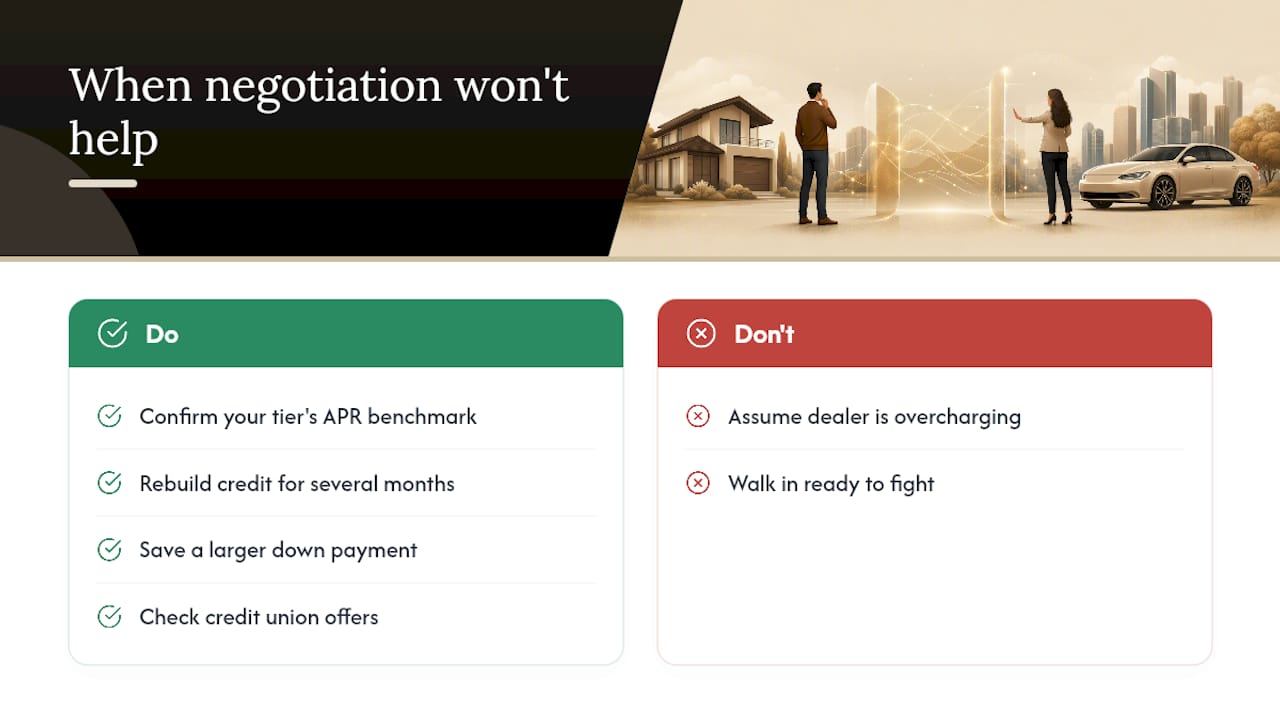
Negotiation works best when the dealer is marking up an otherwise reasonable rate. It works far less well when the APR reflects genuine credit risk. If your score sits in subprime territory, a rate that looks brutal compared to Experian’s averages might still be close to what any lender would offer you.
The honest move is to confirm the benchmark for your actual tier before assuming you’re being overcharged. Sometimes the fix isn’t a better script at the dealership. It’s rebuilding credit for a few months, saving a larger down payment, or comparing credit union options that price risk differently than a dealer’s captive lender does. Know which situation you’re in before you walk in ready to fight.
— Baywall
Get Your Dealer’s APR Benchmarked Before You Sign
This is the check you run before you sign, not after you regret it. Instead of guessing whether your dealer’s number is fair, you get a report that compares your exact offer against real transactions from buyers in your credit tier, with the same loan type and a similar vehicle.
The free version gets you started, and the one-time report costs $2.99 for a full benchmarked analysis with your target APR and estimated savings. If you want ongoing access while you shop multiple dealers or lenders, the Weekly plan runs $8.99 per week. For readers comparing multiple lender quotes side by side, resources like Brandcomparisons can help you track offers before you commit. When you’re ready to see whether your dealer’s rate holds up, head to the Baywall analyze page, enter your loan details, and get your number before you sign anything.
Sources
- Can I negotiate the interest rate on an auto loan with the dealer? | Consumer Financial Protection Bureau
- What Is a High Interest Rate for a Car Loan? | Experian
- Average car loan interest rates by credit score | NerdWallet
FAQ
What Is Considered a High APR for a Car Loan?
An APR is generally high if it sits 3 to 5 percentage points above the average for your credit tier and vehicle type, according to Gerald’s benchmark guide. For context, average new car APRs sat near 6.84% and used car APRs near 12.01% in Experian’s Q2 2024 data.
How Do I Know if My Dealer Marked Up My APR?
Ask directly whether the quoted rate is the lender’s buy rate or includes dealer markup, and request a written loan worksheet itemizing all fees. The CFPB confirms dealers can legally mark up buy rates, and you’re entitled to negotiate that markup.
Can I Refinance If I Already Signed at a High APR?
Yes. Most lenders allow refinancing within 60 to 90 days of purchase once your loan is established, and refinancing can meaningfully lower your rate if your credit improved or your original deal included dealer markup.