Used Car Loan Rates in 2026: Benchmarks and Negotiation Targets

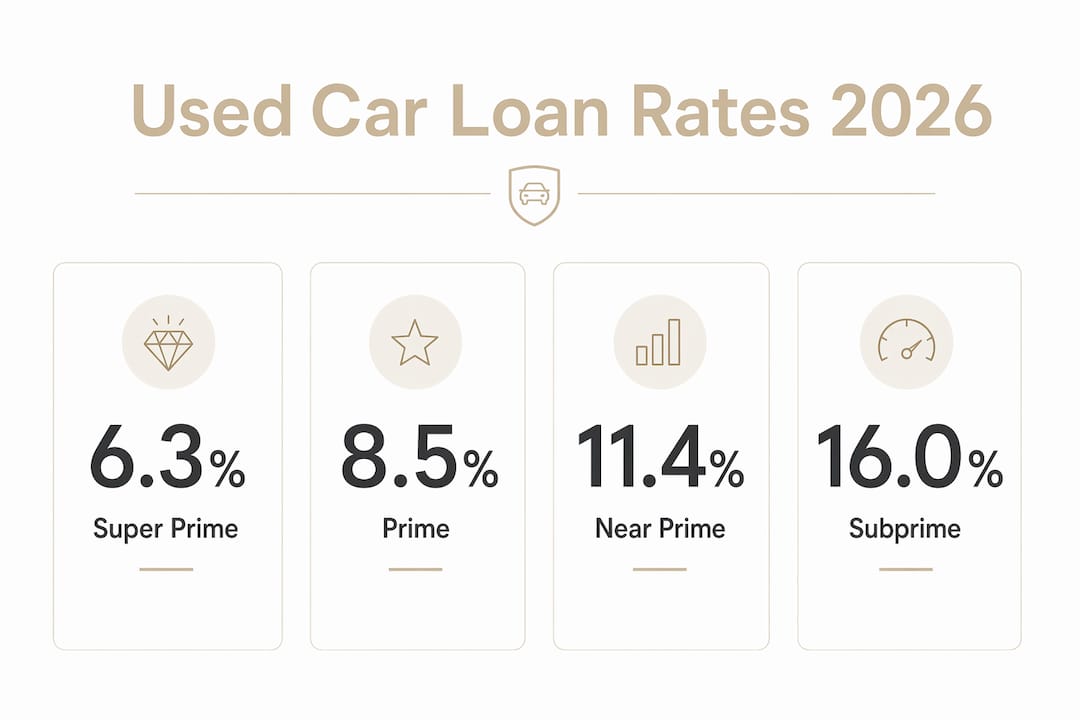
The average used-car APR hit 11.43% in Q1 2026, according to Experian. That number is your baseline. Whether the dealer’s quote is a good deal or money left on the table depends entirely on where your credit score puts you in the tier system below.
Here are the APR targets to carry into any negotiation, by credit tier:
- Super prime (781–850): aim for 6.3–6.8%
- Prime (661–780): aim for 8.7–9.1%
- Non-prime (601–660): target around 14%
- Subprime (501–600): expect 18–19%; push back on anything above that
- Deep subprime (300–500): rates often reach 21% or higher; refinancing after 6–12 months of on-time payments is the exit strategy
If the dealer’s number sits more than 2 points above your tier’s benchmark, you have room to negotiate. Tools like Baywall can tell you exactly how much room, in dollars, before you sign.
Data sourced from Experian Q1 2026. Rates reflect used-car loans only. July 2026.
Table of Contents
- Current used car loan rates by credit tier and term
- Why used-car loans usually carry higher APRs than new-car loans
- How your credit score maps to APR ranges and what you can do about it
- How loan term, down payment, and APR combine to affect what you actually pay
- How to shop, compare, and negotiate a lower used-car APR
- Dealer traps and high-cost financing you should walk away from
- How Baywall helps you check whether a dealer APR is fair
- Key Takeaways
- The markup is the part most buyers never see
- Know your number before you sign
- Sources and where the numbers come from
Current used car loan rates by credit tier and term
Experian’s Q1 2026 data puts the overall used-car average at 11.43%, with an average monthly payment of $521 and a typical loan term of about 67 months. That average blends every credit tier together, so it masks a wide spread. A super-prime borrower and a deep-subprime borrower can be looking at rates 15 points apart on the same vehicle.

The table below maps each credit tier to typical APR ranges across common loan terms, using Experian and industry benchmarks.
| Credit tier | Score range | — | 48-month APR | 60-month APR | 72-month APR |
|---|---|---|---|---|---|
| Super prime | 781–850 | 6.3–6.8% | ~6.3% | ~6.8% | 8.7–9.1% |
| Prime | 661–780 | 8.7–9.1% | ~8.7% | ~9.1% | 8.7–9.1% |
| Non-prime | 601–660 | ~14% | ~14% | — | — |
| Subprime | 501–600 | 18–19% | 18–19% | ~19.0% | ~21%+ |
| Deep subprime | 300–500 | ~21%+ | ~21%+ | ~21%+ | N/A |
Shorter terms tend to carry lower APRs. Industry guidance shows 48-month rates running roughly 0.5–1 point below 60-month rates, and 60-month rates running 0.5–1.5 points below 72-month rates. The catch is that shorter terms mean higher monthly payments, so most buyers end up on 60- or 72-month loans despite the extra interest cost.
Pro Tip: Before you walk into a dealership, get a preapproval from a credit union or your bank. Credit unions consistently offer rates 0.5–2 percentage points below what banks quote for the same credit profile, and that preapproval gives you a concrete number to hold the dealer accountable to.
Why used-car loans usually carry higher APRs than new-car loans
Lenders price used-car loans higher because the collateral is riskier. A new car has a known value, a factory warranty, and a predictable depreciation curve. A used car has none of those guarantees.
The core risk drivers lenders price in:
- Faster residual depreciation: a used vehicle’s value drops more unpredictably, shrinking the lender’s recovery cushion if you default
- Condition uncertainty: no lender can fully verify mechanical state from a loan application
- Smaller resale market: older or high-mileage vehicles are harder to liquidate at auction
- Higher mechanical-failure probability: a breakdown can trigger missed payments even for otherwise reliable borrowers
That risk gap shows up directly in the numbers. Industry comparisons show used-car APRs running roughly 4.5–4.9 percentage points above new-car averages across equivalent credit profiles. On a $25,000 loan at 60 months, that spread alone adds more than $3,000 in total interest.
Vehicle age and mileage push rates even higher. Lenders commonly add a 1.5–2.5 point premium for vehicles older than 10 years or with more than 100,000 miles, and some lenders won’t finance those vehicles at all. Understanding how dealer appraisal tactics affect perceived vehicle value helps explain why the same car can produce different financing offers at different lots.
How your credit score maps to APR ranges and what you can do about it
Your credit score is the single biggest lever on your rate. Moving from non-prime to prime can cut your APR by 5 points or more, which on a $20,000 loan over 60 months translates to roughly $2,500 in savings.
Here are the Experian-benchmarked APR ranges for used-car loans, with the realistic improvement moves that can shift your tier:
- Super prime (781–850): 6.3–6.8% — you’re already in the best bracket; focus on term and down payment
- Prime (661–780): 8.7–9.1% — small score improvements won’t move your rate much; shop lenders aggressively
- Non-prime (601–660): ~14% — paying down revolving balances below 30% utilization can push you into prime within 30–60 days
- Subprime (501–600): 18–19% — dispute any errors on your credit report first; even one removed collection can shift your tier
- Deep subprime (300–500): ~21%+ — a larger down payment reduces lender risk and may unlock slightly better terms even without a score change
Three moves that can realistically shift your tier in 30–90 days:
- Pay down credit card balances to below 30% of each card’s limit. Credit utilization is the fastest-moving factor in your score.
- Dispute errors on your credit report. Pull your free report from AnnualCreditReport.com and flag any accounts that aren’t yours or show incorrect balances.
- Avoid opening new credit lines in the 60–90 days before applying. Each new inquiry and new account temporarily lowers your score.
Pro Tip: Use soft-pull preapproval tools from credit unions and online lenders to check your likely rate without affecting your score. Once you’re ready to commit, submit all formal applications within a 14-day window so FICO treats them as a single inquiry.
How loan term, down payment, and APR combine to affect what you actually pay
The monthly payment is not the cost of the loan. Total interest paid is. Those two numbers often pull in opposite directions, and dealers know it.
Longer terms reduce monthly payments but increase total interest. A shorter term almost always carries a lower APR and costs less overall, even though the monthly payment is higher. The worked examples below make the dollar gap concrete.
Worked examples: $15,000 and $25,000 used-car loans
| Loan amount | APR | Term | Monthly payment | Total interest |
|---|---|---|---|---|
| $15,000 | 6.8% | 48 months | — | — |
| $15,000 | 6.8% | 60 months | — | — |
| $15,000 | ~14% | 60 months | — | — |
| $25,000 | 9.1% | 60 months | $521 | — |
| $25,000 | ~14% | 60 months | $581 | $9,860 |
| $25,000 | 19.0% | 60 months | $648 | $13,880 |
Run your own numbers with a car loan calculator to see exactly how term and APR interact for your specific loan amount.
The same $25,000 vehicle financed at 9.1% versus 19.0% costs nearly $7,700 more in interest over 60 months. That’s a real cost difference, not a rounding error.
How to decide between a shorter and longer term:
- Calculate the total interest, not just the monthly payment. If the difference in total interest between a 48-month and 60-month loan exceeds $1,000, the shorter term is almost always worth the higher payment.
- Check whether you can afford the 48-month payment without stress. A payment that strains your budget leads to missed payments, which costs more than the interest savings.
- Factor in the vehicle’s age. A 10-year-old car on a 72-month loan means you’re still paying for it when it’s 16 years old. Match the term to the vehicle’s realistic useful life.
- Put more down if you can. A larger down payment reduces the loan principal, which cuts total interest regardless of APR.
How to shop, compare, and negotiate a lower used-car APR
The dealer’s first offer is rarely the best offer. Here’s the playbook to get a better rate.
- Pull your credit report. Get your free report from AnnualCreditReport.com and dispute any errors before you apply anywhere.
- Get preapproved by at least two lenders before visiting a dealer. Credit unions typically offer rates 0.5–2 points below banks for equivalent credit profiles. Apply to a credit union, your bank, and one online lender.
- Submit all applications within 14 days. FICO’s rate-shopping window consolidates multiple auto-loan inquiries into a single hard pull when submitted within roughly 14 days. Shop freely within that window.
- Bring your best preapproval letter to the dealer. Hand it to the finance manager and say: “I have a preapproval at X%. Can you beat it?” The dealer’s lender relationships sometimes allow them to match or undercut outside offers.
- Negotiate the rate separately from the price. Dealers sometimes lower the vehicle price while quietly raising the APR, or vice versa. Keep both negotiations separate.
- Ask specifically about the buy rate. Dealers receive a wholesale rate from lenders (the “buy rate”) and are allowed to mark it up, often by 1–3 percentage points. That markup is negotiable.
- Consider refinancing after 6–12 months. If you accept a higher rate now to close the deal, refinancing with a credit union can cut 1–3 points off the remaining balance once you’ve established a payment history.
Lender options at a glance:
- Credit unions: lowest rates for prime/non-prime borrowers; membership required but usually easy to join
- Local banks: competitive for existing customers; faster approval than some online lenders
- Online direct lenders: broad credit acceptance; easy to compare multiple offers quickly
- Dealer-arranged financing: convenient but often carries a markup; use only if the dealer beats your preapproval
Pro Tip: When you bring a preapproval to the dealer, don’t reveal the rate immediately. Ask what rate they can offer first. If their number is lower, take it. If it’s higher, show the preapproval and ask them to match it.

Dealer traps and high-cost financing you should walk away from
Not every financing offer is worth taking. Some are structured to cost you far more than the sticker price suggests.
Watch for these red flags in any F&I (finance and insurance) office:
- Buy-Here-Pay-Here (BHPH) lots: accessible for buyers with poor credit, but BHPH financing frequently carries extremely high rates and may not report payments to credit bureaus, meaning you pay a premium without building credit
- Undisclosed dealer reserve markups: if the dealer won’t tell you the lender’s buy rate, assume they’re marking it up by the maximum allowed
- APRs well above your tier benchmark: anything more than 3–4 points above the Experian benchmark for your tier deserves a direct question or a walk
- Balloon payments: a low monthly payment that ends with a large lump sum due; common in lease-to-own schemes at BHPH lots
- Prepayment penalties: a fee for paying off the loan early; legitimate lenders rarely include these on standard auto loans
- Verbal-only loan terms: never accept a rate or payment verbally. Every term must appear in the written contract before you sign
- Yo-yo financing: you drive the car home, then the dealer calls days later claiming the financing “fell through” and offers worse terms; this is a pressure tactic
Before signing any F&I contract, verify: the APR matches what was quoted, the term matches what you agreed to, there are no add-on products you didn’t request, and the total financed amount equals the vehicle price plus agreed fees only.
How Baywall helps you check whether a dealer APR is fair
Baywall is a rate-benchmarking tool built specifically for this moment: you have a dealer quote in hand and you want to know if it’s fair before you sign.
What you enter:
- Your credit score tier
- Vehicle details (year, make, model)
- Loan amount and term
- The dealer’s quoted APR
- Your location
What Baywall gives you back:
- A label: great, fair, or high relative to comparable deals
- Your target APR to negotiate toward
- Estimated dollar savings if you hit that target rate
- Current market pricing for similar vehicles, so you can negotiate the price too
How to use it before your next dealer visit:
- Gather your dealer’s written quote (APR, term, loan amount).
- Enter the details into Baywall’s analysis tool.
- Review the benchmark report: if the offer is labeled “high,” the report shows you the target rate and the dollar gap.
- Bring the report to the dealer and use the target APR as your negotiation anchor.
- If the dealer won’t move, use the report to approach your credit union or bank with a specific rate target.
The free version gives you a basic benchmark. The paid report ($2.99) delivers a full one-page analysis with your target APR, savings estimate, and comparable vehicle pricing, all formatted to use at the negotiating table.
Pro Tip: Run the Baywall analysis before you go to the dealership, not after. Knowing your target APR in advance changes the entire dynamic of the conversation.
Key Takeaways
Used-car APRs vary by credit tier, so whether a dealer’s quote is fair depends on your specific credit score, and many buyers often have room to negotiate.
| Point | Details |
|---|---|
| Know your tier’s target APR | Experian benchmarks range from 6.3–6.8% (super prime) to ~21%+ (deep subprime) for used-car loans. |
| Get a credit-union preapproval first | Credit unions typically offer rates 0.5–2 points below banks; bring that number to the dealer. |
| Shop within the 14-day window | FICO treats multiple auto-loan inquiries within ~14 days as a single hard pull, so compare freely. |
| Watch total interest, not just the payment | A $25,000 loan at 19% vs. 9.1% over 60 months costs nearly $7,700 more in total interest. |
| Use Baywall before you sign | Enter your dealer’s quote into Baywall to get a target APR, a fair/high label, and dollar savings. |
The markup is the part most buyers never see
Most buyers focus on the monthly payment. Dealers know this, and the finance office is designed around it. The real cost of a car loan isn’t the sticker price or even the APR in isolation. It’s the spread between what the lender charges the dealer (the buy rate) and what the dealer charges you.
That spread, often called the dealer reserve, can run 1–3 percentage points. On a $25,000 loan over 60 months, a 2-point markup adds roughly $1,500 in interest that goes directly to the dealership, not to the lender. Most buyers never know it happened because the contract only shows the final APR.
The fix isn’t complicated. Get a preapproval before you walk in. Know your tier’s benchmark. And check the dealer’s quote against real market data before you sign. That’s exactly what Baywall was built to do: turn a dealer’s number into a verdict and a target, so you’re negotiating from facts instead of guessing.
Know your number before you sign
Most buyers overpay on financing not because they can’t negotiate, but because they don’t know what a fair rate looks like for their specific situation. A 12% APR might be reasonable for one borrower and a 3-point markup for another.
Baywall closes that gap. Enter your credit tier, vehicle, loan amount, term, and the dealer’s quoted APR, and Baywall benchmarks it against real data from comparable transactions. You get a clear verdict (great, fair, or high), a target APR to negotiate toward, and an estimated dollar savings figure. The full report is $2.99 and takes about two minutes. That’s a straightforward trade for knowing whether you’re leaving money on the table before you sign a five-year loan.
Check your dealer’s APR now and walk into the negotiation knowing exactly what you should pay.
Sources and where the numbers come from
The benchmarks and guidance in this article draw from the following sources:
- Experian, “The Latest Used Car Loan Interest Rates for 2026”: primary source for the 11.43% Q1 2026 average APR and all credit-tier APR ranges (super prime through deep subprime)
- Experian, “Used Car Loans and Financing”: source for BHPH financing warnings and credit-bureau reporting risks
- Experian, “How to Get a Used Car Loan”: source for the FICO 14-day rate-shopping window guidance
- ez.car, “Used Car Financing: How to Compare Loan Offers and Avoid Common Traps”: source for the 4.5–4.9 point new-vs-used APR spread, term-based APR variation, and refinancing savings data
- Dr. Vin, “Used Car Financing: Bank vs Dealer vs Credit Union”: source for credit-union rate advantage (0.5–2 points below banks) and financing-choice cost comparisons
- Carsavr, “Used Car Loan Rates”: source for age/mileage surcharge data (1.5–2.5 point premium for older/high-mileage vehicles)
- Broadview FCU, “Current Used Car Loan Rates: 2026 Guide”: source for term-length guidance and the principle that shorter terms reduce total borrowing cost
- Kamocars Car Loan Calculator: an online tool to model how changing APR and term affects your monthly payment and total interest
- Baywall rate analysis tool: benchmarks a dealer’s quoted APR against comparable real-market transactions and delivers a target APR and dollar-savings estimate
This article is general financial information, not professional advice. Confirm current rates and loan terms directly with lenders or a qualified financial advisor before making borrowing decisions.