$1,400 at Risk for U.S. Buyers: Stop Yo Yo Financing Before You Sign

Yo-yo financing happens when a dealer lets you drive off in a car before your loan is actually approved, then calls days later to say the deal fell through and you need to sign new terms — often at a higher APR. The fix is simple to state and hard to resist in the moment: never take possession until financing is confirmed in writing; get preapproved before you ever sit down at the finance desk.
TL;DR:
- Getting preapproved from an independent lender eliminates the dealer’s ability to reschedule or increase your vehicle’s interest rate after drive-off.
- Watch for contract language like “subject to financing” and ensure the lender name and APR are finalized before taking possession of the car.
- State laws vary, but generally, once you sign a retail installment contract, the dealer cannot reverse it without cause, making in-person finalization critical.
- If a dealer calls to say financing “fell through,” demand written proof of rejection and report any attempts to enforce higher terms or withhold your trade-in or down payment.
- Using tools like Baywall’s rate benchmark before signing helps you set a fair target APR and provides documented proof if the dealer’s terms change later.
Table of Contents
- How Yo-Yo Financing Actually Works
- Red Flags to Catch Before You Sign
- What U.S. Law Actually Says About Yo-Yo Deals
- Your Prevention Checklist Before You Ever Visit a Dealer
- If the Dealer Calls Back, Do This Immediately
- Using Baywall’s Rate Benchmark to Protect Yourself Before You Sign
- Why the Standard Advice on This Topic Falls Short
- Sources
How Yo-Yo Financing Actually Works
Dealers call it “spot delivery”: you sign a contract, hand over your trade-in, and drive home the same day, even though the paperwork says the deal is “conditional” or “subject to financing.” That language is the trap. It means the dealer hasn’t actually secured a lender yet. They’re shopping your credit application to multiple banks and credit unions after you’ve already left the lot, hoping one approves the loan at a rate that still nets them a profit.
When no lender bites, or the approved rate is lower than the dealer wanted, you get the call. Usually it comes within a short period after drive-off. The dealer tells you financing “fell through” and asks you to come back and sign a new contract, typically at a higher APR, with a shorter term, or with a bigger down payment. Because you’ve already been driving the car and may have turned in your trade-in, you feel locked in even though you legally may not be.
Subprime borrowers and buyers with limited financing options face this most often, since dealers know they have fewer alternatives to walk away to. Watch for these mechanics:
- Contract terms marked “conditional” or “subject to financing approval”
- A trade-in that’s already been sold or reassigned before your new loan is final
- A callback that frames the renegotiation as urgent or time-limited
- Pressure to sign quickly without reviewing the new terms line by line
The FTC warns that taking possession before financing is final is the single biggest risk factor in these deals.
Red Flags to Catch Before You Sign
Most yo-yo situations are preventable if you catch the warning signs at the table, before you ever touch the keys. The finance office is where the pressure builds, and dealers rely on buyers not reading the fine print during a long, tiring visit.
Watch for these signals in order:
- The contract includes phrases like “subject to financing,” “conditional delivery,” or “special delivery agreement.”
- The lender name or final APR field is blank, or marked “TBD.”
- The salesperson says something like, “Just take the car today, we’ll finish the paperwork later.”
- You notice multiple credit pulls happening without explanation, or you’re asked to leave your only copy of your license or pay stubs at the dealership.
Any one of these should stop the transaction. A completed retail installment contract names the actual lender and the actual APR before you drive away, not after.
Pro Tip: Ask the finance manager directly, “Is this financing final, or still conditional?” Get the answer in writing. A dealer who hesitates to put that in writing is telling you something.
What U.S. Law Actually Says About Yo-Yo Deals
Protections against yo-yo financing exist, but they’re inconsistent, and that inconsistency is exactly why so many buyers get caught. There’s no single federal law that flatly bans conditional delivery. Instead, you’re working with a patchwork of FTC guidance, pending federal rulemaking, and state-specific contract rules.
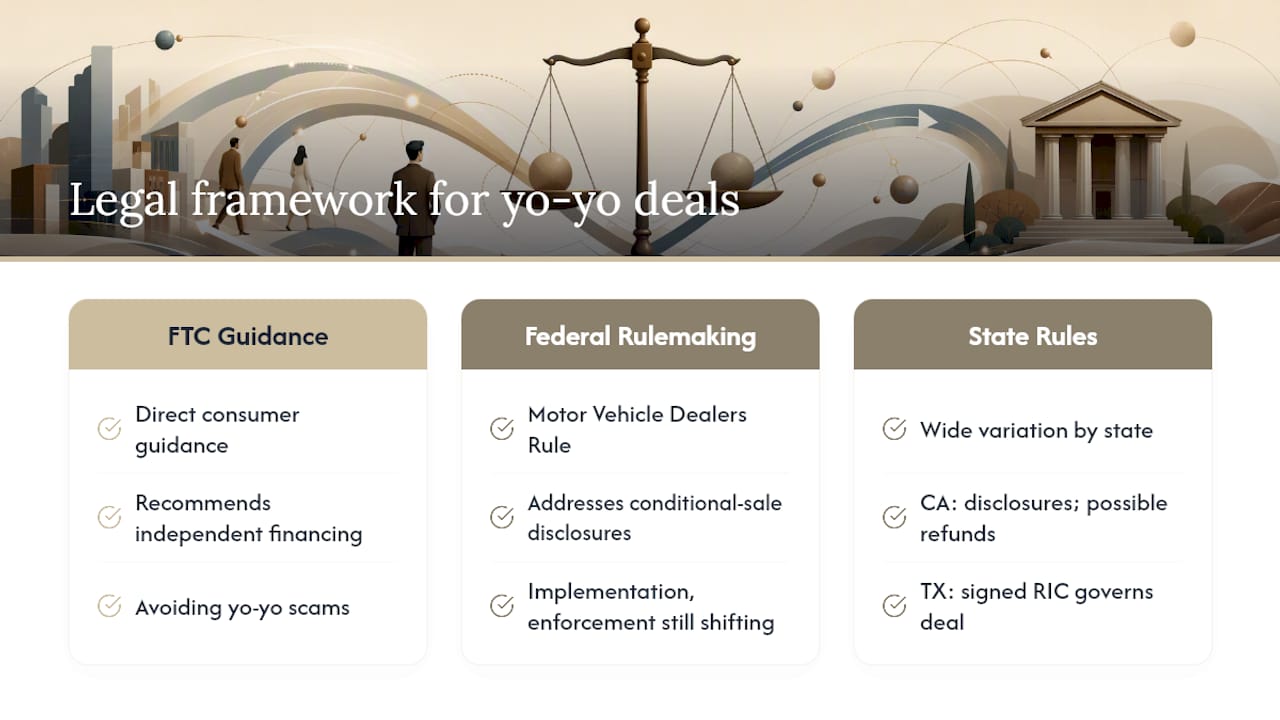
The FTC has published direct consumer guidance on avoiding yo-yo scams, recommending that buyers finance independently whenever possible. On the federal side, the Motor Vehicle Dealers Trade Regulation Rule has moved through rulemaking specifically to address disclosure practices around conditional sales, though implementation and enforcement details continue to shift, which is part of why your state’s rules matter so much right now.
State law is where the real variation shows up. California requires specific disclosures around conditional sale contracts and, in some circumstances, mandates refunds when a deal unwinds. Texas takes a different approach: once you’ve signed a retail installment contract, that signed document generally governs the deal, which limits a dealer’s ability to simply reverse it later without cause.
A signed retail installment contract in Texas is treated as the controlling agreement in many cases, not a placeholder the dealer can rewrite once you’ve driven off the lot.
If you’re unsure what your state allows, your state Attorney General’s consumer protection division or USA.gov’s state consumer resource pages are the fastest way to find out where you stand.
Your Prevention Checklist Before You Ever Visit a Dealer
The single most effective move you can make happens before you set foot on the lot: get preapproved through an independent bank or credit union. When your credit union auto loan is already approved, the dealer has no financing left to yank out from under you. You walk in with a check, not a promise.
From there, follow this order of operations:
- Keep your trade-in negotiation separate from your financing negotiation. Bundling them gives the dealer more leverage to renegotiate both at once.
- Refuse to sign anything marked “conditional” or “subject to financing.” Insist on a completed retail installment contract that names the actual lender before you take the keys.
- If dealer financing is genuinely your only option, get the lender’s written approval and a full copy of the finance package before driving off.
- Bring a clear target APR estimate with you to help guide your negotiations.
That last point matters more than most buyers realize. The FTC’s own guidance confirms that buyers who secure financing independently before visiting a dealer avoid the core mechanism that makes yo-yo scams possible: there’s no loan left to be “conditional.” There are online tools that let you enter your credit score, vehicle, loan amount, and the dealer’s quoted APR to see whether that number is competitive and what rate to counter with in dollars saved.
If the Dealer Calls Back, Do This Immediately
Getting the “your financing fell through” call is stressful by design. Dealers count on you feeling like the deal is already done and you have no leverage left. You have more than you think, if you move in the right order.
- Stop. Do not agree to sign anything on the phone or rush back to sign in person.
- Request the lender’s denial in writing, including the specific reason for rejection. A verbal “it didn’t go through” is not sufficient documentation.
- Pull together your paper trail: the original signed contract, any text or email exchanges, and photos of any new paperwork the dealer sends over.
- If the dealer cancels the deal without a valid written lender denial, demand the return of your trade-in and your down payment.
- Report the incident. File directly at Reportfraud, notify the Consumer Financial Protection Bureau, and contact your state Attorney General’s consumer protection office. Attach your contract copy, the denial letter (or lack of one), and a timeline of communications.
- If the dealer refuses to return your trade-in or down payment, consult a consumer-protection attorney. Read your original contract for an arbitration clause first. It can affect whether you’re able to sue or forced into arbitration instead.
Local reporting has documented these tactics recurring often enough that consumer attorneys treat yo-yo complaints as a routine part of their caseload, not a rare edge case.
Using Baywall’s Rate Benchmark to Protect Yourself Before You Sign
The best time to use Baywall isn’t after a yo-yo call. It’s before you ever sign the first contract. Enter your credit score, the vehicle, loan amount, loan term, and the APR the dealer quoted you, and Baywall benchmarks that offer against real rates paid by buyers in the same credit tier with similar loans on similar vehicles.
The report gives you three concrete things to bring to the negotiation table:
- A labeled verdict on the dealer’s quote: great, fair, or high
- A specific target APR to counter with, based on comparable transactions
- A dollar figure showing what accepting the dealer’s rate versus your target rate actually costs over the loan term
That dollar number changes the conversation. Instead of saying “this seems high,” you can say, “the market benchmark for a similar deal in my credit tier is 2 points lower, and that’s $1,400 over the life of this loan.” If the dealer later calls to say financing fell through and tries to push a new, higher rate, you already have documented proof of what a fair offer looks like, which makes it much harder for them to quietly slide you into worse terms.
Baywall works best alongside independent preapproval, not instead of it. If you have a credit union rate locked in, use that as your floor and let Baywall confirm whether the dealer’s counteroffer actually beats it. If you don’t have preapproval yet, the benchmark report is the next best thing walking in.
Why the Standard Advice on This Topic Falls Short
Most guides tell you to “read the contract carefully” and call it a day. That advice is true and nearly useless, because yo-yo financing works precisely because buyers are exhausted, excited, and outmatched at the exact moment the fine print matters most. Reading skill isn’t the real problem. Leverage is.
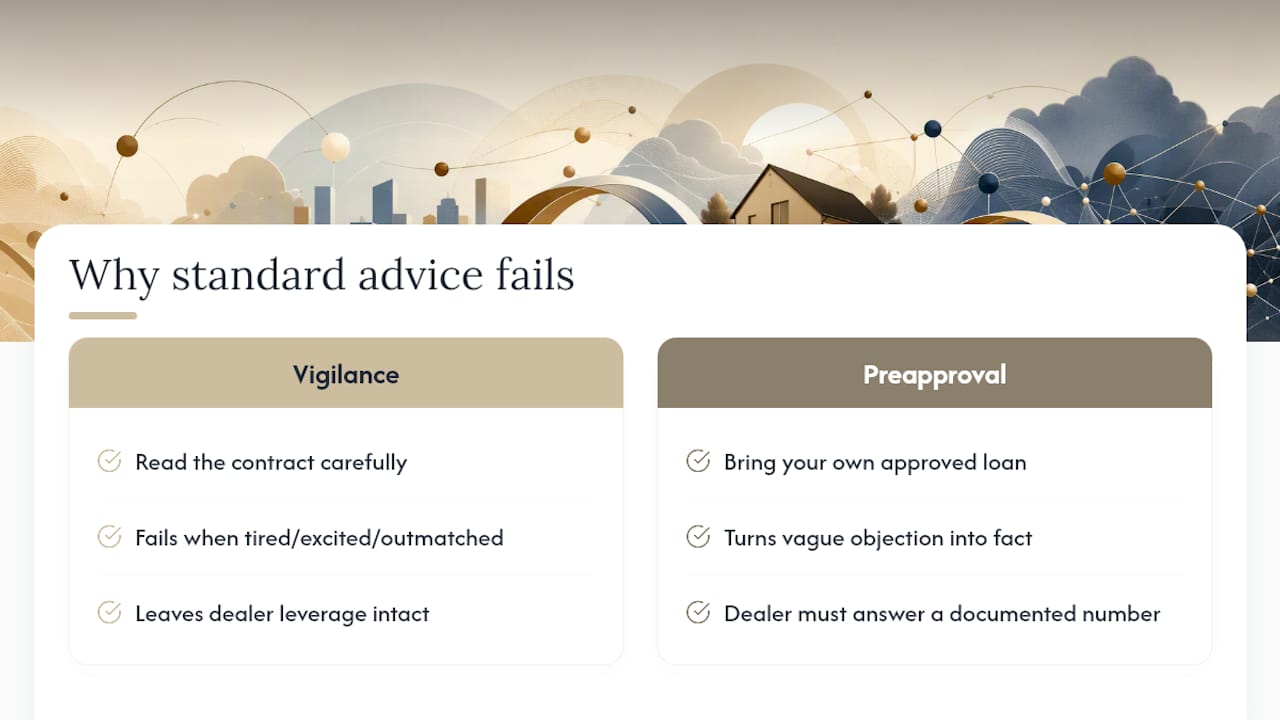
The actual fix is structural: remove the dealer’s ability to hold your financing hostage by walking in with your own loan already approved, or at minimum a documented benchmark you can point to when they claim the numbers changed. A written preapproval or a specific target APR turns a vague objection into a fact the dealer has to answer to.
If you only do one thing differently after reading this, make it preapproval, not vigilance. Vigilance fails when you’re tired and the paperwork is thick. A number in your pocket doesn’t.
— Baywall
This article is general information, not a substitute for advice from a qualified financial advisor. Consult a qualified financial professional about your own circumstances before acting on anything here.
Sources
- Avoiding a Yo-yo Financing Scam | Federal Trade Commission
- Motor Vehicle Dealers Trade Regulation Rule | Federal Register
- Yoyo car financing can drastically change purchase terms | KJRH
- Report fraud | FTC