Zero Percent APR Car Deals in 2026: Compare, Verify, and Negotiate

Strong zero percent APR car deals are available right now to qualified buyers, and the list spans everything from family SUVs to full-size trucks to luxury EVs. The catch: only a fraction of buyers actually qualify for the advertised rate, and taking 0% isn’t always the lowest-cost move when a cash rebate is on the table.
Here’s where to start:
- Hyundai Tucson / Santa Fe / Ioniq 9 — Hyundai Motor Finance is running promotional rates on multiple models; check trim eligibility on Hyundai’s offers page before visiting a dealer.
- Ford F-150 / Mustang Mach-E / Bronco — Ford Motor Credit has promotional financing on select 2025 inventory; confirm the specific trim and term at Ford’s site.
- Nissan Rogue / Murano / Frontier — Nissan Motor Acceptance Company lists promotional rates on several models; regional availability applies.
- Chevrolet Silverado 1500 / GMC Sierra 1500 — GM Financial carries promotional offers on select truck trims; verify the model year and cab configuration.
- Lucid Gravity — Lucid Financial Services has offered promotional financing on select inventory; high MSRP means even a short-term 0% deal saves thousands in absolute dollars.
- Toyota bZ series — Toyota Financial Services lists promotional rates on select bZ inventory as the brand pushes EV adoption.
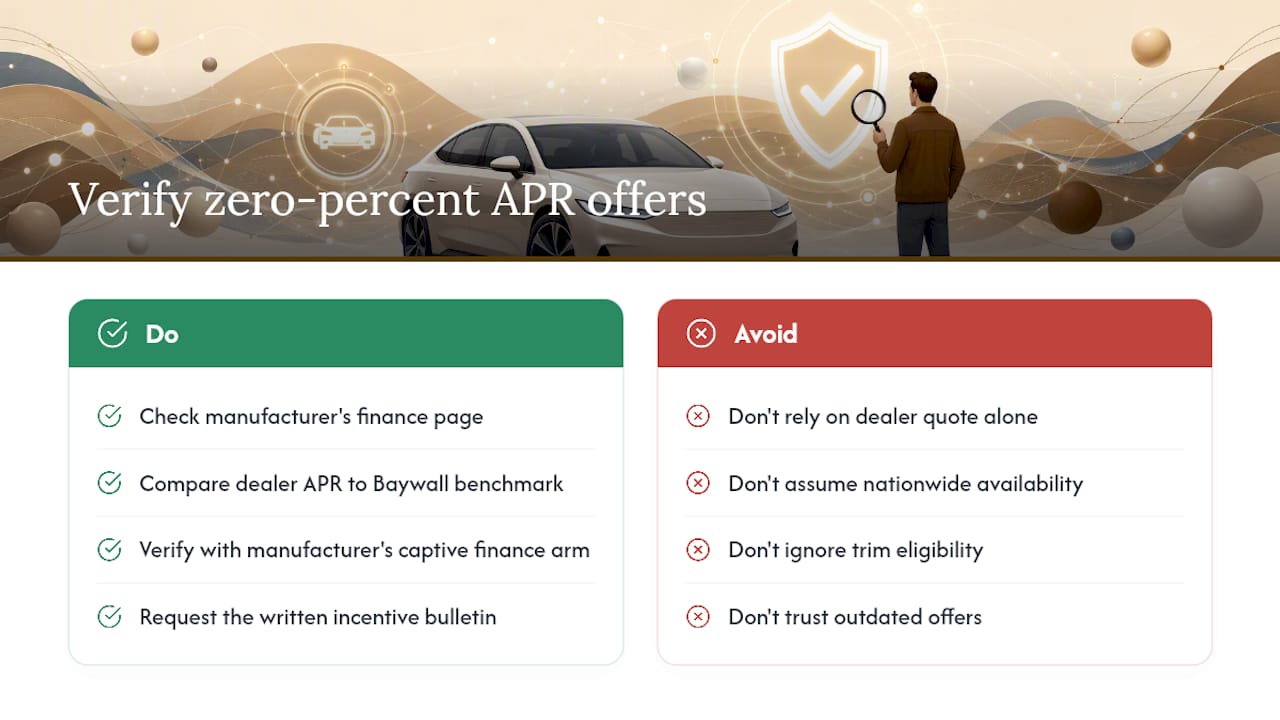
Qualification baseline: most captive lenders require a FICO score of 720 or higher, and many set the bar at 740. Offers are almost always tied to specific trims, model years, and regions. Verify every offer directly on the manufacturer’s finance page — rates change monthly and sometimes weekly.
Disclosure: All offers listed in this article were verified against manufacturer finance pages. Rates, terms, and eligibility change frequently. Confirm current availability with your dealer and the manufacturer’s captive finance arm before signing.
Key Takeaways
| Point | Details |
|---|---|
| Qualification threshold | Most captive lenders require a 720–740+ FICO score; below that, expect a counter-offer APR. |
| Rebate vs. 0% rule | When your outside rate is more than 3 points above zero, 0% usually wins; otherwise run the math. |
| Give-up rebate | Always get the rebate amount in writing and calculate total cost under both scenarios before deciding. |
| Verification steps | Get preapproval from a credit union, request the dealer’s loan worksheet, and benchmark the quoted APR. |
| Baywall benchmark | A $2.99 Baywall report shows your target APR, percentile rank, and estimated dollar savings before you sign. |
Table of Contents
- Which cars have zero percent APR deals right now?
- How does zero percent APR financing actually work?
- How do you qualify for 0% APR and choose the right deal?
- When does 0% APR win, and when does the cash rebate beat it?
- When are the best zero percent APR offers available?
- How do you verify a dealer’s APR with benchmark data?
- Three steps to lock a verified 0% APR deal
- When Baywall recommends taking the 0% deal
- Check your dealer’s APR before you sign
- Sources
Which cars have zero percent APR deals right now?
Last verified: July 2026. Offers change monthly — confirm on each manufacturer’s finance page before visiting a dealer.
The table below covers the highest-relevance models from the current promotional landscape. Baywall’s benchmarking report appears first because verifying whether a dealer’s quoted APR is actually competitive is the right first move, regardless of which model you choose.
That’s the number a Baywall benchmark report is built to help you push back on.
Methodology: offers were compiled from manufacturer finance pages and monthly roundups from U.S. News in July 2026. Terms, trim eligibility, and regional availability change frequently. Always verify the current offer directly with the manufacturer’s captive finance arm and request the written incentive bulletin from your dealer.
How does zero percent APR financing actually work?
The short answer: the manufacturer pays the interest, not you. The dealer gets paid; the buyer gets no interest charges. The bank earns nothing on the rate itself, which is why these programs are funded by the manufacturer, not the lender.
- Manufacturer captive finance arms (Ford Motor Credit, GM Financial, Toyota Financial Services, Hyundai Motor Finance, Stellantis Financial, Nissan Motor Acceptance, etc.) are the only source of true 0% promotional loans. Banks and credit unions don’t offer them.
- Inventory clearance is the primary driver. Manufacturers use 0% to accelerate sales of slow-moving trims, outgoing model years, or models facing new competition.
- EV adoption push is a growing secondary driver. Toyota bZ, Ford Mustang Mach-E, Hyundai Ioniq 5, and Lucid Gravity promotions often reflect manufacturer incentives to build EV market share.
- Seasonal sales targets trigger short promotional windows, especially at quarter-end and model-year changeover.
Key concept: A 0% APR offer is a marketing incentive funded by the manufacturer. The captive finance arm sets strict credit requirements because the manufacturer is absorbing real interest cost. If you don’t meet the threshold, the lender doesn’t lose money by counter-offering you a higher rate instead. Treat 0% as one variable in total cost of ownership, not a guaranteed benefit of walking into the right dealership.
Three terms worth knowing:
- Captive finance arm: the manufacturer-owned lending subsidiary that originates promotional loans (e.g., Toyota Financial Services).
- Give-up rebate: the cash incentive you forfeit when you choose 0% financing instead of taking the cash rebate and financing elsewhere. This is the core tradeoff to calculate.
- Stackability: whether the 0% offer can be combined with other incentives (loyalty cash, conquest cash, military discount). Most promotional APR offers have limited stackability.
For a deeper look at how APR differs from a simple interest rate in total-cost terms, that distinction matters when you’re comparing a 0% offer against a credit union loan.
How do you qualify for 0% APR and choose the right deal?
Those are two separate questions, and most buyers only ask the first one.
Qualification thresholds
| Credit Score (FICO) | Likelihood of Qualifying | Typical Counter-Offer |
|---|---|---|
| 720 or higher | High — strong approval odds | 0% as advertised |
| 720–740 | Moderate — most captives approve | 0% or slight markup (around 1%) |
| below 720 | Low — below most captive thresholds | 4%+ counter-offer |
| below 720 | Very low | about 12% counter-offer |
Captive lenders treat 720–740 as a hard floor for most promotional programs. Below that, approval is rare and a counter-offer is the norm.
Documents and pre-steps to complete before the dealer visit
- Pull your credit report. Check all three bureaus at AnnualCreditReport.com. Dispute any errors before applying — a single reporting mistake can drop your score below the qualifying threshold.
- Get preapproved at one or two credit unions. This gives you a real outside rate to compare against the dealer’s promo. It also preserves leverage: if the captive counter-offers a higher APR, you have an alternative ready. Credit union preapproval is one of the most effective steps a buyer can take before entering a dealership.
- Run a Baywall benchmark report. Enter your credit score, vehicle, loan amount, and term to see what buyers in comparable transactions actually paid. You’ll know your target APR before the dealer quotes you anything.
- Calculate the rebate-vs-0% math. Use the give-up rebate amount from the manufacturer’s offer page and your credit union preapproval rate to determine which option costs less in total dollars.
- Request a written loan worksheet. Before signing, ask the dealer for an itemized buyer’s order showing the vehicle price, the give-up rebate amount, the financed amount, the APR, and the total interest paid over the term.
Negotiation questions to ask the dealer
- “What is the captive program code for this promotional APR offer?”
- “Can you show me the manufacturer incentive bulletin for this vehicle?”
- “What is the give-up rebate if I finance through my own lender instead?”
- “Will you show me a written loan worksheet comparing both scenarios?”
Red flags to watch for
- Dealer holds the vehicle price firm at MSRP and won’t negotiate when you mention 0%. Dealers commonly allow only 0%–2% off MSRP on promotional-rate vehicles, compared to 4%–8% on non-promotional inventory. Know this going in.
- Dealer refuses to show the manufacturer incentive bulletin.
- No written preapproval or loan worksheet is offered before you’re asked to sign.
- The 0% offer is presented verbally only, with no documentation of the term, qualifying conditions, or give-up rebate.
Pro Tip: Get the loan worksheet in writing before you discuss monthly payments. Dealers who lead with monthly payment figures are obscuring the total cost. The worksheet forces the conversation onto the numbers that actually matter.
When does 0% APR win, and when does the cash rebate beat it?
The answer depends on three numbers: the rebate amount, your outside financing rate, and the loan term. Run both scenarios through a calculator using the same negotiated price and identical term inputs — that’s the only way to get an objective answer.
The practical rule: when the gap between your outside rate and the promotional rate exceeds roughly 3 percentage points, the 0% offer usually wins in total dollars. Below that gap, a large rebate often saves more.
Worked example: $40,000 vehicle, $3,000 give-up rebate
How to reproduce this math yourself
- Get the give-up rebate amount from the manufacturer’s offer page.
- Subtract the rebate from the vehicle price to get the rebate-scenario financed amount.
- Use your credit union preapproval rate and the same term to calculate total interest on that amount.
- Compare total interest paid (rebate scenario) against $0 interest (0% scenario).
- The option with the lower total cost wins.
If the higher payment strains your budget, the rebate-plus-longer-term option may be the better fit even if it costs slightly more in total interest.*
In those cases, a meaningful rebate often wins.
When are the best zero percent APR offers available?
Knowing them lets you time your purchase or at least understand why a deal you saw last month has disappeared.
- Model-year changeover (August–October): manufacturers push hardest to clear outgoing model-year inventory before new models arrive. This is historically the richest window for promotional financing, and it often applies to the widest range of trims.
- End of quarter (March, June, September, December): manufacturer sales targets create pressure at the dealer level. Dealers are more willing to work with you on price, and captive finance arms sometimes extend or deepen promotional offers to hit quarterly numbers.
- End of month: a smaller but real effect. Dealers tracking monthly sales targets are more motivated to close deals in the final week.
- Slow-selling trims and models: when a specific trim or model is underperforming its sales target, the manufacturer often introduces a promotional rate to accelerate movement. The Mazda CX-70 PHEV and Infiniti QX80 have appeared on promotional lists for this reason.
- EV-specific windows: federal and state EV incentive deadlines sometimes align with manufacturer promotional financing to maximize buyer incentive stacking. Watch for these windows on Toyota bZ, Ford Mustang Mach-E, Hyundai Ioniq 5, and Lucid Gravity.
Models that cycle on and off promotional lists often return at the next quarter-end or model-year transition. Set a price alert on the manufacturer’s offers page and revisit at month-end.*
One timing trap worth knowing: 0% offers are frequently limited to 36 or 48-month terms, which raises your monthly payment compared to a 60 or 72-month loan. If you’re timing your purchase around a promotional window, confirm the available terms before you commit to a purchase date.
How do you verify a dealer’s APR with benchmark data?
A dealer’s quoted APR is a starting point, not a final answer. The right move is to benchmark that quote against what buyers with your credit profile, vehicle, loan amount, and term actually paid in comparable transactions.
The benchmark standard: a reliable APR benchmark report should show your target APR, your percentile rank among comparable transactions, the number of comparable deals used, and your estimated dollar savings versus the dealer’s quoted rate. Anything less is a guess.
Step-by-step benchmarking process
- Collect the dealer’s loan worksheet. Get the quoted APR, financed amount, term, and monthly payment in writing before you leave the finance office.
- Get preapproval from one or two credit unions. Preapproval from a credit union gives you a real outside rate and creates genuine negotiating leverage. Without it, you’re negotiating blind.
- Run a Baywall benchmark report. Enter your credit score, vehicle, loan amount, term, and the dealer’s quoted rate. Baywall compares that quote against comparable market transactions and tells you whether the offer is great, fair, or high, along with a specific target APR and dollar savings estimate.
- Identify the gap. If the dealer’s quoted APR is above your benchmark target, you have a documented basis to negotiate. If it’s at or below the target, you know the offer is competitive.
- Use the benchmark in the negotiation. Present the target APR from your report and ask the dealer to match it or explain the difference. If they won’t, your credit union preapproval is your fallback.
What to say at the dealer
- “My benchmark shows comparable buyers in my credit tier are getting [X]% on this loan. Can you match that?”
- “I have a preapproval at [Y]% from my credit union. I’ll use that unless you can beat it.”
- “Can you show me the manufacturer incentive bulletin so I can confirm the give-up rebate amount?”
Trust signals to look for in any APR resource
According to CarSavr’s analysis, roughly 12% of buyers qualify for advertised 0% offers — a figure that underscores why benchmarking the counter-offer APR matters as much as chasing the headline rate.
For buyers comparing SUV loan rates across credit tiers, a benchmark report puts the dealer’s number in context against the broader market, not just the promotional floor.
Three steps to lock a verified 0% APR deal
- Prequalify before you walk in. Pull your credit report, check your FICO score, and get preapproved at one or two credit unions. Know your outside rate before the dealer quotes you anything.
- Run the rebate-vs-0% math. Get the give-up rebate amount from the manufacturer’s offers page. Use the worked example formula above to calculate total cost under both scenarios. Choose the option with the lower total cost, not the lower monthly payment.
- Benchmark the dealer’s APR and negotiate in writing. Run a Baywall report on the dealer’s quoted rate. If the quote is above your benchmark target, present the target and ask for a match. Request the loan worksheet and the manufacturer incentive bulletin in writing before signing anything.
Common traps to avoid: accepting a shorter term (36 months) that raises your monthly payment significantly, forfeiting a large rebate without running the math, and signing before you’ve seen the give-up rebate amount in writing.
When Baywall recommends taking the 0% deal
On a typical loan over several years, a common outside rate means you’d pay a significant amount in interest. No rebate in the $1,500–$2,000 range comes close to matching that savings.
The other consideration is liquidity.
The benchmarking step isn’t optional in this decision. That’s the gap Baywall is built to close.
Check your dealer’s APR before you sign
Baywall benchmarks your dealer’s quoted APR against real transactions matched to your credit score, vehicle, loan amount, term, and location. The report labels your offer as great, fair, or high, gives you a specific target APR to negotiate toward, and shows your estimated dollar savings. It’s not a lender and it doesn’t pull your credit. It’s the data you need to walk into the finance office knowing whether the number on the contract is competitive.
The report costs $2.99 and delivers instantly. If the dealer’s APR is above your benchmark target, that $2.99 can translate into hundreds or thousands of dollars recovered over the life of the loan.
Run your benchmark at Baywall before you sign.
Sources
Offers change monthly. Use these sources to confirm current availability directly:
- Cars
- 0% APR Auto Loans 2026: Who Qualifies + 4 Hidden Traps | CarSavr
- Dealer financing explained | Navy Federal
- Cash Rebate vs. 0% APR Calculator: Which New Car Offer Saves More? | Invoice-Pricing
- Rebate vs Low APR Calculator: Which Saves More? | FinCalcs
Methodology note: offers in this article were compiled from manufacturer finance pages and published monthly roundups in July 2026. Each model entry was cross-referenced against at least one manufacturer source. Because promotional APR offers change frequently, sometimes mid-month, this page carries a last-verified date of July 2026. Readers should treat all listed terms as starting points and confirm current eligibility directly with the manufacturer’s captive finance arm or a franchised dealer.
This article is general information, not a substitute for advice from a qualified financial advisor. Consult a qualified financial professional about your own circumstances before acting on anything here.